




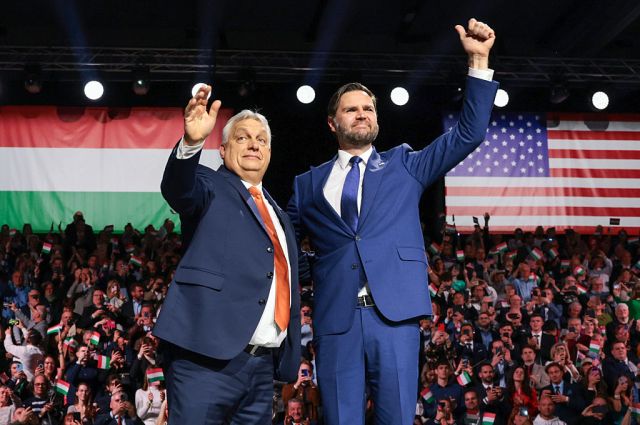
‘Vance is supplanting Orbán as the darling of the intellectual Right.’ Jonathan Ernst-Pool/Getty Images





Norman Stone was a historian of immense learning and talent. Yet his last book, a short history of Hungary, was poorly received. In an acidic obituary, following Stone’s death on 19 June, 2019, Cambridge’s old Regius Professor of History, Richard J. Evans, told how the publishers of Stone’s book had some expert go through it with a fine comb; a 20-page list of errors was submitted, and even then plenty of others were discovered after the book was published.
By the usual scholarly standard, Hungary: A Short History (2018) was a failure. But it doesn’t take much for the reader to figure out its real purpose. Early on in the book, Stone recalls that he knew the then-Prime Minister of Hungary, Viktor Orbán, back when he was a student at Oxford in the Eighties: “he has gone on to great things.” Among the pictures inserted in the book are two showing Orbán at different stages of his dramatic political ascent. The point of the book is to present Orbán as the happy culmination of Hungary’s unhappy history. Orbán had fought valiantly against “Official Europe”; he fought, during the migrant crisis of 2015-16, for “national survival”. Hungary, Stone explains, “had already had a Moslem occupation”, under the Ottomans. If Hungarians had now been delivered from such a calamity a second time, they had Orbán to thank.
Norman Stone died in Budapest — and where else? Conservative intellectuals in the 2010s swam the Danube as surely as now they swim the Tiber. What Berlin was around this time for anxious, artsy, digital nomads, Budapest was for the kinds of people who love Wagner and hate brutalism. In both cases, the expats gained local infamy for never learning the language; Stone, a virtuoso polyglot who knew Hungarian already, was atypical in this respect. Stone had advised Thatcher on European affairs; he spent his final years as an affiliate of the Danube Institute, run by another alumnus of Thatcher’s Downing Street, John O’Sullivan.
As the Right-wing intellectuals began to move in a more postliberal (and Catholic) direction, the “illiberal democracy” which Orbán was building in Hungary became all the more alluring. Here, the Postliberal International crowed, was a little beacon of hope, a flicker of that old Europe, which elsewhere had been trampled over by Brussels and modernity. Hungary was a quaint little land, a land of Baroque castles, folk dance, and King Saint Stephen. It was a land filled with common sense, oikophilia, and serious Roman Catholicism, as embodied by that most serious papabile, Cardinal Erdő.
No matter that Hungary is less Christian (42.5%) than even Vermont, America’s least Christian state (45%). No matter that Hungary’s fertility, for all Orbán’s much-hyped “family policy”, is about the same as Britain’s, pitifully beneath the replacement rate. No matter that Hungary is one of the poorest countries in the EU — indeed, for a certain kind of postliberal, this is really rather a good thing, because poverty is godly, a triumph over luxury and Mammon. Orbán earned the praise of the Right-wing intellectuals by securing the border, by taking the fight to Brussels, by banning same-sex marriage, and, more recently, by making overtures to Putin. He kept them warm with talk of culture, values, and God.
Orbán’s Budapest had pretty cathedrals and “Scruton Cafés”; it had Old World gentility and Mitteleuropa charm. It had, too, the finest (and best-funded) network of Right-wing think tanks and institutes anywhere in the world outside America. In his master’s thesis, Orbán dealt with the ideas of Antonio Gramsci: he understood that the populist Right needs “organic intellectuals” of its own, and that it needs to aspire to cultural hegemony. From his firsthand experience of communism, he knew what cultural and intellectual power the state could wield, and the urgent need for the Right’s own patronage network. So he set about building an entire ecosystem from the ground up. Aside from the Danube Institute, there is the Mathias Corvinus Collegium (MCC), a private university and talent incubator. Orbán’s government gave it $1.7 billion— 1% of the country’s GDP — and a satellite in Brussels, for the purpose of monitoring the beast up close. Orbánist postliberalism was becoming a globe-spanning enterprise. It was to rival goulash and the Rubik’s Cube as Hungary’s top cultural export.
“In 1989, we thought Europe was our future,” Orbán declared in 2019. “Today, we know that we are the future of Europe.” It was a tremendous weight to place upon a nation of less than 10 million. Orbán was clearly flattered by his global celebrity, and hoped, this time in vain, that it would provide some electoral advantage. Throughout his campaign, the great and the good of the international Right would come to praise him and the country he had built: winners (Meloni, Milei, Netanyahu) and losers (Mateusz Morawiecki, Liz Truss) alike. The website for “CPAC Hungary 2026” announces that, although “Brussels and Kyiv” might not like it, “Europe and the world stand with Viktor Orbán”. There was thus a pronounced globalist streak to Orbánist nationalism.
Americans, especially, would sing their encomia. The conservative intellectual Rod Dreher, a key player in the conservative Budapest scene, garlanded Orbán with the highest compliment he knows, by drawing a rather strained parallel between his life and JD Vance’s — these were the two brightest stars in the postliberal firmament. Both Orbán and Vance were country hicks, sneered at by the liberal elites: Orbán’s hometown Felcsút, apparently, is the Appalachia of the Carpathian Basin. Both managed to break into the elite, studying at Oxford and Yale respectively. Both, then, spurned the social class into which they had raised themselves: they chose rather to be loyal to the people who raised them. If this brings a manly tear to the eye, let it not be diminished by the revelation that Dreher was on the Orbán payroll: how much art and beauty, after all, has been the work of court sycophants?
Such, anyway, was the Budapest bacchanalia, 2010-2026. For his first order of business as prime minister, Péter Magyar will pull the plug. Already he has announced that he will investigate the state funding of MCC and CPAC. It’s not hard to imagine the Orbánist think tanks and institutes being turfed out of Budapest, much as Orbán turfed out the Soros-funded Central European University in 2018. The CEU upped sticks upriver, to Vienna; who knows where the Orbánist institutions will go, or which other European illiberal will attempt to pick up Orbán’s mantle. Slovakia seems a plausible contender; it would not be surprising to see the Postliberal International descend upon Bratislava. Prime Minister Robert Fico is rather similar to Orbán, even in his physical appearance; he supported Orbán in the election and tends to align with him within the EU, including on Russia. He might, however, now look upon Orbán as something of a cautionary tale, and consider the possibility that the ambitious and expensive intellectual project was ultimately a misfire.
Indeed, at least for the duration of the Trump administration, the intellectual Right still has a Mecca, and a money spigot, in Washington, DC. Against the glitz and glamour of the “cruel kids’ table”, we impoverished Europeans have little to offer, except for winding streets and old stone. Vance, of course, was an Orbán booster during the election, and is close to Dreher and Budapest’s postliberal circle. He undoubtedly hopes that the network which Orbán cultivated in Budapest will swing behind him, in full force, in 2028 — and indeed that, if he does become president, he can hit the ground running with friends and connections in high places in Europe. Vance had already been supplanting Orbán as the darling of the intellectual Right — and unlike Orbán, he’s a Catholic, to boot. Without being anchored in Budapest, one can imagine the old network relying more on American financial support, and becoming even more Americanised. CPAC probably gives us a hint of what this would look like in practice: more strobe lighting, more God.
Magyar, meanwhile, is now faced with the difficult task of uprooting all that Orbán laid down. He is, as is widely observed, hardly a pin-up for liberals and Europhiles, who are cheering him only because they see him as a relative improvement. Now, as prime minister, he has to go to war against what is, in effect, an Orbánist deep state. He has to take on politically compromised and infiltrated universities. He is staring down the state broadcasters, telling them that they will not receive a penny from the taxpayer until they have restored their “public service character” and can guarantee “objective, impartial reporting”. Already he has announced his intention, in a bracingly ruthless manner, to dispatch the incumbent president, an Orbánist placeman. Even if he succeeds in all this, Orbán might not be gone for good. Trump’s comeback in 2024 will doubtless be on Magyar’s mind; as will the Right’s victory in the presidential election in Poland last year, less than two years after the liberal Donald Tusk became Prime Minister.
Encouraged, and often handsomely remunerated, by the Orbán government, the international Right-wing intelligentsia has paid careful attention to Budapest. They have hoped to learn various lessons — about policy, tactics, and the difficult business of statecraft. But the new Hungary, Péter Magyar’s Hungary, might prove to be of interest, too. If, for example, Reform UK wins the next election in Britain, they will be met with open hostility from the universities, the civil service, the BBC, the bishops, the judges, the Lords, perhaps even the Crown. There is still much for the Right to learn in Hungary, if only they know where to look.
