




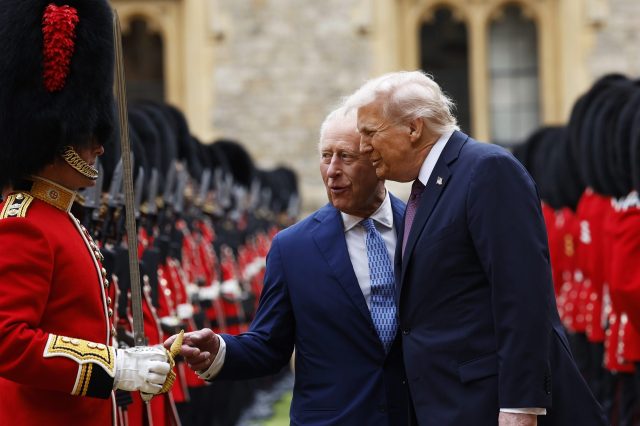
King Charles III and President Trump at Windsor Castle, 17 September 2025. (Anna Moneymaker/Getty)





In This House, we love Horrible Histories. You might describe the TV series as “attention-deficit Blackadder”: high-speed history-themed comedy sketches, focusing less on narrative than violence and fart jokes. My daughter can sing the whole royal succession song from memory. But my personal favourite is “Born 2 Rule”, a boy-band-style ballad sung by the Hanoverian Georges I, II, III, and IV. It’s funny, if you like that sort of thing, and also conveys the prevailing modern British attitude to our monarchy: important, but also slightly ridiculous.
I doubt this week’s royal visit by Charles III to Washington will do anything to change that. The first visit to the United States by a reigning monarch since 2007, it is to mark this year’s 250th anniversary of American independence — their repudiation of our Crown. The actual Horrible Histories version of these events was in the style of football commentary, naturally featuring George III. I think overall it manages to ridicule everyone equally. But wondering how they’d portray the meeting between Trump and Charles III brought home to me how differently Brits and Americans still feel about many aspects of the transatlantic relationship.
For a central theme of British history, over the period most frequently covered by Horrible Histories, was the tendency of British people to leave Britain and set up home literally anywhere else around the world. The aggregate result was, for a long time, a global empire comprising both extended-family settler states and also colonial holdings. Meanwhile the particular, ambivalent “specialness” of Britain’s relationship with America stems both from this common genealogical story, and also from America’s later role in bringing that empire to an end.
In its aftermath, Britain’s self-image and economic survival has been shored up from three directions: closer economic ties with Europe, vague ties of (sometimes) goodwill with a post-imperial “Commonwealth”, and a close, if subordinate, military relationship with the USA. For a long time, this trifecta afforded British grandees more than enough opportunities to think and act internationally, as if Great Britain were still a global imperial power. But as the long 20th century comes to an end, it’s growing increasingly clear that the settlement won’t hold much longer.
In extended families, there are always topics you shouldn’t raise over Christmas dinner. In this case, the most sensitive is the British Empire, and America’s role in dismantling it. This story has been sanitised over the generations, but my step-grandfather, an RAF pilot and Colditz captive, felt it viscerally and hated Americans. I never really understood why. Hadn’t they fought alongside us in the war? Perhaps, I wondered, it was because American soldiers had liberated him from Colditz before he could put his escape plan into action, and so spoiled his fun?
It was only recently that I learned more about the punitive terms of US wartime loans to Britain, and the way US politicians demanded an end to Britain’s “imperial preference” trade protectionism as a condition of wartime assistance. From a US perspective, this was all robust realpolitik aimed at bolstering the US national interest. From a British one, it weakened Britain economically and helped foster the disintegration of the British Empire, which had been a US foreign policy aim from Woodrow Wilson onward. In this context, I’ve come to wonder if my step-grandfather, an upper-class Englishman, spoke that way about America because he understood that our cousins across the Atlantic had both aided Britain in the Second World War, and also played a key role in ending the empire he’d been raised to govern.
In turn, it was this same process of disintegration that later prompted the famous line uttered in 1962 by Dean Acheson, erstwhile US Secretary of State, about how Britain had “lost an empire and not yet found a role”. Acheson made the remark at a West Point Military Academy conference, in which he predicted that Britain would need to move toward Europe. This would be necessary, Acheson said, because seeking to expand our influence via the Commonwealth and “special relationship” with the USA wasn’t enough to make Britain a “power” in our own right. In particular, he thought, Britain had tried to carve out a role on the basis of “being the head of a commonwealth which has no political structure or unity or strength and enjoys a fragile and precarious economic relationship”. This role, he thought, was “about played out”, and what would most likely replace it would be closer union with Europe.
What Acheson left out of this is that British politicians came to believe we needed closer union with Europe because imperial preference had been forcibly ended, in favour of the GATT. The integration with Europe that Acheson predicted wasn’t realised until 1973, when Britain joined the Common Market. But by that point it was viewed as an alternative trading bloc to replace the erstwhile imperial one (a decision that would, in turn, have further negative consequences for British manufacturing).
Three years later, and one year after the referendum that confirmed Britain’s EEC membership, Elizabeth II visited the USA to mark the bicentennial of America’s independence from the British Empire. In her address, she cited the Commonwealth whose geopolitical force Acheson dismissed so brutally, as an example of the positive influence America had exerted on Britain. For, she said, America taught us the moral importance of freeing peoples to govern themselves. As she put it: “Without that great act in the cause of liberty performed in Independence Hall two hundred years ago, we could never have transformed an Empire into a Commonwealth!”
I wondered, on reading this, whether she intended the ironic subtext. We might also wonder if the point when the empire disintegrated is also the one where British monarchs became slightly ridiculous, as well as historically important. Either way, we very much do have the USA to thank for the Empire having become a Commonwealth. Indeed, when it was formed, the point of the Commonwealth was mostly to give the formerly imperial British monarch somewhere to visit, other than bits of the British Isles. As critics pointed out at the time, including Acheson, as a group it was never cohesive. These days, at least some of its members are so far from friendly they’ve taken to voting via the UN for Britain to send them money.
But is it time to revisit our wider alliances? In its current form, the Commonwealth has proved too internally contradictory to be supportive; but America’s rival internationalist body, the UN, itself now also feels a relic of the past. This year, Trump withdrew US funding and membership from multiple UN-affiliated organisations, and this is hardly the only recent indicator that the postwar age of internationalism is coming to an end. History is back, sometimes horribly so.
Meanwhile Britain is, to put it mildly, not well-placed for balance-of-power games. We import too much of our food and energy, and our military is down to three men and a popgun. Everyone in Europe hates us for Brexit, and everyone in Britain hates Trump for tariffs, Greenland, Iran, petrol prices, and killing the housing market, to name but a few. This is all further complicated by a Net Zero commitment that has left Britain deeply reliant on China, a fact we don’t really talk about: we just wave through the London super-embassy with the secret underground rooms a few feet from important data cables full of sensitive City messages.
But we’ve come back from worse. On the occasion of Elizabeth’s 1976 visit, to mark a major anniversary of this most testy and rivalrous of special relationships, we were as gravely in the doldrums as we are today. Then, as now, we had Belfast car bombs, failing utilities, and an overwhelming sense of government sclerosis. Our transatlantic cousins had would-be Presidential assassins too: security for the Queen was beefed up in the wake of two attempts to murder President Gerald Ford in 1975.
And yet eventually the sclerosis ended. A few years later, a radical government was elected and (even if improvements were unevenly distributed) the country changed. So for those on either side of the pond now tempted to paint Britain in shades of disaster: it wasn’t all over then, and I doubt it is now. Likewise, notwithstanding the “No Kings” boomers and their fears of Orange Caesar, I fully expect the American republic to survive its 250th anniversary as much a republic as ever.
But not everything is the same as it was in 1976. In Britain, we are militarily much weaker. Every indicator is that this will matter as time goes on. But there are deep historic reasons to feel nervous about closer military cooperation with Europe. There are also more recent, Iraq and Afghanistan-shaped ones for feeling nervous about leaning too far toward America. With this in mind, I wonder if we haven’t been too quick to forget about, or dismiss, the friendship of our other cousins: those who, like America, had their roots in Britain’s imperial expansion and have since become polities in their own right.
Britain will surely continue to need and feel a deep kinship with America, one that goes well beyond bare political calculation. But as postwar history attests, we also sometimes have divergent interests, not just in the distant past of 1776 but in the present era too. So in the short term we must hope that Charles III has the wit and grace to adapt to his new role as emollient regal vanguard for Britain’s new small-power politics, and that in this role he inclines more toward important than slightly ridiculous.
Meanwhile, though, Canada, Australia, and New Zealand all remain within the Commonwealth. These are also globe-spanning special relationships and deep ties that Britain might benefit from reinforcing. As history rumbles back into gear, sometimes horribly, we might all be relieved to ease the pressure on the American special relationship, by remembering there are other branches of the extended family too. Even if that that sometimes means getting into trouble with the cousins Down Under as well, for making songs about them escaping from prison disguised as kangaroos.
