




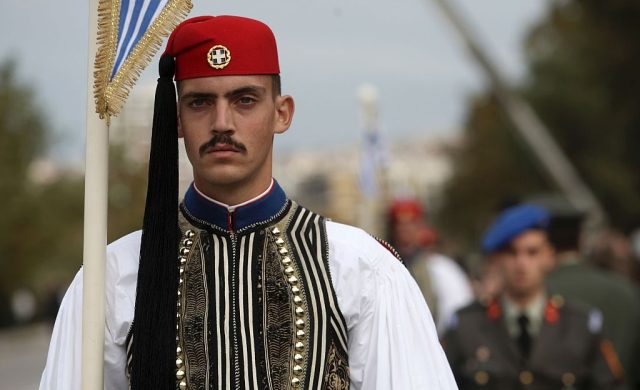
Chinks of light are mitigating Thessaloniki’s historical oblivion. (Sakis Mitrolidis/AFP/Getty)





The first time I visited Thessaloniki, my guides were a brother and sister whose fluent English still carried a sprinkling of tell-tale local touches. They told me about, and we sampled, the city’s food. It’s perhaps the best in Greece, with its strongly-spiced meat and vegetables, fruit-infused stews and creamily luscious sweet and savoury pastries. “It’s very political cuisine,” said the brother. As, indeed, it is, in its heavy gastronomic debt to the mightier city — the supreme polis — to the east. To many Greeks, even today, one city alone truly matters: Constantinople, fount of faith, culture — and food. Its Turkish name, Istanbul, merely encodes a Greek phrase meaning “to the city”.
Yet those mouth-watering bougatsa and bouyiourdi count as “political” in the mundane English sense as well. Ottoman Salonica only became Greek Thessaloniki in November 1912, after rule — sometimes strict, sometimes lax — by Sultans that had endured since 1430. In the confusion of the Balkan Wars, it was for a while touch-and-go whether Greeks or Bulgarians would prevail in their military competition for the city. Many Salonicans, at that time living in the only large city on Earth with a plurality of Jews, would probably have preferred the plan for free-city status under Habsburg protection. But the Ottoman culinary influence that had already spiced up the local palate only grew in the Twenties, when an influx of Orthodox Christians from Asia Minor followed the “exchange of populations” mandated by the 1923 Treaty of Lausanne. By the Thermaic Gulf, you find history — in every sense — on a plate.
In the decades before the First World War, Salonica — booming fourth port of the Sultan’s empire, after Istanbul, Smyrna and Beirut — embodied a pluralist commercial culture that enchanted many but disgusted others. “How can one like a city with this cosmopolitan society, nine-tenths of it Jews?” asked a Greek officer after the 1912 annexation. “It has nothing Greek about it, nor European.” In fact, the 1913 Greek census revealed 40,000 Greeks, but 46,000 Muslim “Ottomans”, and 61,000 Jews. Still, that Hellenic conqueror would not have long to wait to see his hankering for homogeneity rewarded.
Tens of thousands of Muslims left with the Greek seizure; the Great Fire of 1917, which razed the port area and neighbouring districts, hastened the flight of inner-city Jews; then the Lausanne “exchange” drove the remaining Muslims out until, by 1925, only 97 remained. Those few had only stayed thanks to Serbian or Albanian papers. Finally, in summer 1943, ethnic cleansing reached its hideous finale in the rapid deportation of around 50,000 Salonican Jews to Auschwitz by the Germans: one of the fastest mass exterminations of the Third Reich. The Sultan’s port, birthplace of the “Young Turk” movement and of Kemal Atatürk himself, the “Mother of Israel” to its Jews for the centuries of welcome it had offered, had purged its supposed impurities to become a Greek provincial town. As it long remained.
Thessaloniki offers a salutary, and frequently sad, lesson in the 20th-century shrinkage of cultures through disaster or design. A quarter-century ago, when I first visited, the process of forgetting the non-Greek past seemed almost complete. Traffic on new urban highways thundered past shuttered, crumbling 15th-century mosques. Students at the Aristotle University chatted on terrain that once hosted one of the world’s grandest Jewish cemeteries — whose gravestones, uprooted and smashed by the vandalism of Nazis and their collaborators, went to repair nearby churches. A solitary minaret still stood beside the 4th-century Rotunda of Galerius: first a Roman mausoleum, then a church, a mosque between 1590 and 1912, then a church again. Museums, such as that in the Turkish-built White Tower on the waterfront, skipped over the entire Ottoman era as a long limbo of oppression and stagnation. Displays inside the well-guarded family home of Mustafa Kemal (later Atatürk) on Apostle Paul Street — meticulously curated by the Turkish state — confirmed the destiny of divorce for Greeks and Turks.
At least it has become possible to read in English about the lost riches that the modern city seemed so keen to bury beneath motorways, office blocks and Hellenising myths. In 2004, the historian Mark Mazower’s landmark study Salonica: City of Ghosts joined a literature of reminiscence that includes Leon Sciaky’s classic memoir Farewell to Salonica, with its wistful and lyrical evocation of a pre-1912 Jewish childhood in a place he felt “secure and happy”. Later, Victoria Hislop brought many of the strands of the old Salonican tapestry to life in her well-researched 2011 novel The Thread. Now Michael Arditti has drawn on his own family history with a captivating saga of a Jewish dynasty through four generations, as historical upheavals send them out from the Salonica of 1911 to France, England, Argentina and Israel.
The Tribe wisely doesn’t attempt to tell the city’s entire story in all its depth. Instead it makes one family’s experience into a lens that condenses vast panoramas of change. We first meet the Carraches — tobacco magnates, textile merchants and bankers — at the height of their late-Ottoman pomp, then in the war-ravaged France and England of the Forties. Finally, they gather in the Sixties for a reunion in a city that has, as one local survivor of the Holocaust puts it, “tried to eradicate every remnant of the Ottomans”. Tante Esther, who has settled in Manchester, laments that her “Papa’s cosmopolitan ideal is no more”. Half a century earlier, an ambitious manager who marries into the Carraches could blithely assert that “No war can stand in the way of commerce”. Few Salonican Jews (or Muslims) of 1911 would have disagreed.
Arditti’s novel places its focus on the relatively small group of Sephardic Jews of Spanish heritage who had arrived in the city from Italy, and still enjoyed Italian consular protection (although that would not save them from deportation). Yet it gives a vivid account of the sheer diversity that flourished not only among late-Ottoman cultures, but within them too. Most Jews around the port were firmly working class: artisans, dockers, weavers, factory workers, domestic servants. The Tribe shows us industrial disputes in the tobacco workshops; the squalid poverty of mixed slums (there were no “ghettoes” as such); the appeal of both socialism and Zionism to the urban Jewish poor. As the firebrand teacher Leah says to Esther: “They live in poverty, so that you live in splendour.”
This is no sentimental multi-cultural idyll. Although the reform edict of 1856 lifted most of the burdens of second-class dhimmi status for non-Muslim citizens of the Ottoman Empire, insecurities remained. The Tribe never downplays hardship, conflict, and the prejudice that lay forever ready for a crisis to ignite it into violence. Still, its first act illuminates the stability and self-assurance of Salonican life on the eve of the Ottoman collapse. Leon, Jacob’s rebellious son, may have a rebetika-singing Greek girlfriend, Xenia; he can still calmly picture a sedate future of “consummate respectability” as “director of the company, elder of the synagogue, member of the Community Council”, pillar of the gentlemen’s club. Packed with historical incident and crowded with firmly-drawn characters, The Tribe shows how events — and ideologies — smash all the Carraches certainties. Like the family museum of “Ottoman Sephardic Life” that one of Jacob’s granddaughters opens in the city of the Sixties, the novel serves as a poignant and powerful “memorial to a community that had been all but erased”.
Thankfully, however, that erasure has turned out to be partially reversible. Since I first saw Hellenised Thessaloniki, its uniformity has diminished. Chinks of light mitigated the historical oblivion. The city’s Jewish museum opened in 2001, and enlarged in 2019. Around 2028 it will be joined, after years of delay, by the Holocaust Museum of Greece, sited by the old railway station where scores of thousands departed to their deaths. One of its principal benefactors is Albert Bourla, CEO of Pfizer, who comes from one of the few Jewish Salonican families to survive the deportations. Eid al-Fitr is now celebrated at the picturesque “new mosque”, the Yeni Cami, built by an Italian architect in 1902 for the mysterious Dönme community. They merged ancestral Judaism and Islamic worship in a way that still baffles, and intrigues, outsiders; a long-standing, unfounded rumour makes Atatürk himself a Dönme. This year, the municipality promises to open the restored Hamza Bey mosque of 1460 — better known, to more recent Salonicans, as the Alcazar cinema. Much of this opening-up, to the past, and to the wider world, began during the reforming mayoralty (2011-2019) of Yiannis Boutaris: himself a descendant of the Slavic Vlachs, one of the lesser-studied elements of his home’s patchwork past. He once vowed that: “We will not return to the grey, introverted condition” of the ultra-Greek city that (literally) buried the evidence of its mixed history.
Confirmed in June 1923, the Lausanne treaty for the first time made ethnic sorting and population transfer not just a de facto process in times of conflict and emergency: but a ratified part of the law of nations. Within months, more than a million formerly Turkish Christians arrived in Greece; half-a-million Muslims went the other way. The non-Muslim population of Atatürk’s new Turkish Republic dropped from a fifth to just 2%, the decline hastened not only by ethnic exodus but, in the case of Armenians, by systematic massacre. And nothing that happened in pre-Nazi Salonica came close to the horrors of the annihilation of Smyrna/Izmir, where, in 1922, Mustafa Kemal’s forces slaughtered Christians and reduced another great multi-ethnic port to ashes and blood.
A visit to Thessaloniki ought to be compulsory for any politician or pundit who stokes the current nostalgia for “homogeneous” national communities. There, not in some remote corner of the Orient but a region now firmly planted within Western Europe, the advocates of “remigration” had their way. “Cohesion” prevailed over complexity. Immense human suffering — and long-term cultural impoverishment — were the results. A century ago, across the Mediterranean and the Middle East, the rise of nationalist ideologies and the decline of the old imperial orders meant that the ideal of living on your own, with your own, moved from fringe fad to dominant discourse. Lord Curzon, who had pioneered the separation of communities in the calamitous Partition of Bengal he introduced in 1905 while Viceroy of India, gave it a name. He called it “the unmixing of peoples”.
Rival nationalisms, still a driving force in the region’s politics, not only demonised Aegean neighbours, but simplified history too. So, for instance, the hybrid hubbub of pre-1912 Salonica could be framed as an unchanging period of uniform “Turkocracy”. A purified present — mirrored over the border, where posters exhorted “Citizens, Speak Turkish!” — required a well-scrubbed past.
Scholars often cite Curzon’s phrase as if it represented the last word from a malign imperialist meddler. Yet by the time of Lausanne, the reckless splitter of Bengal — then Foreign Secretary — knew better. He deplored that “unmixing” as a “thoroughly bad and vicious solution” for which the world “would pay a heavy penalty for a century to come”. So it has proved, and still proves.
That fetish of ethnic “unity” condemned Greece and Turkey alike to a century of fruitless, draining antagonism and shrivelled domestic cultures. Even if we treat the genocidal doctrines of the Nazis as a class apart, Europe’s modern history supplies ample proof of the folly of any politics of enforced “cohesion”. Think of the quarter-million dead in the internecine wars of splintering Yugoslavia: a bloodbath not really rooted in ancient enmities but fed by the opportunist demagogues who reclassified neighbours as foes. For decades, community separation was all the geopolitical rage. From the million lives lost in India’s Partition in 1947, to the reciprocal expulsion/flight of Palestinians from newborn Israel, and of Jews from all the great cities of the Middle East and North Africa, Baghdad and Tehran to Cairo and Casablanca, the homogenisers won.
The “unmixing of peoples” never ends well, as Curzon came to understand. The worst consequences of such a revived political programme would be all-too-imaginably grim. The best, in time, might resemble the Thessaloniki I first knew, a charming amnesiac backwater which by ejecting its supposed “strangers”, and their memory, had exiled itself from its past. As Greece, Turkey and many other places learned during the 20th-century’s cults of ethnic solidarity, purity can be a lonely, haunted place.
Boyd Tonkin is a journalist, editor, and literary and music critic, and author recently of The 100 Best Novels in Translation.
 BoydTonkin