




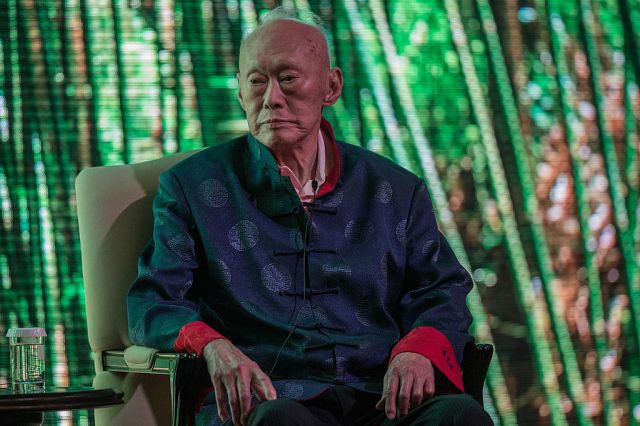
Singaporean strongman Lee Kuan Yew in 2013. Credit: Getty





Adam Oh is a prototypical Singaporean success story: he graduated from law school in 2024, secured a cushy job at a prestigious firm, and found a young woman with whom he hoped to settle down. In his spare time, he does acrobatic parkour “free running.” His life should be smooth sailing — at least, according to the many admirers on the Western Right of Singapore’s technocratic, interventionist government. Some conservative thinkers place outsized emphasis on material prosperity and societal order and are thus captivated by Singapore’s low crime rates and high standard of living, which often exceeds that in Western Europe.
For many years, the Singapore model, combining technocratic managerialism and authoritarianism, seemed to be working. The city-state has become synonymous with immaculate streets, reliable public transportation infrastructure, efficiency in civil service administration, and the upholding of exacting standards in public education. But the model is now faltering, and Oh’s tribulations trying to secure housing explain why.
Like most entry-level workers in Singapore, Oh turned to Singapore’s public housing authority — touted as a model system throughout the world — shortly after graduation in search of a starter home. He dutifully applied for a built-to-order, or BTO, apartment. Such apartments range in size from roughly 400 to 1,200 square feet and come with a side of social engineering: they’re reserved for singles who are over 35 or heterosexual couples who are married, providing an incentive to tie the knot young.
In other ways, they’re less ideal. They cost hundreds of thousands of Singapore dollars (about $0.79 to the US dollar), and they can’t be owned in perpetuity, but instead are leased from the government for 99 years. And they aren’t fitted with faucets, water heaters, or bedroom and bathroom doors unless one opts into an Optional Component Scheme for BTO flats. To avoid this system and renovate one’s home to one’s tastes, tenants must select from a list of contractors pre-approved by the government. And to get one in the first place, they must survive a balloting process.
Oh was relatively lucky, and his application took only two ballot attempts, many reams of paperwork, and about five months. Many others are less so. Young Singaporeans have increasingly begun to voice their frustrations at the state of public housing. Indeed, a TikTok video by a woman who had her ballots rejected 11 times recently went viral. The process was akin to a bureaucratic Groundhog Day.
Once the euphoria of rapid success began to wane, Oh was confronted with the sobering reality that he would have to wait approximately four calendar years before he could finally move into his flat — by which time he would be 30. “It is quite absurd that the government expects young Singaporeans to start a family when many of us won’t have a space to call our own before we hit our 30s,” he says.
Given these predictable fruits of a managed economy, it is curious that the anti-democratic segment of the Right has developed a romantic obsession with Singapore’s founding father, Lee Kuan Yew. Lee served as Singapore’s first prime minister from 1959 to 1990 and is regarded as having been pivotal to Singapore’s remarkable ascent from a third-world backwater to a first-world metropolis. Anti-democratic blogger and software developer Curtis Yarvin, who gained notoriety for advocating that states should be operated as for-profit corporations by CEO-monarchs, has celebrated Yew as a glittering example of a hegemonic figure who has developed an “effectively family-owned” state that delivers “a very high quality of service to … citizens, with no meaningful democracy at all.” Likewise, the far-Right philosopher Nick Land fawned over him for being an “autocratic enabler of freedom.”
For such figures, it’s attractive that LKY, as he was known during his lifetime, was a vocal skeptic of mass democracy. One of his most famous coinages is: “I have never believed that democracy brings progress. I know it to have brought regression.” He openly employed strongman rhetoric — “whoever governs Singapore must have that iron in him or give it up!” — and he has been a global icon of single-minded managerialism and a technocratic, top-down governance style.
He has also embodied the principles of the Nazi legal theorist Carl Schmitt, a favorite of the autocratic Right, who posited the need for a decisive sovereign, unconstrained from acting above the law in times of crisis. Admirers might point to LKY’s treatment of Catholic social workers in 1987 as an example. The workers were alleged to have been part of a “Marxist conspiracy.” LKY weaponized the Internal Security Act 1960 in order to detain them, and when the Singapore Court of Appeal struck down the order, the strongman reacted swiftly, mobilizing his People’s Action Party-dominated Parliament to amend the constitution in order to exclude executive decisions under the Internal Security Act from judicial scrutiny. The detainees were released from prison but immediately re-arrested under the new laws. Whether the detainees posed a genuine threat remains contested, but for aficionados of strongman governance, Lee’s willingness to repudiate judicial constraint is the Schmittian ideal.
There is a strong case to be made that this single-minded managerialism has led to contemporary Singapore’s public housing crisis and its impending demographic collapse — global trends, to be sure, but which have unique local causes in Singapore.
After coming into power in the 1959 general election, LKY’s People’s Action Party launched an aggressive and utopian public-housing program designed to eradicate the slums and resettle dwellers in traditional communal “kampong” housing into the kind of modern apartments proper for an urban metropolis. When slum and kampong dwellers wished to stay where they were, LKY’s government enacted the Land Acquisition Act 1966, giving itself indiscriminate power to seize any parcel of land for “any public purpose.” Government seizure itself was “conclusive evidence that the land is needed for the purpose specified therein,” according to a legal scholar at the time.
Thanks to these reforms, by 1985, the government owned 76% of land (up from 31% in 1959), most of it purchased from private owners at below-market value. Yet this concentration of land in state hands did more than facilitate development. It also obliterated the feedback mechanisms that typically regulate a free market for housing, and all but eliminated the private market. Private developers are forced to purchase land from the government monopoly through expensive tenders. As such, the overwhelming majority of Singaporeans are consigned to living in public housing, with only the ultra-rich able to pay the high premiums it costs to afford private housing.
And public housing isn’t as available as government rhetoric would indicate. In addition to winning the lottery in order to buy a BTO home in a new development, Singaporeans can theoretically take advantage of a “resale” market of existing housing, created by others selling their lease. However, the resale apartments, as they are called, are far more valuable than BTOs, since they are in “mature” estates that offer access to amenities like schools, polyclinics, shopping malls, and public transportation. Prices have become exorbitant, with a five-room flat recently selling for over a million Singapore dollars.
As a result, prospective homeowners have been priced out of both the private and resale market. And while demand for BTOs has surged, supply hasn’t adjusted organically, and instead Singapore faces a chronic shortage of houses. Though the government has vowed to address this by committing to the construction of 50,000 flats between 2025 and 2027, such measures only address supply-side problems. The government has left unaddressed the more fundamental concern that BTO flats — whose prices are pegged to the prices of resale flats — are becoming increasingly unaffordable for prospective homeowners.
It is true that many other developed cities are embroiled in housing crises of their own — crises that both private markets and governments might seek to address, if imperfectly. Singapore has virtually no private market, and its government option, far from solving the crisis, perpetuates it. The 99-year leases and resale options are supposed to allow the average Singaporean to accumulate wealth through homeownership for future retirement needs. And they have done so, but only for an elite few — and even then only after a long wait, as Oh’s case demonstrates. The autocratic technocracy, supposedly so efficient, is providing neither the “high quality of life” nor the “freedom” it promises.
Lee was also a eugenicist, another pet cause of the contemporary Right.
Prior to 1969, abortion was almost fully illegal in Singapore. In 1969, Yew’s government enacted the Abortion Act because the city-state could not “afford to breed” the handicapped or potential delinquents. The government also sought to curb population growth, and rolled out the Singapore Family Planning and Population Board Act 1966 which established a state-led program to promote smaller families, and the Voluntary Sterilisation Act 1974, which incentivized permanent birth control, particularly among lower-income groups and those with disabilities. Its now-infamous “Stop-at-Two” policy imposed financial and social penalties on larger families, including reduced access to public housing, education priority, and other state benefits.
When the legislation led to lower-than-expected uptake, LKY’s government further liberalized abortion restrictions, allowing women of any age, including minors, to terminate pregnancies of up to 18 weeks upon request. These innovations successfully created a dramatic spike in abortions and a successful suppression of the birth rate.
Now, in 2025, Singapore is one of the many Asian countries facing a population collapse. The total fertility rate has fallen to a record-low of 0.87, and current Deputy Prime Minister Gan Kim Yong has said that by the 2040s, the state will have to import tens of thousands of immigrants to stem the tide. Again, this is a global trend, but in Singapore’s case, it demonstrates the limitations of the supposedly omniscient technocratic vision.
The state’s antinatalist policies were highly successful — but the government didn’t predict a population collapse, and nor has it been successful in reversing the trend. A landmark 2005 study on the matter by professor and philanthropist Saw Swee Hock found that while the original policies were hugely influential, measures such as baby bonuses and paid childcare leave have been of “limited effectiveness” — the antinatalist programming has gone too deep, and people prefer the new norm.
New Right types of an anti-humanist bent might note that population decline will eventually cure the housing crisis, and they might also believe that a state that suits only the elite is just fine. These are moral failures, of course, but they’re also a justification in hindsight, not a strength of the autocratic model. Society is unpredictable, and the manager — even the very talented one — who believes himself capable of engineering its happiness has been proved, time and again, to fail. As a Singaporean, I hope my nation’s crises will serve not as an inspiration, but a cautionary tale.