




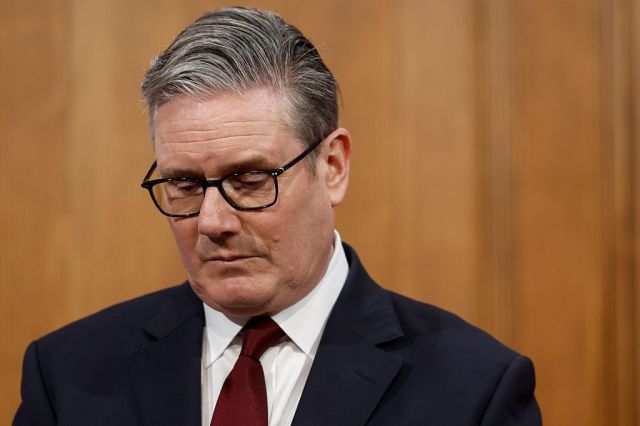
‘Lord only knows how deliciously this vision of British institutional chaos must be playing in Moscow and Beijing.’ (Brook Mitchell/WPA Pool/Getty)





There has been something unsettling about watching the inner workings of government exposed this week during Whitehall’s convulsive self-examination over how Peter Mandelson was propelled to Washington as Britain’s ambassador despite the concerns of United Kingdom Security Vetting (UKSV). In terms of Britain’s global reputation, it is rather like meeting a friend once widely respected for clear-headed judgement and finding them broken down in the corner of a tea-room, hat askew, full of dense, flawed logic and muttering the same phrases over and over again. Lord only knows how this vision of British institutional chaos must be playing in Moscow and Beijing.
The disruptive ambitions of “aggressive, hostile powers” were a clear concern of Sir Olly Robbins, the former permanent under-secretary to the Foreign Office, in his appearance before the Foreign Affairs Select Committee yesterday. But he is now dismissed from his post, along with the weight of institutional expertise he carried. Sir Keir Starmer explicitly blamed Robbins for the fact that he was not until recently told of the damning UKSV assessment which deemed Mandelson high risk before his departure for Washington. A career civil servant, long steeped in the nuances of internal process, Robbins offered explanations with the eloquent but slightly stunned air of a man roughly pushed out of a space capsule, suddenly breathing different air. Yet as his quizzing by MPs shed light on the battle between the Government and civil service, it was the civil service that came out bruised but on top.
At the heart of this row are two different understandings on process, both flawed in different ways. The Government is simply careless of process, unless its pious invocation serves to advance a policy goal — which is why, for instance, a particular interpretation of “international law” was so loudly and persistently invoked over the doomed Chagos deal. With the Mandelson fiasco, though, Starmer’s inner circle has been exposed as unusually contemptuous of the civil service, along with its operations and safeguards. It is a dispiriting development from a Prime Minister elected in large part because of his professed adherence to ethics.
In response to pressure from No. 10, the civil service didn’t jettison process. But it did burrow deeper into it, finding procedural levers which technically permitted it to give the government what it so badly wanted. By Sir Olly’s account, an uneasy Foreign Office tried at times to stand its ground, and at others worked diligently at the flexible outer limits of permitted procedure to fulfil the Government’s requests. Ironically, it was for pursuing the latter path that Robbins has now found himself shoved into a pothole. Yet neither strategy exactly inspires full confidence in how the British state works.
Before the question of the Peter Mandelson appointment ever reached Sir Olly’s desk, barely a week into his new job in January 2025, it had flouted normal process in almost every way possible. As a candidate for ambassador to the US, the UK’s most sensitive diplomatic posting, Mandelson was already a dubious choice. From his earlier resignations to his infamous “Prince of Darkness” nickname, it didn’t take tremendous insight to guess that Mandelson might run into some difficulty with higher-level vetting.
Aside from his now notorious friendship with Jeffrey Epstein, Mandelson had business links to China and Russia through his Global Counsel consulting firm. This was flagged early during due diligence, of which Starmer was made aware. Even the most naïve inhabitant of 10 Downing Street would surely have taken a cursory look at the Mandelson CV and thought “one to watch” — and Starmer was no greenhorn but a former director of public prosecutions. Quite apart from this, Simon Case, the cabinet secretary in November 2024, had openly warned the Prime Minister that if he intended to make a political appointment to the post of Washington ambassador, then the Foreign Office would develop a vetting plan to reveal any issues “of which you should be aware before confirming your choice.”
Case’s advice was ignored, for reasons which Starmer still hasn’t explained. The fact is, No 10 wanted their man in post quickly. Mandelson, a long-standing mentor to the Prime Minister’s chief of staff, Morgan McSweeney, was seen as a potentially invaluable, politically sinuous Trump-whisperer: the whiff of sulphur was a key element in his appeal. Downing Street publicly trumpeted the appointment in December, long before Mandelson’s full vetting was completed. Robbins said that some in the Cabinet Office queried whether Mandelson needed vetting at all, something Number 10 denies. Either way, Mandelson’s transition to Washington was clearly treated as a done deal, including giving him advanced access to high-level briefings. By late January, when responsibility for high-level vetting arrived in Robbins’s in-tray, the political stakes were very high indeed. There were frequent phone calls and “constant pressure” from the Prime Minister’s office, Robbins said, asking when the vetting was going through.
Even as No. 10 apparently sought first to ignore, then rush, then pressure the process around the appointment, it completely lost sight of the essential principle such a procedure is meant to uphold: that individuals deemed dangerous to national security must not be placed in positions of high trust and influence.
Robbins, in contrast, was clearly concerned with national security. Even during his grilling from MPs, he expressed anxiety that the spotlight on the details of developed vetting might be of undue interest to malevolent foreign states. When the negative UKSV evaluation trickled in, it must have proved an awkward moment. But the Foreign Office had the final say, and Robbins said that its own security team had expressed full confidence that they could “manage the risks” from Mandelson, which is why he signed the appointment off.
The most obvious flaw in the process arises from how the UKSV assessment was passed on to Robbins. He learned of it, he said, in terms of an oral briefing from a Foreign Office security official who described the UKSV judgement on Mandelson’s status as “a borderline case” but “leaning towards” recommending clearance be denied. By this reading, the final call might still be up for grabs, with mitigations. But that is far more tentative than the actual UKSV document now being circulated, in which the “overall concern” about the candidate was marked “high” and the outcome was “clearance denied or withdrawn”. It appeared Robbins was discouraged from seeing the physical UKSV document, according to department protocol. Yet while he rightly defends the high confidentiality of developed vetting, there seems no reason why a hard copy of the outcome alone should not have been made visible to him.
Was the secrecy of the process such that Robbins himself was misled? Either way, the debacle suggests that for all the British state’s theoretical commitment to correct procedure, its fulfilment is highly dependent on the government’s respect for it. And the more that is known about the Mandelson affair, and No. 10’s behaviour around it, the more apparent it becomes that the impatient or deliberate casting aside of proper protocol and safeguards is not a bug of Starmer’s government — but a feature.
In his testimony, Robbins said that Downing Street made inquiries as to whether a “head of mission” diplomatic role might be found for Matthew Doyle, then serving as the PM’s head of communications. Robbins had explained that this would be hard to defend at a time when he was in danger of making very senior and experienced diplomats redundant. There was also a suggestion from No. 10, Robbins said, that Mandelson might make Doyle part of the US embassy team. In the end, Doyle was elevated to the House of Lords, where he was subsequently denied the Labour whip after campaigning for a candidate accused of paedophilia. But Robbins saw the Doyle discussion as part of a wider push to put political appointments in roles previously occupied by civil servants, which had generated discomfort in the Foreign Office.
Beyond Starmer and McSweeney, meanwhile, there are other signs that members of the Prime Minister’s inner circle are resistant to external examination. Consider Jonathan Powell, the National Security Adviser (NSA). He has often been quoted as observing that Mandelson’s appointment process was “weirdly rushed”. But his own has not been without controversy. His appointment as NSA is the first time that the role, created in 2010, has been given to a special adviser and political appointee; normally it’s occupied by a career civil servant.
Unlike his predecessors, and despite repeated requests, Powell as NSA hasn’t once publicly appeared before the Joint Committee on the National Security Strategy (JCNSS) — though he has agreed to attend in private. Having appointed a special adviser to the job, the Government has since argued that it is not “appropriate” for serving special advisers such as Powell to give evidence before select committees. It seems comfortable with an unusual degree of opacity surrounding his international operations.
In late March, a JCNSS report expressed concern over the national security threat from China, and the balance which the Government is striking between security and trade in its dealings with Beijing. It was published days after Powell met the Chinese foreign minister in Beijing, a trip not publicly disclosed in advance. The “lack of clarity” over who was responsible for national security, the report said, “hampers the possibility for external scrutiny and challenge.”
In opposition, trust and transparency were Labour watchwords. Yet the disabling of Starmer’s ethical antennae will surely go down as one of the tragedies and mysteries of modern British history. A lawyer by profession – and by all accounts a conscientious one – did he allow himself somehow to be persuaded that this is how clever people do politics? If so, his team of young bucks and old Blairites has not served him or the country well. During the Prime Minister’s painful, tight-lipped performance in the House of Commons on Monday, he was asked if there could be other instances in which people had failed UKSV vetting with national security implications. He flatly indicated that this, and more, would form part of the coming review. The questions summoned by the erstwhile Prince of Darkness still have a very long way to run.
Jenny McCartney is a journalist, commentator and author of the novel The Ghost Factory.
 mccartney_jenny