




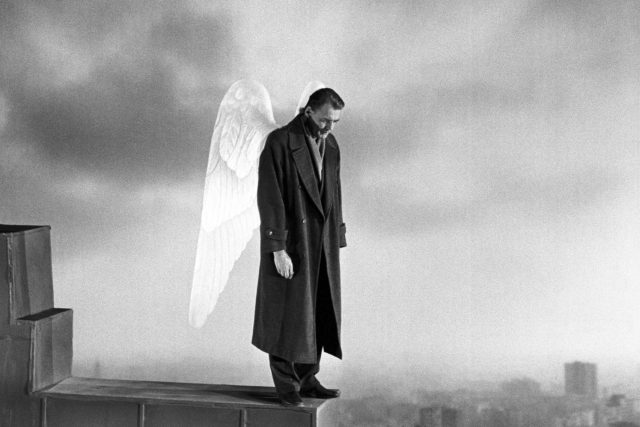
A still from Wings of Desire (1987), directed by Wim Wenders.





On 28 September 1915, my hero, the Swiss-Scottish author Blaise Cendrars, had his right arm blown off during the Second Battle of Champagne while serving as a corporal in the French Foreign Legion. Friends claim that his arm was only partly severed by German machine-gun fire and that he finished it off himself with a trench knife. He wrote about his experiences in the war in the books I Bled and I Killed.
In his 1945 memoir, The Astonished Man, Cendrars recalled the death of one of his fellow soldiers. Hit by a sudden round of artillery fire, the man rose into the air and disappeared before him. That was when Cendrars became “The Astonished Man”.
***
My latest novel, Boyhood, is my seventh and I have become accustomed, but never reconciled, to the magical process of writing and the encounter, time after time, with the writer beyond the writer. For a long time, I misunderstood William Blake’s assertion that he wrote prophetic books. I thought that he meant books that predicted the future. What he really meant was books that are spoken out of the air. Charles Baudelaire, too, spoke about this “other” that we encounter in the process of writing, this presence that seems to be co-creating alongside us. Philip K. Dick, Arthur Rimbaud, William Butler Yeats, all of them referenced the speaking of something beyond the self in the act of writing. What I have come to realise is that, through the writing of it, this other takes its place in our lives as much as it operates in our fictions.
Boyhood revolves around a group of remote viewers who work for the secret service in Northern Ireland, monitoring paramilitary activity. When a young boy is murdered, they realise their true calling as angels, and as the guardians of boyhood. Midway through writing it, I travelled to New Zealand and on the plane I got talking to an air hostess from Georgia — Georgia in the Caucasus, Black Sea Georgia — who told me her name was Tamar. She asked me if I would buy her some chocolates for the way back. I said that I would. I immediately forgot all about it, until I was on the flight back home and I spotted her once again. She was cradling a little baby boy in her arms, walking it round the cabin, kissing it and talking to it. She came over to me and said, seeing as you are a writer, I have something to recite to you. “Prose poetry,” she called it. Then she recited, off by heart, in Georgian, some lines from a book I had never heard of, The Knight in the Panther’s Skin, by Shota Rustavelli. It was beautiful and incomprehensible. Then she gave me her phone number. She wrote it down on a piece of paper alongside the name of the book and the author. “Call me,” she said. “Call me once you have read The Knight in the Panther’s Skin.” But I knew that I would never call her. I knew that whatever happened after that had to work its way out in the book, because I had come face-to-face with one of the angels of Boyhood.
I got home and searched out a copy of The Knight in the Panther’s Skin. It turns out that it centres around a quasi-angelic figure named Tamar: Queen Tamar. Tamar had given me a book in which she figured as an angel. I sat down and wrote Tamar into the ongoing narrative, an air hostess that one of the characters meets on a flight to and from New Zealand to attend a book festival there. I had no idea what her role might be, and as she interacted with the characters I had to hold fast to my faith, as she threatened to derail it completely, by seducing one of the book’s other characters and generally behaving in the most fantastic and unlikely of ways. And then she revealed herself as the guardian angel of an unloved character who had gotten himself into serious trouble:
“Andrew Lethal rushes down the stairs and crosses the road to the park where the birdwoman waits for him in the rose garden. It is Tamar. The birdwoman is Queen Tamar stood among the roses. Tamar, Andrew Lethal says, Tamar, what are you doing here? I thought you were a bird, I thought you were a tall bird, rising up from the flowers, when I first saw you, he says. I’m your guardian angel, Queen Tamar says. Easy to mistake for a bird, she says. Flight and consciousness, she says. Flight and consciousness are the same thing, she says. Wow, Andrew Lethal says. Exactly, he says. They are as far as we can go, he says. In terms of ingress, he says. It’s normally one or the other, Queen Tamar says. Except in the case of angels, she says. Which means that I am always with you. And Andrew Lethal starts to cry, stood there, in the rose garden, at the revelation of his guardian angel. Here, she says. I have something for you. She hands Andrew Lethal a file with the word ‘Welt’ on it. Everything is forgiven, she says. In the end. And she puts her wings around her little boy, stood there, shaking, in Tollcross Park, in the rose garden, in the east end of Glasgow, on this bright new morning.”
When I was young, my father would tell me that an angel touched me on the head when I was born. As soon as I was old enough, he told me that I had been adopted, that he and my mum had picked me out in a cot, in a foster home, and that when he had reached down towards me, I had reached up and wrapped my hand around his finger. That was when he knew I was the boy for him, he said.
I have always thought of my adopted status as a gift. And my father as a fisher of men. It meant that I could do anything, be anyone. There was no example for me, no one that looked like me, nothing to inherit but the love of my parents. Years later, I read about a thing called a bastard wing, an odd evolutionary development in birds where they grew a smaller secondary wing that allowed them to fly even higher.
***
Every time that I look at Blaise Cendrars’ old pock-marked and booze-riddled face on the cover of his Selected Writings, published by New Directions in 1966 with a preface by his big fan Henry Miller, I want to use up my own body. Didn’t Antonin Artaud say something about how it’s the state of your body, in the end, that figures the final judgement? Has this body died from a surfeit of life, I asked myself, when I read the news of my Uncle Jim’s death, my Uncle Jim whose terribly disfigured face used to send my brother and sister and I into fits of screaming terror when we would visit him in Holytown after begging our mum not to take us.
“WAR HERO DIES,” the headline read. Jim Tosh was a rear-gunner in a plane that was shot down during the Battle of Britain and who was treated by a special unit led by Archibald McIndoe, from New Zealand, who pioneered radical new techniques for rebuilding badly burned faces, including eye-lid reconstruction, and who insisted that his patients wore their service uniforms, and never convalescent pyjamas, while receiving treatment. McIndoe called his patients, with their astonishing faces, “his boys”. Despite his disfigurement, and his partial reconstruction, my Uncle Jim’s fiancé married him, before he drank himself to his war hero’s death. In my novel Monument Maker, a man returns to his long-lost love after receiving a face transplant from an experimental surgeon and marries her all over again without ever revealing his true identity.
Blaise Cendrars’ youngest son, Rémy Cendrars was killed in the Second World War while serving as an airman escorting military planes in Morocco. Cendrars wrote about the death of his son in a book entitled Sky, most of which is taken up with the unearthing of stories about the ultimate idiot-saint of flight, Saint Joseph of Copertino, who theological history enthrones as the only saint to demonstrate the miracle of flying backwards, an event that Cendrars describes as “unique in the annals of aviation”. But not, as Cendrars himself demonstrates, in literature.
As a writer, I have taught myself to fly backwards. All of my books have been written with the speed of angels, in astonishment and gratitude. Astonishment, at the way the world speaks when you think it into existence with writing, and gratitude, for the precious gift.