




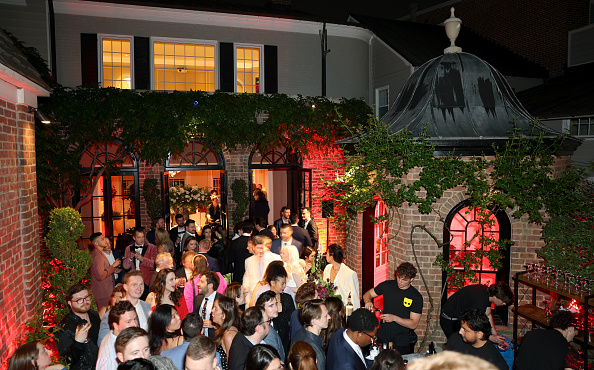
(Tasos Katopodis/Getty for Grindr Inc.)





Long before Saturday’s shoot out at the Hilton, many of my fellow DC journalists and writers had already been having a pretty lethal week. The annual White House Correspondents’ dinner (WHCD) arrives in the nation’s imperial capital at the crest of a week-long wave of alcohol and sponsored parties. From the rather splendid springtime garden of the British Embassy to the ballroom of the Four Seasons’ Hotel, one bounces from free bar to free bar, offerings which — at least to the British delegation — are approached less in the spirit of invitation and more of open challenge: to see who, bar or man, will be finished off by whom.
My Saturday evening began just over the road from the White House, waiting to see if Clavicular had sufficiently recovered from his overdose to make a much-heralded appearance at the Substack party along with the one Democrat whose phenotype is Chad enough to have gained the looksmaxxer-in-chief’s prospective electoral endorsement, Governor Newsom. In the end, the secret service arrived before either men-of-the-moment, sealing off the street and sending security swarming up the main stairway of the Renwick Smithsonian Gallery to place the entire party under lockdown. No leaving! we were told. No, not even to go to the Time Magazine party at the Swiss Embassy. At least for an hour or two. Commanded at gunpoint to return to the open bar — a degree of compulsion that I sensed was quite unnecessary — we did our duty and obeyed.
Before that night’s armed assault, however, the main battle of the week lay in gaining access to one party in particular: the inaugural Grindr WHCD Party in the prime-time Friday night slot. According to breathless reporting in Vanity Fair — who, one notes, have a party of their own to plug — Grindr’s was among the “most sought-after invitations of the weekend”: “the talk of the town”. A spread of “top power gays” were forecast to be in attendance. How exactly, I wondered, would this serve to differentiate it from the scores of other parties held throughout the year in the district of Columbia? There was only one way, I was repeatedly told, to find out.
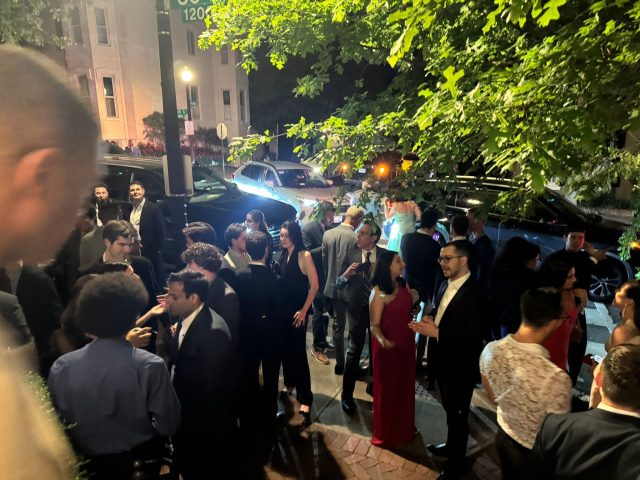
Arriving just before 10pm, thinking it best to make Grindr the last pit-stop of an overworked evening, the sight that first met the eye was a little discouraging. The venue was an unsellably large Georgetown townhouse, now re-purposed as an “event space”. Leading up to the colonnaded entrance was a club-style queue of some hundred or more restless male homosexuals, and the occasional ally, showing no visible sign of forward movement. The ominous phrase “one in one out” was being thrown around. Worse still, it transpired, this was the queue for people who had been invited. Mainly “circuit gays”, a chaperone who I had acquired on the way observed, deploying expert local knowledge. All the same, poor form from Grindr, I thought, to insist you can host only to leave your men begging entry from the curb.
At the business end of the line, and somewhat to the detriment of any “one in one out” principle, a more interesting sociological spectacle played out. Every 30 seconds or so a monstrous black SUV would pull up to the entrance, the doorway closely guarded by half a dozen blonde women wearing Britney-mic headsets. An entourage would emerge — “power gays”, I inferred – and either cruise straight through the doorway unopposed, or thrust an iPhone mid-call towards the chief headset-wearer, putting her in touch with a mystery speaker – identity unknown – who seemed to have the power to compel admittance faster than words could be spoken. Occasionally, there was a negotiation. “I have two of Karoline Leavitt’s boys coming from across town, I want to make sure they get let in”, one arrival barked at a headset blonde, holding her eye with an intensity seldom seen outside of an ophthalmological examination room. Unable to take the press secretary’s name in vain myself, it was clear I was going to have to rely on my ability to project a certain amount of soft power. A minute or so later, I was received indoors.
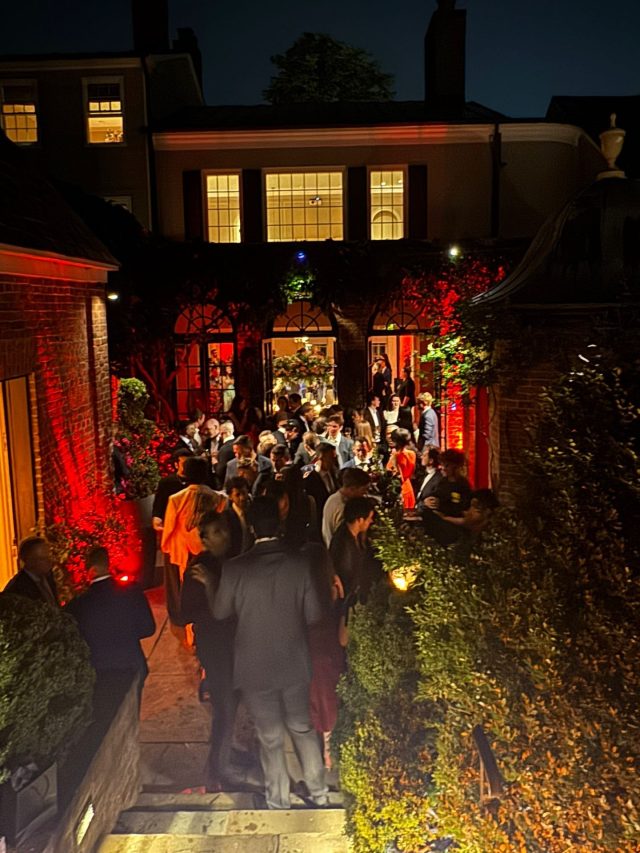
Commentators who insist the current mood of American party politics is antipathetic to gay interests might have had trouble explaining the scene inside. A Where’s-Wally panorama of half-familiar state department faces, mixed in with the younger, prettier congressional and senate staffers. Behind them all stretched a long garden, concealing many bars and hiding places. CNN’s Don Lemon was apparently somewhere on the dance floor; Scott Bessent, half-jokingly spoken of as likely to make an appearance, was apparently not. Instagram male models bussed in from New York squeezed in between the guests with buckets of oysters harnessed to their waists.
A great deal of mutual studying was taking place: is this, I wonder, what women are getting at when they refer obscurely to the “male gaze”? Every interaction was a function of two parameters: attractiveness and power. Some had both, but it seemed likely you needed at least one to get anybody’s attention. Once or twice, I was warned of an approaching young man that “she” is dangerous. But for the most part, the crowd was notably professional, conservatively dressed; there was little in the way of the modern LGBT-movement’s characteristically garish paraphernalia or costume. Intergenerational, too: the young men confident in their natural appeal, the older guests for the most part gristly bodies in over-tight suits, their faces unnaturally unlined and with an odd chemical shine. Nobody was fat. When I try to order a beer, I am practically thrown out under suspicion of being heterosexual. A harder drink is placed in my hand.
“Donald loves the gays,” a White House staffer reassures me. “They’re good workers. He lost a lot of good people in the Eighties”. Of a foreign journalist we both know, there is an exasperated flourish of the wrist: “another blonde woman”.
Why, one wonders — both in DC and in Westminster, too — do gay men seem to be so over-represented in elite politics, at least behind the scenes? While drinking with a Tory staffer on the terrace of the Stranger’s Bar in Parliament, he had only to open the Grindr app on his phone for it to start vibrating uncontrollably, overheating as the deluge of solicitations mounted up. In DC, a political monoculture on the scale of a capital city, the effect seems even more pronounced. In recent years, Grindr has crashed through overuse at Republican National Conventions. And as recounted in James Kirchick’s recent, exhaustive history of the subject, Secret City: The Hidden History of Gay Washington, the paranoid notion that the gays may have fully taken control of national politics proves oddly recurrent. In 1969, J Edgar Hoover began investigating the Nixon White House, suspecting it of having been infiltrated by a “ring of homosexualists” operating at the “highest levels of the White House”. Later rings – always rings – were suspected to be in control of subsequent candidates. From the Fifties onward, a list of the 4,000 or so homosexual men estimated to be living in and around Washington DC was supposedly compiled on the grounds that these characters constituted an obvious Soviet blackmail liability. Whatever the fate of that defunct list, clearly Grindr has compiled a similar database of its own.
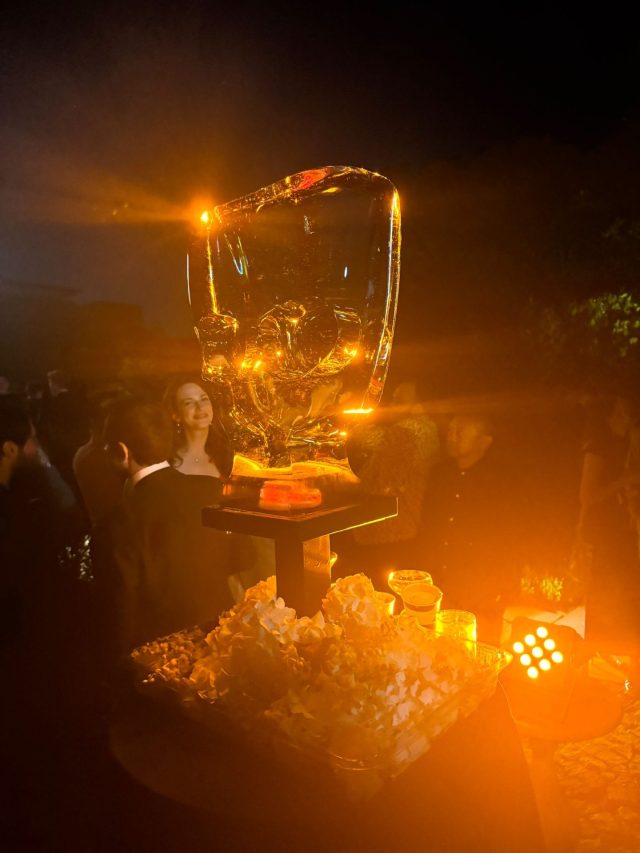
Observing the partygoers on Friday, it was difficult to know whether Grindr was attempting to court the historical stereotype or dispel it. Is the aim to project an insistent normality or something more illicit? Did the event belong or stand apart from the rest? One senses the popularity of the party owed something to a confused mixture of the two. At the garden’s centre a large, illuminated ice-sculpture of the Grindr mask melted gradually over the course of the evening. The bathroom – somewhat disconcertingly – was set up in a re-purposed sauna complex at the end of the garden. But few other clues would have helped distinguish it from the many other parties of the week.
As the soirée ended, the crowd was forced out onto the street and into the fleets of circling cars that waited to power the gays away. At least, until the next evening. Perhaps there had been too many women present for things to get seriously out of hand. Or perhaps the real action was happening just off-stage, in a room yet more inaccessible: a very DC-coded fear to have.
