




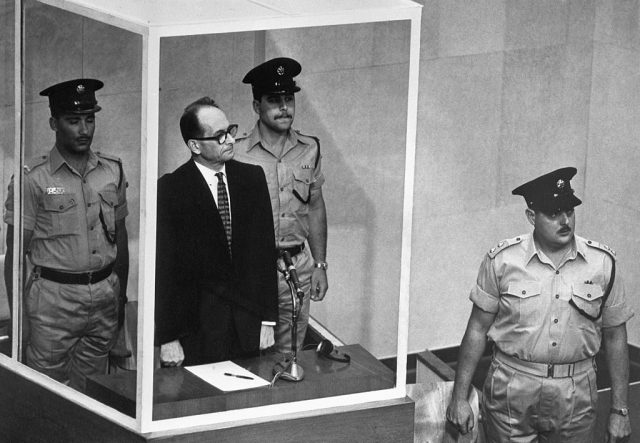
Adolf Eichmann on trial in Jerusalem. (Bettmann/Getty)





Shortly after midnight on 1 June 1962, Adolf Eichmann was hanged in an Israeli prison. Only a small number of people were present: several officials, four journalists, and a clergyman. Convicted six months earlier, on 15 counts ranging from war crimes to crimes against humanity, he was found to have wholeheartedly believed in the Nazi cause, and to have served as a key perpetrator of the Holocaust. After the execution, Eichmann’s body was cremated, and his ashes strewn over the Mediterranean.
None of this brought joy to Israel. In its unsmiling sobriety, the Eichmann trial represented the country’s only opportunity to bring a leading Nazi to justice. Over 100 witnesses testified to the horrors of the Final Solution, leaving the new Jewish State, then still home to hundreds of thousands of Holocaust survivors, mesmerised, shocked, traumatised. “Justice,” Hannah Arendt wrote in her famous account of the trial, “demands seclusion, it requires sorrow rather than anger.”
Eichmann’s was the second and last judicial execution ever carried out in Israel. And, as the atmosphere around his death implies, it was framed by robust moral reasons. In a country created as a safe haven for Jews after the Holocaust, the very notion of legally executing other human beings went against the grain for large parts of the population. Judaism generally frowns upon the judicial killing of others, albeit with a particular focus on other Jews, while the historical legacy of Jewish persecution meant a long-term insistence on the sanctity of human life.
Yet if the death penalty for murder was abolished back in 1954, it has now returned with a literal vengeance. Late last month, the Knesset passed a law permitting the execution of Palestinians in the West Bank. If that wasn’t stark enough — among other things, it explicitly excludes Israeli Jews — the law’s passage was also accompanied by celebration. Itamar Ben-Gvir, Israel’s security minister, popped champagne, proudly wearing a noose-shaped lapel pin as he went.
Ben-Gvir’s law is not entirely new. As the Eichmann execution implies, Israel already permits the death penalty in exceptional circumstances. These include involvement in genocide, but also a range of security offences, from warmongering and undermining state sovereignty to treason.
In practice, though, these laws were almost never enforced. The only known case of legal execution besides Eichmann’s occurred in June 1948, when one Meir Tobianski was accused of passing military secrets to Jordan. But he was posthumously cleared of treason, while the death sentences of several Jewish murderers were commuted, largely thanks to the injunction that since man was created in the image of God, only God has the right to deprive him of life. The final abolition of the death sentence for murder came following a lengthy discussion in the Knesset, where Jewish tradition, universal humanitarianism, and the lack of deterrence were all invoked.
As for Palestinians accused of murdering Jewish Israeli citizens, and sentenced to death by Israeli military courts, their punishments were repeatedly overturned by higher courts. This was in part because of the same legal and moral arguments applied to Jewish criminals. As Adi Carmi, a former senior Shin Bet official, said in March: “as an Israeli citizen living in a Jewish and democratic state, any encounter with terrorists should end with their neutralisation or if needed taking them out. Once the terrorist has put up his hands and been arrested and cuffed, from my point of view the battle is over and he needs to be tried. As a Jew who sanctifies the sanctity of life, I do not want to see the death penalty.”
There have historically been more hard-nosed reasons to avoid executions too. As security-minded officials have warned, executing those who resist Israeli occupation, normally referred to in Israel as terrorists, would be counter-productive. Transforming them into martyrs, their deaths would merely fuel the cycle of violence. This reluctance also played a part in Israel’s claim to have joined the general trend in the West of viewing executions as inhumane — in contrast to its Arab neighbours, where the death penalty has been more common, or to Iran, whose theocratic regime has carried out public hangings and other gruesome acts.
In 2015, Benjamin Netanyahu himself opposed a proposal by members of his own coalition to adopt the death penalty. Only six MKs supported the law and 94, including most of the Right, opposed it. In this, they were only following tradition. Writing in 1969, Natan Yellin-Mor, a leader of the extreme-Right underground during the British Mandate in Palestine, warned that “if the death penalty is used at a time of a national struggle, it may elevate the person sentenced”. For their part, former security officials have also worried about the international repercussions of the death penalty, with Carmi noting that it could harm Israel’s relations with its Arab neighbours. Other experts have made a similar point about Israel’s wider reputation abroad, with former Shin Bet official Lior Akerman suggesting that executing Palestinians could “exacerbate attitudes toward us by states around the world.”
All this has now changed. Ben-Gvir’s party is called Otzma Yehudit — the Hebrew for “Jewish Power”. The far-Right, ultra-nationalist party traces its ideological roots to the outlawed Kach Party, itself banned in 1994 for its outright support for racism and Jewish terrorism. Kach’s most infamous supporter was Baruch Goldstein, a Brooklyn-born settler who murdered 29 Palestinians at the Cave of the Patriarchs in Hebron. Ben-Gvir has described Goldstein as a “hero”, and until 2020 hung a portrait of the killer at his home in an illegal West Bank settlement.
The death penalty voted into law by the Knesset on 30 March is an extraordinary piece of legislation, even by recent Israeli standards. The law makes absolutely no pretence about being exclusively directed against Palestinians, stating that any resident of the West Bank found guilty of killing someone in a “terrorist act” must be sentenced to death by a military court, barring exceptional circumstances that would impose a mandatory life sentence instead.
At the same time, a death sentence no longer requires, as it previously did, a unanimous decision by a panel of military judges, nor that they be at least at the rank of lieutenant colonel. Indeed, according to this new law, the death penalty must be imposed even if the prosecution asks for a lesser sentence. As for the state of Israel proper, the new law vaguely mandates that any killing intended to undermine the existence of the state must similarly be punished with death or a life sentence, and that the execution must be carried out within 90 days, barring intervention by the prime minister. In short, the new law clearly imposes the death penalty only on occupied Palestinians — and potentially on Palestinian citizens too — but not on Jews.
Before the law can go into effect, it will be reviewed, and possibly overturned, by the Supreme Court. This could happen for humanitarian reasons — in reference to Jewish law and to the “Basic Law: Human Dignity and Liberty” of 1992 — or, given the law’s prejudicial nature, on judicial grounds. In recent years, however, the court has increasingly veered to the Right, as well as becoming ever-more timid, and it may well either hedge in some manner or allow the law to be enforced.
Whatever the judges decide, it is impossible to define this new law as anything but blatantly racist, making a clear distinction between two groups, Jews and Palestinians, on the basis of their nationality and ethnicity. It is another substantial step in the ongoing establishment of an apartheid regime in the West Bank, as well as its creeping extension into the state of Israel itself. The same state that, just over six decades ago, executed a Nazi perpetrator for implementing a racist genocidal policy against European Jews — in a trial that in many ways served to establish the Jewish state’s legitimacy as a safe haven for Jews after the Holocaust — is now in danger of abandoning its last claim to a just legal system.
The consequences of this new legalised racism, deeply rooted in the far-Right’s ideology, are unfathomably destructive. Beyond his antics in the Knesset, Ben-Gvir made that clear, promising the law would ensure “a day of justice for the murdered” — and “a day of deterrence” for Israel’s enemies. And if legal experts from the Israel Democracy Institute see things differently, defining the law as “unconstitutional, immoral, and contrary to Israel’s commitments according to international law”, it is hard not to see a more basic moral collapse from Arendt’s sombre reflections.
I grew up in Israel before the occupation of 1967, and recall listening to recordings from the Eichmann trial on the radio with my family every evening. For someone like me, the transformation of Israel from a country that perceived itself as the clearest answer to persecution and genocide — to one that is engaged in systematic oppression against Palestinians, and is now seeking to legalise their judicial killing, is devastating. These are not only the actions of extremists such as Ben-Gvir and finance minister Itamar Smotrich; more than half of Knesset members voted for the law. That Zionism, which set out to emancipate the Jews, has now become an ideology geared towards dehumanising Palestinians, is not only tragic. It is, I think, sufficient cause to reject the ideology altogether, and call instead for the remaking of the state into a just and equal society for all its inhabitants. For now, it remains to underline that the law is a breathtaking plunge. One is hard put to think of a more stunning turn of events.