




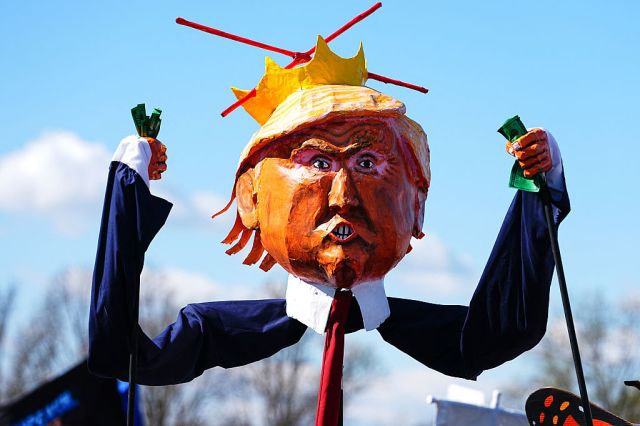
An effigy of Donald Trump as seen at a No Kings rally in Washington, DC over the weekend. Credit: Getty





Speaking to military leaders at Quantico last September, President Trump admitted how easily he’d managed to rename the Department of Defense to the “Department of War,” a provocation that, in an earlier political era, might have generated weeks of outrage. Instead, nothing. “I thought it would be met with fury on the Left,” he said. “But they’re sort of giving up, I must be honest with you. They’ve had it, they’ve had it with Trump. I really thought that we were going to have to sort of fight it through. There’s been no fight.”
He wasn’t wrong. After winning in November 2024, Trump seemed invincible. He’d practically dumped Joe Biden in hospice and drained the fighting spirit out of the #Resistance, too; old opposition standbys like Katy Perry and Timothy Snyder decamped to Canada. The libidinal economy of opposition politics during Trump’s first term — when every outrage instantly produced a march, a slogan, a crying congresswoman, or a sassy slogan on a tight dress or a tote bag — had finally burned through its own glucose. In early 2025, Americans watched the Department of Government Efficiency cripple several federal agencies without making a noticeable dent in federal expenditures — but also without putting anyone in the streets. The anti-DEI blitz drew mostly faculty-lounge outrage. Democratic politicians went on soul-searching sabbaticals. The pussy hats were mothballed.
But no more. As Saturday’s “No Kings” protests proved, the period of resigned apathy is over. An estimated 8 million people marched in 3,300 events across the country, reportedly making it the largest single-day demonstration in US history. Nearly half of the events took place in Republican strongholds; Texas, Florida, and Ohio each had more than 100 scheduled protests, and one demonstration took place in lonely little Kotzebue, Alaska, which has about as many wind turbines as Democrats. There’s even a new, brightly hued protest hat: a red knit Melt the ICE cap, modeled, for better or worse, after those worn by Norwegians in the 1940s to protest the Nazi occupation.
Marches, of course, aren’t magic, and a few million people with signs aren’t automatically a durable political force, much less a revolution. And those who turned out for No Kings events were typically older, whiter, and more college-educated than the electorate. That’s a feature of the graying Resistance: Boomer and Gen-X libs are the key demographic (the Millennials who made Left populism feel hipster-cool a decade ago have tuned out, and the Gen-Zs are either disillusioned or voted for Trump). Still, the protests matter as a temperature check of America’s political mood and a preview of a coming Republican wipeout in November.
Trump only has himself to blame. In the year since the inaugural No Kings rally, he doubled down on his authoritarian antics and acted more like, well, a king. He has treated Congress and the courts less as coequal branches than as ceremonial bodies occasionally invited to applaud and rubber stamp his agenda. Instead of slowly backing away from the old neoliberal model of foreign policy, the so-called rules-based international order, he tried to blow it up entirely on his own authority. He launched what he called a strike against Venezuela and captured its president without notifying Congress in advance. He blew up civilian vessels in the Caribbean for alleged crimes that don’t carry the death penalty in the United States. He threatened half the countries in the Americas, and even rattled his sabre toward Greenland. An invasion of Iran followed in February, another war of choice conducted without a declaration, without a vote, and without apparent interest in what anyone outside the Pentagon thought (he may not have solicited many opinions from inside the Pentagon, either).
Now he’s coming for the money supply. The Treasury Department announced that Trump’s signature would appear on all new paper currency, the first time a sitting president’s John Hancock had been placed on dollar bills since the practice began in 1861. In other words, the man who told reporters that “I’m not a king” had, in 14 months, annexed a performing arts center, renamed a gulf, stamped his face on the Department of Justice building and his signature on the currency, and launched two wars without asking anyone’s permission. Hail Caesar?
Yet judging by the signs, the speeches, and the people I spoke to at the No Kings rally in Harrisburg, Pa., what finally jolted the anti-Trump public out of its stupor was mass ICE mobilizations. At that same Quantico speech last fall, Trump boasted that he had signed an executive order creating “quick reaction forces” that could help quell civil disturbances in large cities, essentially a personal domestic strike force aimed at what he called “the enemy from within.” Seen in this light, Operation Metro Surge in Minneapolis was less a specific border enforcement initiative than the opening act of something larger, an emerging framework in which federal military power flexed its muscles domestically, and American cities were recast as new theaters of operation.
When ICE officers killed Renee Good and Alex Pretti — a mother of three and a Veterans Affairs nurse, respectively — the federal government’s response was to justify both shootings before any probe was complete, contradict its own account on video, and then refuse to share evidence with state investigators. Good and Pretti became martyrs, victims of the sort of jackbooted federal thuggery conservatives once liked to imagine happening to themselves.
There is a reason that this weekend’s rally in Minnesota’s capital city became the symbolic flagship of No Kings, with Bruce Springsteen performing “Streets of Minneapolis” to a crowd of at least 100,000. Operation Metro Surge had effectively made Minneapolis a laboratory for the “war from within” doctrine, and even many people who aren’t especially ideological can recognize when a government starts to feel tyrannical.
The numbers tell their own story. No Kings, for all its messy ideological sprawl and boomer-heavy demographics, had 8 million souls marching outside, with an overarching sense that people who had been sitting on their hands for months had finally been jolted out of the house. There’s also some data showing that the people showing up aren’t just venting for a single day. One analysis of DC marchers showed that town-hall attendance rose to 38%, up from 31% prior to their participation in the protests, and that four-fifths had boycotted or deliberately purchased products for political reasons, up 16 points in 14 months.
Compare all this to the Right’s attempts to muster a crowd. At the Conservative Political Action Committee gabfest, held the same weekend, a few hundred sat in a convention hall in Texas. The usual blowhards tried their best to spin the new Iran war as an expression of “America First” foreign policy, rather than a sudden and dramatic reversal of its core promise. Trump skipped it, and judging from online footage, the conference less resembled MAGA’s victory lap than a convention of Republicans nervously assuring one another that the king was still wearing his clothes.
The deeper irony is that Trump is now the one stripping off his own garments. He benefited, at least for a while, from a country too demoralized to oppose him with the theatrical intensity of the first term. That lull created the illusion of a blank check for enacting MAGA’s policies, no matter how extreme, and let Republicans imagine that the public had finally adjusted to him, that Americans had accepted a more openly punitive politics as the new normal. But that was before the bodies started dropping on the sidewalks of Minneapolis and missiles started flying in Iran.
It turns out the best organizer the American Left has had in years is Donald Trump in a crown he couldn’t stop himself from trying on.
