




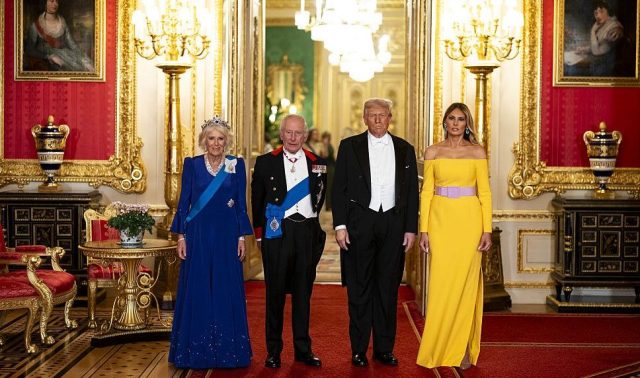
Can the Special Relationship endure? (Aaron Chown-WPA Pool/Getty Images)





Late in the spring of 1946, Winston Churchill was invited to speak at a small Midwestern liberal arts college — named Westminster, suitably — in the flyspeck town of Fulton, Missouri. The newly unemployed prime minister accepted the undeniably incongruous invitation once he learned that President Truman himself would perform the introductions, and promptly vowed to make it a humdinger, a speech for the ages.
What is best remembered now is the line that essentially gave formal birth to the Cold War: “from Stettin in the Baltic to Trieste in the Adriatic, an Iron Curtain has descended across Europe…” But what King Charles and Queen Camilla will undoubtedly find in the briefing notes as they pack for their short transatlantic expedition this week, in defiance of the unsuccessful assassination attempt on President Trump on Saturday night, is the fact that Churchill then went on to call for a couplet of other developments he thought important. One was “a fraternal association” between the world’s English-speaking nations; the other was a “special relationship” that he saw being forged between Britain and her former colonial possession, now all grown up to become the United States.
The implication was more than clear: both of these — the association and the relationship — were things that could and should be nurtured and preserved as counters to the slew of alien barbarisms that could well otherwise envelop, overwhelm and corrupt the postwar world.
Less than 20 years later, in 1963, I found the relationship more than special. Indeed, it was little short of outstanding. I had a gap year to fill, and decided to spend the summer hitchhiking in America. I was 17. In mid-May, I crossed the frontier from western Canada through the border arch in Blaine, Washington, and stuck out my thumb. It was 38,000 miles of unceasing adventuring. One highlight was shaking hands with President Kennedy during a ceremony at which I found myself in a remote corner of Michigan. “Hey, Mr President, this kid’s come from London, England!” said an onlooker, pushing me up to the rope line.
I eventually left for Canada on the way home, passing out of the US by way of the border village of Calais, Maine. I counted my money: the entire three-month trip had cost me just $18: the generosity and hospitality of Americans was quite staggering. I had a small Union flag on my rucksack, catnip to the curious: cars swerved to a halt, get in kid, where you wanna go? The drivers all wanted to know about the Great Train Robbery, about Christine Keeler and John Profumo, and, invariably, had I ever met the Queen?
A further decade on and I could answer yes to that last. It was a time when both of Churchill’s Fulton phenomena were still in rude good health, as I remember well from my days covering (for The Guardian) Queen Elizabeth’s symbolically hugely important visit to the US to help celebrate the country’s bicentennial on 4 July, 1976.
The visit could have been awkward — Americans waxing excited and triumphant in front of a sovereign from whose very ancestors their own forefathers had so violently broken away. But in the end her tour, with Prince Philip amusingly in tow, proved a triumph, an adroitly whisked soufflé of reconciliation and congratulation. The Queen came armed with a top-shelf collection of gifts: a handmade presentation copy of the Declaration of Independence, a brand-new cast of the Liberty Bell to be hung in Philadelphia, and a precious copy of Magna Carta kindly loaned by Lincoln Cathedral.
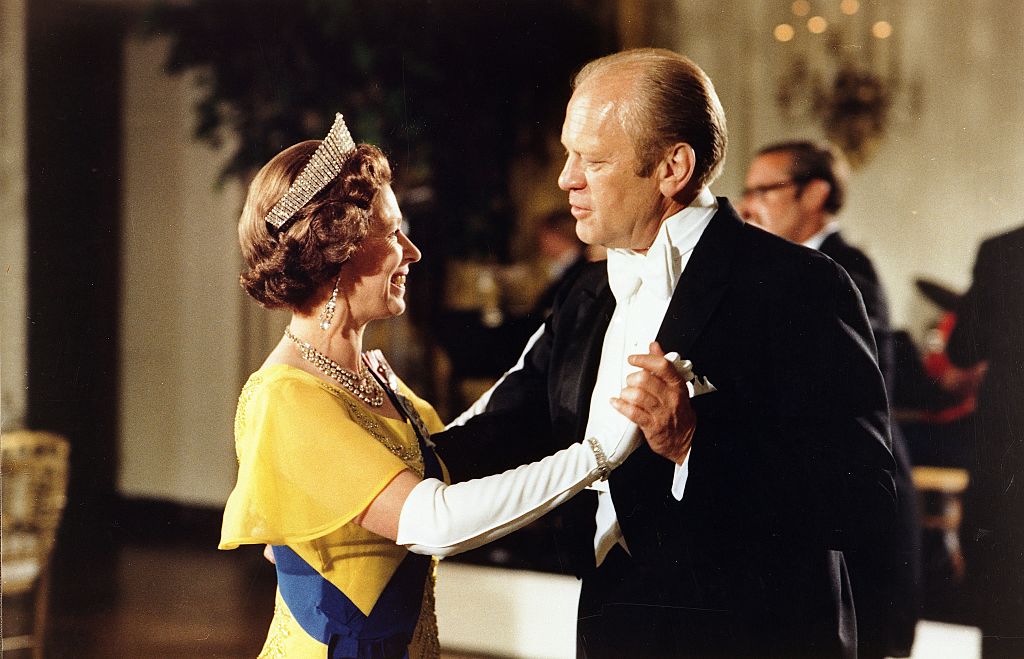
It was all very relaxed. At the White House state dinner, her Majesty danced with President Ford, and later felt sufficiently comfortable at a small private gathering to be a little bawdy — remarking that a certain rather portly ex-police-officer-turned-politician seen at the dinner appeared to be wearing his truncheon under his dinner-jacket trousers. When I suggested that he was probably just pleased to see her, she threw back her head and roared with happy laughter.
At the time, the special relationship still seemed to be both healthy, and more importantly, in balance, in near-perfect equipoise. Britons were still in particular awe of America’s technical achievements — the fact that, just four years beforehand, a naval aviator from Chicago and a geologist from New Mexico were strolling around on the surface of the moon still had the power to enthral. And though most in London’s chattering classes were appalled by the corruption exposed by the Watergate affair, the fact that all the intricacies of democracy functioned as perfectly as the Founding Fathers had planned — the press exposed the crime, the justice system sent the guilty to prison, the leading perpetrator, President Nixon, fell on his sword — was impressive, even admirable.
The feeling was mutual. Americans in the mid-Seventies still loved about Britain what they always had loved: the long history, of which they had so little, the ceremonial, the dignity, the calm, the countryside, the pub, the BBC, Rolls-Royce, even cricket. And as shown by the adulation during the Queen’s brief stay, they adored the very idea of the Royal Family. True, there had over the centuries been moments of unpleasantness, beheadings, drownings in barrels of Malmsey wine and abdications. But the royals’ continuity and reserve was, to most, just enviable.
Before I became an American citizen in 2011, I was grilled by a humourless-seeming immigration official. At one point he asked, rather sharply I thought, whether I agreed to forswear allegiance to any “foreign prince or potentate” as the law had it — because he had seen in the paperwork that I had been given an OBE back in 2006. Would I be willing, he asked snappishly, to give it up? When I said that of course I would, his official face broke into a grin. Just testing, he said. We’d never ask you to. “She’s not a foreign potentate, after all.” And then he proceeded to ask about Buckingham Palace, what the ceremony had been like, and did they give me tea. (They did not.)
The man’s affability concealed, however, a reality that had been growing stealthily over the previous decades — that the relationship between our two countries had been shifting, both in terms of its quality, and more particularly, in terms of its balance.
While Britons remained mesmerised by America’s relentless scientific and engineering advances, the internet, the cellphone, the worldwide web (its British origins conveniently forgotten), there was a growing sense of anger and resentment over Washington’s now vast and quasi-imperial powers — a resentment born, perhaps, of Britain’s now fully-exposed demotion from global primacy.
And the anger was very real. Few who watched the BBC on the night of 9/11 will easily forget the bewildered, almost tearful state of the American ambassador, confronted by a studio audience who appeared not entirely to sympathise with the still-unfolding tragedy, with not a few suggesting that perhaps America had needed to be brought down a peg or two, perhaps had even deserved it. And on the American side, too, there was a growing realisation that during this same period, the Britain they once loved had now changed, and out of all recognition.
Some might argue that the evolution had actually begun a long while before — before the war, before Churchill, before the Fulton speech. It was first sensed, if vaguely, by the poet John Betjeman back in 1936, when he wrote of the unease felt by some after the death of King George V, and the arrival in the capital of Edward, his very different successor:
Old men in country houses hear clocks ticking
Over thick carpets with a deadened force
Old men who never cheated, never doubted
Communicated monthly, sit and stare
At the new suburb stretched beyond the runway
Where a young man lands hatless from the air.
That had been the Britain, and those the Britons, that America had once so admired. The old country may have started on this change long before, yet the magic of the special relationship endured for many decades more, as I so happily experienced them. But come the new millennium, the inevitable alteration begun in the Thirties was all but complete, and Britain had demographically and socially turned herself into what she is today: a modern, multicultural nation that is in truth now little different, though without the power and even without much influence, from America herself. And, in that similarity, a nation and a people are far less to be admired than they used to be.
Yet some optimists still cling to the magic. As mentioned, I became an American in 2011, the ceremony conducted on that 4 July Independence Day on the afterdeck of a venerable sailing warship, the USS Constitution, in Boston harbour. Sir Brian Urquhart, the British diplomat and longtime UN Assistant Secretary-General, who was a friend and neighbour and who, like me, had long been enraptured by America, asked to come to watch the process. So utterly moved was he that he promptly applied for citizenship himself, at the age of 95. It was granted when he reached 98, and for his three remaining years he was as happy as a dog with two tails. Nothing could be finer, he once told me, than to be a citizen of two countries that he so loved and admired, and which in his view still so loved and admired one another. The couple’s relationship was, he insisted, very special indeed. And it would endure, most certainly.