




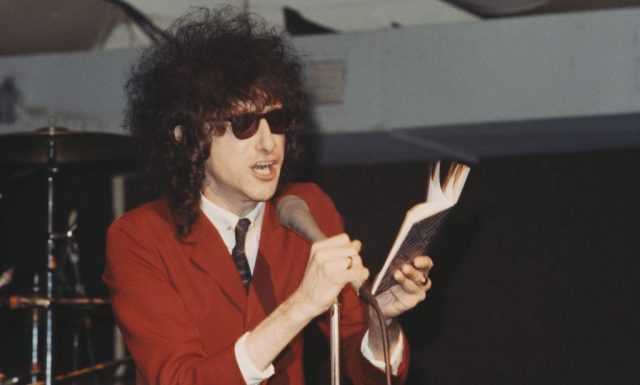
‘Get back on the drugs!’ (Michael Putland/Getty)





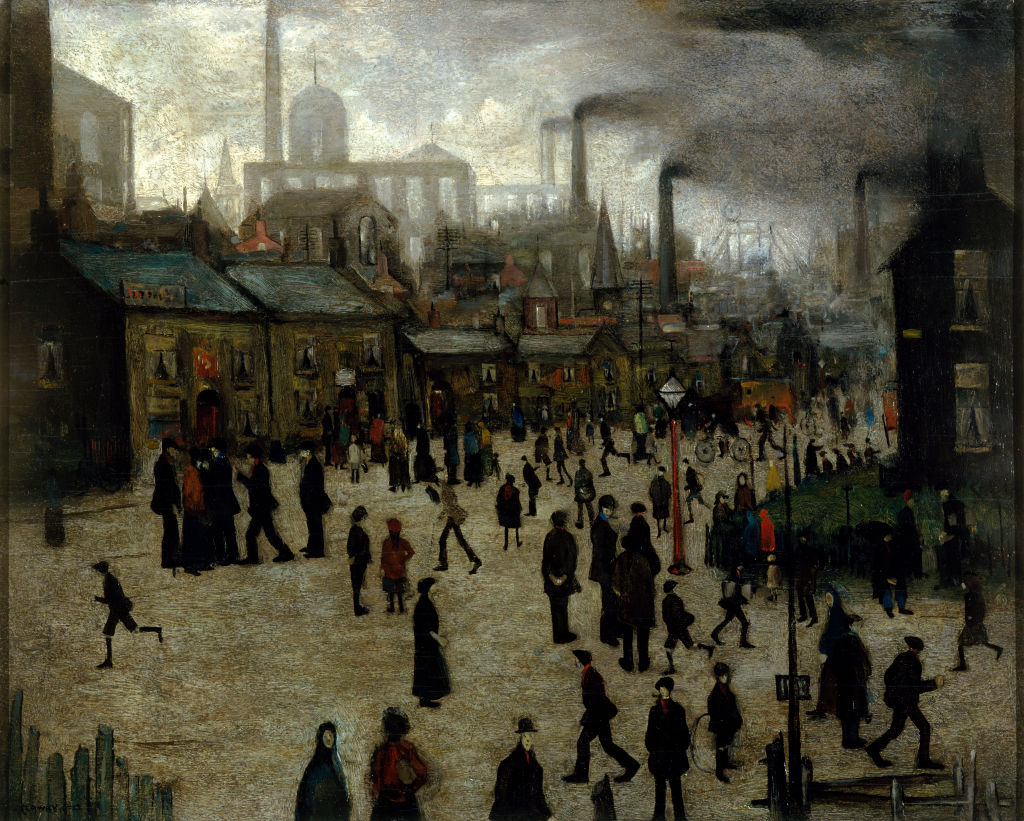
The painter L.S. Lowry died 50 years ago this year, and spent some of his time painting in my hometown of Salford. In fact, my mother used to see him sketching by the road on her way to work. He was given a wide berth by most of the local population — not only because he was that queer thing, an artist, but because his regular job was being a rent collector. He is said to have refused a knighthood three times, and there may be a grain of myth in it. Why would the Establishment be so persistent?
One answer might be that they thought he was politically safe. This portraitist of the proletariat was from a middle-class background in a posh part of Manchester (the family actually kept a servant). He was also a stout Conservative who poured scorn on the suggestion that his work was in any way Left-wing. In one sense, that’s clearly true: to represent working people on canvas isn’t to promote their cause. Yet Lowry portrayed them as having a dignity and poignancy which one can see as implicitly political. What an artist says of his or her own work isn’t necessarily the last word. T.S. Eliot described “The Waste Land” as no more than a piece of rhythmical grousing. He was wrong.
Salford in those days was a town with a river so foul that not even canned fish could survive in it. Even so, the place was immortalised by a celebrated local folk singer, Ewan MacColl:
I heard a siren from the docks,
Saw a train set the night on fire,
Smelt the spring on the Salford wind,
Dirty old town, dirty old town.
Not every Salfordian rejoiced in the knowledge that their city was a byword for squalor. MacColl was a communist activist who in the Thirties had been a member of Red Megaphone, a Salford-based theatre group which was revered throughout Europe. His partner was the formidable Joan Littlewood, whose Theatre Workshop brought politically committed drama to the East End of London in the Sixties. Littlewood took under her wing a young woman called Shelagh Delaney, the daughter of a Salford bus driver, whose play A Taste of Honey stunned the cultural scene. Unusually for the time, the piece included a character of colour, though in Salford this wasn’t that surprising.
Salford, after all, was home to the Manchester docks, where ocean-going vessels came and went up the Ship Canal, making it something of a cosmopolitan place. As a child, I lived in constant terror of being kidnapped by a Lascar, without having the faintest idea of what a Lascar was. Many years later, a truculent young man by the name of Morrissey, who was a pupil at my grammar school and has since fallen under the malevolent spell of Nigel Farage, pointed out that his songs were laced with allusions to Delaney’s play.
Delaney, who was employed for a while at a factory where my father spent most of his working life, had an on-off romantic relationship with the brash young son of a Salford bookmaker. His name was Albert Finney, and the two of them made a short film together. Finney went from Salford grammar school to RADA, graduating at just the moment when the new wave of working-class film and drama was breaking across Britain. One of his school friends, Harold Riley, became a distinguished painter, following in Lowry’s footsteps. Finney, too, is rumoured to have turned down an honour from the Queen. My mother also remembered seeing the young writer Walter Greenwood, whose Thirties bestseller Love on the Dole became an immensely popular film, setting out for London in his ill-fitting best suit for a brief spell of celebrity.
The connections don’t stop there. When the Salford filmmaker Mike Leigh needed money to fund his early cinematic efforts, Finney stumped up the cash. Leigh also gave me some invaluable advice when I had a play staged in London 30-odd years ago. He hailed from the only area of the city which could be described as middle-class, a tiny enclave, and grew up not far from the home of an Indian schoolboy who attended Manchester Grammar School and whom I encountered while we were both working on the Christmas post. The next time I saw him was on the big screen playing Gandhi, having changed his name to Ben Kingsley.
Unlike Lowry and Finney, he seemed to enjoy being a knight. Nor was he the only Salfordian to win respectable recognition. My primary school was set in a warren of malodorous little streets in the city centre, and the composer Peter Maxwell Davies was born and brought up in one of them. He would later study at Manchester, Rome and Princeton, ending up as Master of Music to the Queen and a knight of the realm. We once appeared together on a TV arts show, and I astounded him by whispering the words “Holly Street” into his finely tuned ear as the studio manager was counting down. He later decamped to Orkney, about as far from the dirty old town as one could wish.
Around the corner from Holly Street lived a lab technician who spent his spare time reading Rimbaud and Baudelaire in the Salford public library. He was to become the country’s most renowned punk poet, and his name was John Cooper Clarke. Both of us have honorary doctorates from the local university, so that Cooper Clarke, with his cadaverous features, snake-thin body and purple-dyed spiky hair, now solemnly calls himself “Dr” in the publicity for his poetry-reading tours. He gave up hard drugs some years ago and even put on a tiny amount of weight, though he’s still almost invisible if you look at him sideways. Some ironist on a Salford street shouted at him: “Ay, Clarke, get back on the drugs, yer fat fuck!”
Lowry, Riley, Delaney, Finney, Clarke, Morrissey — all these names have something in common. It was Irish immigration into Salford and Manchester that laid the basis for a thriving working-class culture there. Even Eagleton is an Irish name of sorts, though Scottish in origin. The family probably went to Ireland as planters and returned, suitably humiliated by the Almighty, as proletarians. It’s easy to be pious or sentimental about such self-fashioning artists and writers. The Monty Python team had a hilarious sketch featuring a working-class writer sweating over the raw stuff of language while rebuking his coal-begrimed son for poncing around in the pit and betraying his old dad’s plebeian values.
Yet there were mill girls in Lancashire in Victorian times who would rise an hour early before work to read Shakespeare together, and it’s hard to be satirical about that. Few traditions are more honourable than those of the men and women who taught themselves to read, write and debate despite their lack of formal education. Ruskin College in Oxford, the Workers’ Educational Association, and university departments of continuing education have all played a vital role in this project. Some literary critic once described the novelist Thomas Hardy as an “autodidact”, despite the fact that Hardy, an apprentice architect, was more highly educated than the great majority of his fellow country people. What the critic meant was that he hadn’t been to Oxford or Cambridge. Hardy’s last novel, Jude the Obscure, makes it abundantly clear that he could imagine few worse fates.
An Oxford don was once invited to speak to a group of students at Ruskin College, most of whom would have been trade union activists or Left-wing militants in their former lives. Anxious not to strike a patronising tone, the speaker decided that self-flagellation was the most productive tactic, breaking off his speech every few minutes to confess how little he really knew about the subject in hand, and how frightfully difficult it was to say anything definitive about it. He indulged in this scraping and squirming right up to his final words, which were a coyly self-effacing “I really don’t know” whereupon a voice from the back of the room thundered, “You’re paid to know!”
Some years ago, I was asked to give a talk in Bristol to one of the local groups which composed what was then the Worker Writers Association. This was a network of working people throughout the country who as former train drivers, postal workers or domestic servants were mostly engaged in writing their autobiographies, and who would meet together to discuss their work. A few of them even managed to get their stories into print. I was asked to speak about the theory of autobiography, and tried to keep it as comprehensible as I could without squirming and scraping, aware that nobody in the room had seen the inside of a college. When I finished speaking, an elderly, partially blind woman rose to her feet and asked rather querulously, in a rich West Country accent, what kind of language I was talking. Fearful that I’d failed to make myself clear, I was about to launch on a reply when she spoke up again. “Because I’d like to learn that language.”