




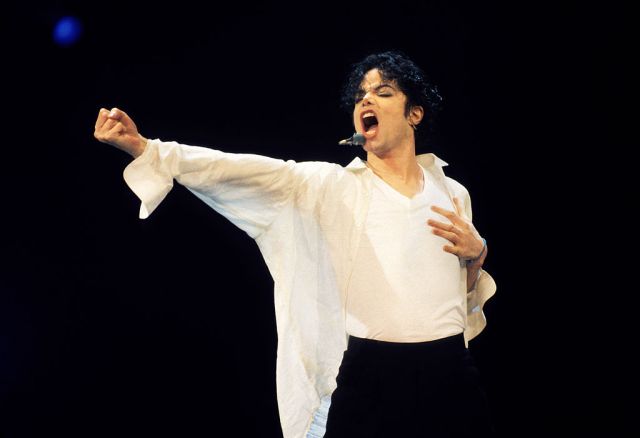
(Credit: Kevin Mazur/WireImage)





A couple of days before I saw Michael, Antoine Fuqua’s biopic about Michael Jackson, I found the movie’s “Final Trailer” on YouTube. I was moderately interested in this trailer, but what I really wanted to see were the comments, how many people were expressing simple adulation of Jackson as a musical artist and how many were bringing up the creepier stuff, the accusations of sexual abuse of young boys that shadowed the last decade-and-a-half of his life.
I did this out of genuine curiosity. I’d never gained a reliable sense of where we’d landed on this matter, as consumers and judges of pop culture. On one hand, there’s been little sustained effort to render Michael Jackson anathema, to cancel him, even though the accusations against him are numerous, and they concern offences on which the judging public is disinclined toward mercy. Yes, he was acquitted in the one trial he faced, but he’s also accused of assaulting several other boys, as recounted in Leaving Neverland, the troubling documentary series from 2019. And the things he indisputably did, like having young boys spend the night at his house and sleep with him in his bed, would mean permanent infamy for a normal celebrity. Instead, in 2022, people made a Broadway musical about Jackson — a “jukebox musical” that focused on the songs and ignored the creepy stuff altogether.
On the other hand, the name and memory of Michael Jackson are noticeably tainted. His famous songs get played in various places, but the people who play them seem to rush past the tainted name in mentioning the great music. No one’s doing lengthy digressions on the beloved genius who sang “Beat It” and “Billy Jean”. Jackson’s memory, it seems, is veiled not so much in outrage or open disgust as in careful and rigorous discretion. It’s as if the case of Michael Jackson has returned us to an earlier, less lurid era, in which — unlike our own sex-mongering, scandal-happy time — a respectable person didn’t openly discuss the seedier types of crime and folly.
Or that, anyway, is how it’s felt to me in the 17 years since Jackson died of a drug overdose administered by his personal physician. So when I started reading the comments under the trailer, wondering who would bring up the bad stuff, I figured lots of people would. But instead they made me think that I was just imagining a broader culture seized in the queasy ambivalence I felt myself. Because there was nothing about the bad stuff. I scrolled and scrolled but found no comments in which Jackson was treated like an Epstein or a Weinstein. All I saw were things like “Boy is he missed” and “There will never be another Michael Jackson!!!!!” I had to scroll through hundreds of comments before I found one that even mentioned his troubles, and that comment was entirely sympathetic, and the troubles it mentioned were totally different from the ones I was thinking of: “[W]hen he was alive they were killing his soul with rumours and talking about him being broke and bad money habits.”
Bad money habits? I honestly don’t remember any talk about Michael Jackson having bad money habits, my mental access to those biographical details obstructed, perhaps, by all the things I recalled about him allegedly molesting little boys. It seems the general public, at least as represented by those thousands of YouTube comments, has chosen a psychic strategy of repression or denial, to act as if that sexual assault stuff either doesn’t matter to us now or, perhaps, never happened, not even the allegations.
The makers of Michael chose denial as well, but not the subconscious sort of denial psychologists talk about. Theirs was a conscious, defiant sort of denial. Antoine Fuqua denies there’s anything to be ambivalent about. He denies that Jackson’s accusers are telling the truth. Of those accusers Fuqua said, “sometimes people do some nasty things for some money”. Fuqua seems to believe that Jordan Chandler, the source of the earliest allegations from 1993, was induced to lie by his parents, for money. And, to be fair to Fuqua and Jackson’s other defenders, those parents do not make the most trustworthy accusers. They won a $23 million settlement against Jackson, after which the family stopped cooperating with the prosecutors and the criminal case they initiated was dropped. Fuqua’s scepticism about Jackson’s accusers also grows from a broader belief that white America has it out for successful black people. “When I hear [accusations] about us — Black people in particular, especially in a certain position — there’s always pause,” he said.
Accordingly, and defiantly, Fuqua opened his original cut of his film with a flash-forward shot of the 1993 police raid of Jackson’s Neverland Ranch in response to the Chandler allegations, with the rest of the movie focused on his earlier conquest of the pop music world. So Fuqua’s intended version of Michael had the tragic structure he alluded to, in which black success leads to racist persecution. “I shot [Michael] being stripped naked,” Fuqua said, “treated like an animal, a monster.”
But the Chandler settlement prevented Fuqua from realising his defiant vision. After the film was shot, according to Variety, “attorneys for the Jackson estate realised there was a clause in the settlement that blocked the depiction or mention of Chandler in any movie”. Fuqua was forced to reshoot much of the film, at a reported cost of $50 million, so that the final cut carries no reference to Jordan Chandler, sexual assault, criminal persecution, or any of the other things that make up the iffy parts of Michael Jackson’s reputation. Contrary to the intentions he brought to Michael, then, Fuqua was forced to replace his defiant sort of denial with the other sort, where people pretend not to be aware of something they’re probably all aware of, subconsciously if not consciously.
But, even for someone who wants to defend Jackson against unproven allegations, it’s pretty much impossible to present his life in any detail without reminding people of those allegations — even people desperate not to be reminded. Michael contains truly touching scenes of Jackson sitting with dying children in hospital wards, but, for obvious reasons, the meaning of these scenes can’t be contained within any defensive or hagiographic framework, and so even as you’re being moved by Michael’s generous way with the child dying of cancer, your mind’s wandering to Jordan Chandler and Wade Robson and James Safechuck. There are several other scenes as well in which we see how Jackson, hemmed in by fame and terrorised by his father (Colman Domingo), relates to children in a way he can’t with anyone else but his mother, Kate (Nia Long). The film wants the viewer to sympathise with poor Michael, the genius performer forced to live this distorted life, but the viewer’s like, “Damn, there’s those little kids again.”
Of course, Fuqua’s original cut sought to order this interpretive mess preemptively, with that persecution imagery in the opening scene. It’s hard to know how well this would have worked. Perhaps it would have immunised the audience against their own unwanted thoughts, imposed a potent presumption of innocence that, among other things, justified Antoine Fuqua in directing a sympathetic movie about Michael Jackson, accused child molester. But in making that opening statement about persecution, and thereby conceding the allegations in explicit terms, Fuqua would also have raised the whole matter to the level of polemic: “If you think Michael molested those boys, then you belong with his (racist) persecutors.” I don’t think that would have made the movie more enjoyable.
And Michael is, for much of its running time, pretty enjoyable. There’s a great deal of clumsy earnestness in it, and not much wit, and Fuqua’s touch as a director is inconsistent at best, and the character of Michael Jackson is frankly unpleasant in its ominous weirdness. But, because Fuqua’s persecution framing went in the editing can, the movie is largely, and sort of naively, about Michael Jackson’s music, and Michael Jackson’s music is, of course, fantastic. The movie puts you in the seats for early Jackson 5 performances, at clubs and theatres, where you get to imagine the audience’s awe in watching the young Michael (Juliano Valdi) sing “I’ll Be There” and “ABC”. It portrays the historic partnership of the older Michael (played by Jaafar Jackson, son of Michael’s brother Jermaine) and Quincy Jones (Kendrick Sampson) at its origins, their recording of Jackson’s breakthrough solo album “Off the Wall”. It re-stages the filming of the famous “Beat It” and “Thriller” videos with a fidelity that brings to mind both liturgical Christianity and Jorge Luis Borges. For anyone who remembers those videos from MTV, these are rousing, if also eerily postmodern, scenes.
And Michael puts Jaafar Jackson through some very impressive paces in recreating Michael’s famous concerts. Handsome, gentle-voiced Jaafar really learned to dance like his superstar uncle. I found these concert scenes quite powerful, despite my efforts to keep suspicion and misgiving at the centre of my Michael experience. Michael performs “Billy Jean” at Motown’s 25th Anniversary extravaganza in 1983, inciting madness in the audience as he Moonwalks for the first time, which is an undeniably exciting thing to see faithfully recreated in a movie. Michael, rejoined by his brothers for the Victory Tour in 1986, sings “Human Nature” to a swooning crowd in Los Angeles, which is pretty irresistible. And then Michael does a fierce rendition of “Bad” for 70,000 people at Wembley Stadium in 1988, which is a real tour de force.
And that’s it. That’s the end of the movie. It’s the relatively prelapsarian year of 1988. The Jordan Chandler allegations are still half-a-decade away. Michael’s nose has been shaved down several times, but it still resembles a human nose, pretty much, and not the alien vestige it was on its way to becoming. And, crucially, it’s been close to an hour, when the movie reaches this triumphant musical conclusion, since we’ve seen Michael befriending any children. Michael leaves us with an apotheosised Michael, the abstract, mass-consumed Michael Jackson who ruled the Eighties, a phenomenon of musical talent and huge celebrity, but not really a person.
Forced to skirt the controversy about Michael Jackson the accused child molester, Fuqua inadvertently raises another, more fundamental dispute — whether we should or can separate artists from their art. I’m not going to pretend here. I don’t think there’s much of a dispute on the first matter. We should separate the artist from the art. When an artist of bad character or evil conduct leaves us with works of real beauty and greatness, it’s self-defeating and philistine to banish the art from our cultural life. To make such banishment a principal is to empower the would-be political bosses among us.
A more interesting psychological question, perhaps, is whether we can separate the art from the artist, whether we can have an experience of art purified of the damning knowledge about the artist we bring to the experience. Michael makes a strong, probably accidental case that we can. Antoine Fuqua began wanting to prove that the nasty things people said about Michael Jackson were not true, but he ended up showing that, at least as a matter of art and aesthetics, these accusations are easily set aside. In moving from Jackson’s personal formation as a quirky child prodigy to his musical triumphs of the Eighties, Michael slowly distills the suggestive personal weirdness from its portrait, and ends up staging another jukebox musical. At the end of the movie, if you want to go back to thinking about the damning stuff, you first have to wipe the smile off your face and stop tapping your toe.
But this peremptory resolution of the art/artist debate doesn’t really close the issue of what to do with this movie, or how it will land with audiences this weekend and beyond. There remains the matter betokened by Antoine Fuqua’s combative language, the counter-accusations he levels at Jackson’s accusers and anyone inclined to believe them. I attended a preview screening open to the public the day before the movie’s general release, and the audience was about 80% black, with one young black man costumed as Eighties Michael Jackson, with the turned-down porkpie hat, the silver jacket and the black slacks, the silver socks bunched over black loafers, and the glove. This was in contrast to the movie’s portrayal of Jackson’s fans and concert audiences, which were racially mixed and, indeed, predominantly white. Like those YouTube comments, it made me think that the cultural ambivalence I’ve sensed around Michael Jackson since his death is not really ambivalence. It’s just another racial division, his posthumous reputation just another racial Rorschach test, with black Americans perhaps more willing than whites to believe him innocent and, thus, readier to attend and enjoy a movie about his life and music. As someone who harbours naive dreams of a post-racial America, I find these regular Rorschach moments depressing.
But even if the ambivalence I discerned in our collective treatment of Michael Jackson is just another racial division, my own ambivalence is a real thing, informed by the art/artist matter I describe above. I might express that ambivalence in these terms: I admit to enjoying Jackson’s music when I hear it, and I don’t renounce this enjoyment, but I’m not sure we should be making toe-tapping movies about his ugly, unhappy, tragic life.