




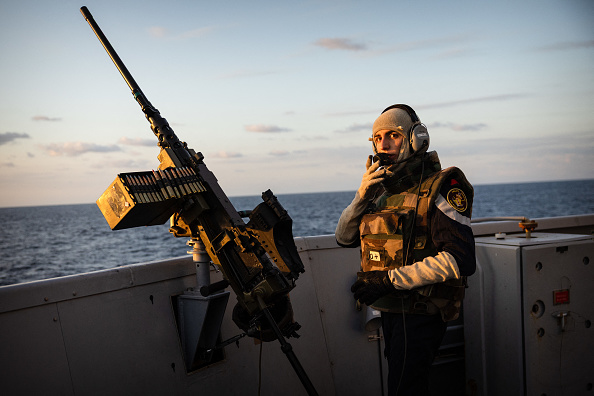
Europe’s tolerance for war deaths is lower than America’s. (Clement Mahoudeau/AFP/Getty)





“Thanks, Mr President, but no thanks.” That is what Benjamin Netanyahu should have said when Donald Trump responded to Israel’s request for “resupply priority” by intervening directly in its air assault on Iran. Israel, after all, has always craved US weapons — which were rigorously denied when they were most needed in the years before the 1967 war — but its leaders never wanted America to do any of the fighting. When, for instance, US Patriot batteries and their crews were rushed in to counter Iraqi missiles during the Gulf War, Israeli operators took over very quickly, compressing weeks of training into a matter of days.
The US has too many other interests — both in the Middle East and beyond — to be Israel’s unconstrained ally in its endless fight for survival. And then there is the sharp “post-heroic” asymmetry between the two nations. American tolerance for war casualties is certainly still higher than Europe’s, where President Macron abandoned 1.9 million square miles across the Sahel, long secured by just 5,000 French troops, to the jihadis, apparently terrified that 10 might be killed at once. When that number of French troops died on a single day in Afghanistan, President Sarkozy’s presidency was irredeemably ruined.
Since October 7, 2023, Israel has lost 1,152 soldiers without political consequence — whereas Trump would be impeached, with plenty of Republican votes, if a population-proportionate 50,732 Americans were killed while fighting Iran. The same is probably true even if that number were halved, or quartered.
More generally, meanwhile, Netanyahu should have declined Trump’s heart-warming offer to be Israel’s superpower ally because of the very same free-wheeling pragmatism that induced Trump to get involved. Pragmatism has its virtues, and so does Trump’s perpetual optimism. But there are still some unyielding realities in this world, including geographic ones. One of these is that about a fifth of the world’s oil, about a fourth of its liquid natural gas, and over 10% of its fertiliser, travels through the Strait of Hormuz.
Iran’s naval warships and submarines are no more, and even the Revolutionary Guards’ motorboats are mostly destroyed. But there are still at least 10 islands that must be denied to infiltrated Revolutionary Guard units to ensure the Persian Gulf’s navigable channels are truly safe. There are also some 1,500 miles of Iranian coastline, every mile of which must be constantly surveilled, in granular detail, to detect and destroy any anti-ship missile launcher or similar threat.
That calls for quite a lot of deployable troops — many more than the 5,000 Marines bandied about these days — with the resultant exposure to casualties. The US may be more willing to bear casualties than Europe, but each death nonetheless entails a political cost much higher than was the case during the Vietnam War, whose soldiers were born when the US fertility rate was well over 3.5. Every death is a tragedy, obviously, but losses must be even more intolerable now that few families have more than one child.
One can see why some perfectly reasonable people respond to all this by asserting the simple truth that American power is ultimately generated by its own magnificently inventive society, kept in funds by the world’s most courageous investors — European financial prudence is now the biggest obstacle to European progress — and not by anything beyond America’s shores. It is now very possible to imagine a US that is still the leading superpower, by virtue of its vastly superior technology, but without being a global power.
Abandoning the Persian Gulf to Iran’s Shia supremacists, who would quickly control the Arab side as well, would be a very long step in that direction, and there are even good excuses to assuage the shame factor. That is the “defection” of the European allies, whose very existence as independent states originated in the US decision to remain in Europe after the end of the Second World War.
This defection was already very plain last year, with the frankly astonishing refusal of most European allies to acknowledge the deadly peril of Iran’s roughly 400 kilograms of 60% enriched uranium which, as the director general of the International Atomic Energy Agency patiently explained at the time, would allow Iran to produce at least 10 fission bombs in short order.
Yet when dozens of Israeli fighter bombers — and seven US B-2 stealth bombers — demolished Iran’s nuclear installations on 25 June last year, there was no outburst of gratitude across European capitals, each of which would otherwise have had to contend with nuclear-armed Revolutionary Guards, whose willingness to kill tens of thousands of their own citizens suggests a readiness to kill hundreds of thousands or millions of Western unbelievers.
But there was no applause, no gratitude, no support — only more “anti-colonial” polemics against Israel, and even more anti-American resentment, as if the conjunction of nuclear weapons with fanatics waiting for the return of the Twelfth Imam and the “end of history” were not a danger unprecedented in history.
This time around, when Israel’s aim was to prevent its own destruction from a gigantic barrage of Iranian missiles, by attacking missile factories and underground storage sites, and the US aim was to destroy the headquarters and depots of the Revolutionary Guards and their murderous Basij militia, with the faint hope of an uprising, the response was not just a lack of gratitude. It was outright sabotage through the denial of access to US bases or the prohibition of overflights. The first defector was Pedro Sánchez, Spain’s impeccably elegant bourgeois prime minister, who rules his country by herding over a dozen Leftist and regional separatist parties in coalition.
It was not that Sánchez denied the support of his country’s armed forces — which feature such wonders as a pair of proudly Spanish-made submarines that cost as much as nuclear subs, and an army which has 150 generals for perhaps 4,000 combat-ready soldiers. What Sanchez denied was the use of the Rota naval station, and the Torrejón and Morón airbases, important for US deployments to the Middle East as the first refuelling stops after crossing the Atlantic.
President Macron, who long ago gave up his attempt to modernise France, followed by also denying US military overflights and, more ambitiously, trying to deny freight overflights carrying cargo for US bases. Even Giorgia Meloni — the same one who kept flying to Palm Beach to seek favour at Trump’s court — denied the use of the Sigonella airbase in Sicily.
The British government has been altogether more cooperative, quietly allowing unfettered use of US fighters stationed at RAF Lakenheath, and also the use of RAF Fairford with its especially long runways for the refuelling transits of US bombers. Even so, Britain farcically demanded the right to approve individual targets; as if they were not routinely switched in the course of operations.
Trump’s reaction to the performative anti-Americanism of Sánchez, Macron and Meloni has an extra edge. But even Americans who intensely dislike Trump understand that a new elite anti-Americanism now exists across Europe, an embittered reaction to its glaring failure to keep up with US innovation. Yet now that the US has left Iran without an airforce or a navy, Trump has invited the Europeans — the very countries that need oil and gas from the Gulf — to send their own armed forces to secure the Strait. At the very least, they can gain recompense from the Arab states that Iran attacked.
Professor Edward Luttwak is a strategist and historian known for his works on grand strategy, geoeconomics, military history, and international relations.
 ELuttwak