




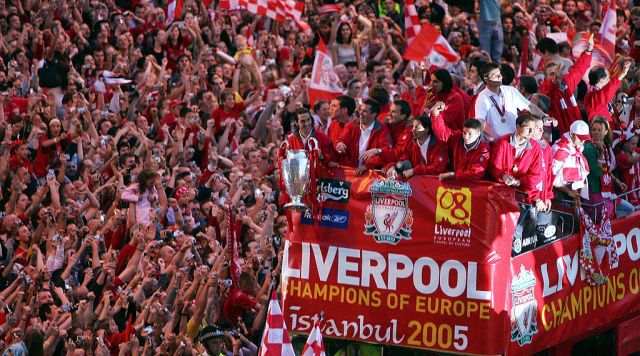
The Liverpool team after their 2005 victory. (Scott Barbour/Getty Images)





The Champions League semi-finals start this evening. I haven’t a clue what this means, but it provides a convenient starting point for a few reflections on sport and exercise. Being in my early eighties, I attribute this modest degree of longevity to a strict avoidance of all forms of physical exercise. The odd bout of debauchery has also been a help. I remember being wheeled around in a push chair as an infant and vowing to prolong this way of life into old age. The only sport in which I’ve ever indulged is the odd game of dominoes outside French cafes, which I’ve usually had to follow up with a few hours’ rest. They say that golf spoils a good walk, but for me all sport ruins a good lie down. It’s much the same with food. The various exhortations to diet by which we’re besieged, the grim warnings against strokes and heart attacks, are clearly the work of the deep state, which is out to starve to death as many of us as possible so as to relieve the burden on the National Health Service.
It’s true that under severe marital pressure I once took to visiting a gym. After a year of grudgingly lifting weights and hanging like an inverted bat from wall bars, the only perceptible difference to my body was a slight increase in the circumference of my calves. So I jacked it in and returned to debauchery and six-course meals heavy in carbohydrates, all of which made me feel a lot more lithe and sprightly. Exercise can be fatal to your health. Having spent a lifetime high on various kinds of dope, Jerry Garcia of The Grateful Dead was arm-twisted into going to a gym, where he did a few sit-ups and promptly dropped dead.
My churlish attitude to sport is shaped by childhood experience. A sickly, waif-like creature, I was forced to play rugby at school and opted to be a winger, which meant I could race purposefully up and down the touchline avoiding the ball. Over time, I developed the technique of appearing to play rugby but not actually doing so with a virtuosity far superior to those whose heads were stuck in the scrum. At the end of a game, the captain would clap me on the back with a gruff “Well done, Eagleton”, having mistaken taking flight for taking part. Afterwards I would sleep for a day. It’s remarkable how exhausting not playing rugby can be.
There have been moments, however, when I was proud to be mistaken for an athletic type. I was once in a swimming pool in the United States (I don’t know why, since I can’t swim) when two young boys approached me and asked “Are you a lifeguard, sir?” No doubt they needed a lifeguard present if they were to swim. I conceded rather reluctantly that I wasn’t but returned to my hotel glowing with quiet pride. Being mistaken for a lifeguard seemed second only to being mistaken for Tom Cruise.
So there’s something to be said for sport after all. In fact, it’s hard to think of a brand of popular culture which has such universal appeal as football, yet which combines this mass devotion with such magnificent displays of artistry. According to most theories of 20th-century culture, this isn’t supposed to happen. Instead, culture is sharply polarised between high and low, the former being unintelligible to the latter and the latter being contemptible to the former. Not much manages to slip over this well-policed frontier. There’s Shostakovich on the one hand and the Sun newspaper on the other. Yet football dismantles this opposition. It pulls in millions of ordinary men and women, yet also offers a dazzling display of talent which at times can touch on genius. No other cultural form can equal it in this respect.
It is, in fact, a form of secular religion, vastly more popular than the churches, with its own pantheon of saints, demi-gods, collective rituals, communal ecstasy and time-honoured ceremonies. In the United States, the religious fervour surrounding sport borders on the pathological: no political speech is possible without a sprinkling of sporting metaphors. One day when I’ve nothing better to do I might find out what a slam dunk is, since it occurs about as often in American speech as the phrase “proud Americans”. (I know what a slam dunk means, but not what it is.) As for Britain, if you want to bring the place to its knees, ban all football games immediately. The result would be an outbreak of social disruption not far short of revolution. Governments would be toppled, public buildings would be razed to the ground and supporters’ clubs would take over the running of Whitehall.
In reality, football is a cunning way of heading off such turmoil, not of creating it. All ruling classes are aware that it’s not only bread but circuses that keep the common people content. Theatre, pageantry and spectacle are crucial ways of keeping governments in power, siphoning off energies which might otherwise prove troublesome. Much of this today is known as television, rather as for the ancient Romans it was called gladiatorial combat; but football offers a great deal more than TV.
For one thing, it allows every plumber and taxi driver in the country to be an expert. People who might have trouble in spelling “fortuitous” can make the subtlest of judgements on whether a player is minimally off-side, or whether someone who’s playing mid-field should be moved upfront. They could also probably tell you when their club last played Everton, and what the score was. In a society for which the past is largely irrelevant unless you can package it as “heritage”, football helps to sustain the idea of tradition. You are heir to a heritage which stretches back far beyond your birth. Not many young Mancunians know who Harold Macmillan or Harold Wilson were, but a lot of them know about Matt Busby and George Best.
Football also allows people an experience of solidarity in a social order sorely lacking in it. It’s true that like many forms of solidarity, this can involve a collective hostility to others. Could there be Celtic without Rangers? But there’s more to it than that. A demonstration is a crowd of men and women united by a common goal — to drive out immigrants, for example, or protest against a war. A football crowd, like an audience at the London Philharmonic, is united simply by a shared love of what they’re witnessing, and that affection is intensified by the knowledge that thousands of others are feeling it too. It’s true that a lot of players are grotesquely overpaid, but many of them would probably want to do what they do even if they weren’t so grossly over-recompensed, which is more than you can say about sausage manufacturers.
Football is a form of collective celebration which includes an appreciation of the individual — of the defensive agility of one player or the strategic sense of another. Besides, football clubs can be the focal point of local identity, in the way that supermarkets or the town hall can’t be. Even those who’ve never been to a game in their lives may well see the club as in some way symbolic of their city. All this, to be sure, has been much diminished by the absorption of the sport into corporate capitalism, a scandal which has politicised many an outraged fan. The obvious solution is that clubs should be owned and controlled by their patrons, not by avaricious overseas businessmen who wouldn’t know a free kick from a throw-in.
When did I last go to a soccer game? Maybe 70 years ago. I haven’t ever played the game myself, since as I began by saying I have principled moral objections to physical exercise. If others want to shorten their lives by chasing a ball, doing 50 press-ups a day or indulging in other potentially suicidal activities, that’s up to them. This isn’t a popular view in a society which makes a fetish of the body. We live in a culture in which you bear your body around with you like a sickeningly fragile piece of china which might shatter at any moment. In a postmodern world in which people insist on being themselves, one treats the body as though it were someone else’s. One thinks of the unctuous Mr Pecksniff of Dickens’s Martin Chuzzlewit, warming his hands at the fire as benevolently as if they belonged to a friend. It’s a self-alienation implicit in the phrase “to put something in your body”, as if it were an icebox or a paper bag. You mustn’t put a vaccine in your body, for example, even if failing to do so may inflict a painful death on others. Having to take an aspirin can trigger a panic attack in some young people. A meal becomes as complex, potentially as lethal an operation as defusing a landmine. Judiciously selected items are occasionally placed in the body with scrupulous care, an activity once known as eating. We become custodians of our bodies, attending to their every whim like those of some imperious aunt or querulously demanding pet.
Postmodern bodies also demand their own sealed-off spaces. It’s a far cry from the libidinal riot of medieval carnival, where it could prove hard to say where one body ended and another began. Some people today say “excuse me” if they come within five yards of you. Smoking is forbidden not only because it can kill you but because smoke violates other people’s space. It constitutes a lethal, almost invisible link between them. It won’t be long before we walk around zipped up in astronaut suits and communicating only by radios built into our helmets. Hygiene is a posh word for not interacting with others. In this context, football reminds us of the other meaning of the word “body”, namely a mass of men and women who assemble together either for some practical purpose or just for collective enjoyment. It’s the people’s theatre or concert hall. Which doesn’t mean that I’ll be watching the Champions League any time soon…