




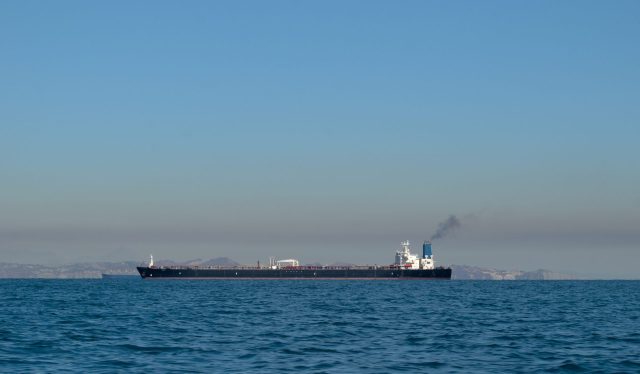
I have been stranded in the Strait of Hormuz for 46 days. (German Vogel/Getty)





I have worked on board tankers for almost 20 years, which means that difficult situations are nothing new. I’ve encountered difficult captains, old vessels, and truly exhausting voyages across incredible distances. I’ve experienced bullying and harassment, and even been uncomfortably close to piracy. At a port in Nigeria, I once loaded a tanker while pirates raided ships within miles of us; and I passed through the Gulf of Aden, which connects the Mediterranean to the Indian Ocean, in 2008, when its security corridor was in its infancy. As we sailed, my crewmates and I could see the pirate skiffs prowling, waiting for a ship to hijack.
But the Strait of Hormuz crisis is something else entirely. The Strait is still blockaded, meaning that about 20,000 seafarers are stranded on more than 1,600 vessels. I am one of those seafarers: a senior officer currently on board a loaded supertanker. We have been stuck in the Persian Gulf since 28 February.
Since then, we have endured nearly 50 days of military planes passing by, of drones flying and being shot down. Sometimes debris hits a fellow tanker. We’ve heard explosions near and far, and sighted fires in the distance. Sighted from afar, those fires might be on the shore or on offshore platforms; it’s hard to tell. But on one occasion, there was no ambiguity. On 31 March, when the Al Salmi oil tanker was hit by an Iranian drone while at anchor in Dubai, we were close enough to see the fire unfold in real time.
It was a privileged view, in a sense, but a disturbing one. Because supertankers are designed to carry crude oil, on-board fires are extremely dangerous. I couldn’t ignore the fact that what happened to the Al Salmi could have happened to us. Watching it burn felt like looking into a mirror.
But work must go on, even when we’re at anchor. We’ve had to continue our routine jobs, such as navigational watches — the bridge is manned 24 hours a day, even at anchor — machinery maintenance, and cleaning. One of the few things that’s changed is the amount of maintenance we do on deck. In the interest of safety, we are largely limiting the area we cover to the part of the deck closest to the accommodation area, so that nobody gets stranded outdoors should danger arise. Those of us who carry out these on-deck duties do so in pairs while carrying an ultra-high frequency radio.
We will probably remain at anchor, carrying out these duties, for a long time. We have provisions and fuel, both provided by the shipping company we’re working for. As for drinking water, we have desalination equipment on board the ship, so we’re not going thirsty. We know of other crews who don’t have even those basics. The idea of crossing the Strait of Hormuz, where we would risk being attacked ourselves, is much scarier than continuing to wait.
But waiting has its own downsides. We are frightened, and we are busy, yet we are also bored. Long voyages are always liable to get boring, but when a ship is at anchor, the boredom — for some subconscious reason — becomes more intense. I’m reading a lot, watching TV when our satellite internet allows, and following the news. My crewmates sometimes fish or work out. But it’s not enough; the crew is tired and mentally unwell.
The reactions to the stress of this situation vary, and by now I’ve seen everything: from inappropriate jokes and needless arguing to grown men crying and a full-blown panic attack. All the crew are facing their own demons while sitting here, waiting. And for every crew member here, there is a group of people on shore facing their own worries, frustrations and fears of having their loved ones stuck here. I know my family has been worrying about me.
Since we’re in a warzone, my crewmates and I are on double pay. Even so, we are fighting hard to sign off and be relieved by other seafarers. We were not given a choice to be stranded here. Those who replace us, if they decide to come, will have made that choice. We all have the right to refuse to sail, but as long as the Strait of Hormuz remains closed to mainstream companies, there is really no commercial pressure to get the vessel to sail and therefore no reason for our employer to relieve us. That makes the vessel effectively a prison.
The last time anything like this happened was the Covid pandemic, when seafarers were kept on board for months with no access to shore. At least back then there was no risk of drone attacks. But it was still a difficult time for us, and it seems that nothing has really changed. We are still treated partly as hostages, partly as mythically resilient beings, the backbone of the world, who will endure everything for the sake of bringing the cargo to shore.
But we are humans: we are fragile, we have families, and we are dependent on others — in our case, the shore personnel who top up our supplies and are supposed to keep us safe. An office worker ends their day, closes the computer and leaves work to go home. We want to do the same, either at the end of our contracts or if we are put in a situation so dangerous, and so far beyond our control, that we don’t wish to continue.
To help us cope with the situation, our employer has provided mental health resources, helplines and live chats, all of which can provide momentary relief. But therapy relies on knowing someone, on trust building between the patient and the doctor, whereas these helplines are like speaking to a stranger. I doubt that, once our contracts are up, we’ll be given much help. I fear that a lot of what we have experienced here will take months or years to wash away.
I have to remind myself that, up till now, I’ve almost always enjoyed my job. It’s challenging, it pays well, it gives you a lot of time off – about four to six months each year. It’s an office with an amazing view, and it’s a chance to see other countries and to connect with people from other cultures. After all the time I’ve spent nurturing this career, I want to reach the top, to become a captain.
But this is the first time that I’ve had to seriously re-examine my choice of becoming a seafarer. It feels as if my company has no empathy, or even shame, because it is keeping its employees on board against their will in a situation that could actually kill us. I don’t want to stop being a seafarer, but if things go on like this I’ll have to: partly for the sake of my safety, but mostly for the sake of my dignity.
Naturally, I’m following the news non-stop. Our supertanker is a small part of a surreal moment in history. We’re not on shore in Iran or Lebanon, where war is a constant reality, but we’re in a position a little like the eye of the hurricane.
But this hurricane is man-made. I dislike Trump immensely; I also dislike Iran’s regime immensely. I tend to see this war as an unwanted attack from a bully country, while still at the negotiation table, with very little understanding of the consequences of its actions. There are no right sides in this war, all have done terrible things, and in the end, no one will win.
As for me and my crewmates, what we need above all else is clarity: a plan from our employer as to when we will be relieved. Not knowing, silence, is a terrible poison to have on board a ship. Now that a ceasefire is in place, I feel that we have a window of opportunity in which to get people out and in. Our fear is that if the Strait remains closed, and attacks resume on airports and other infrastructure, then we will be stuck here much longer than the weeks that have already elapsed.