




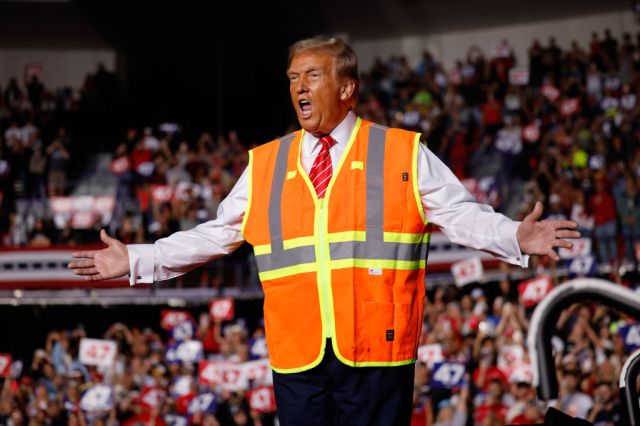
Trump affects loyalty to the working class. But is it genuine? (Chip Somodevilla/Getty)





In the bleak final chapter of Orwell’s Animal Farm, the animals look through the farmhouse window, and can no longer distinguish the pigs from the humans they originally overthrew. Somehow, by degrees, the pigs have found themselves reproducing the very conditions that prompted their uprising in the first place.
By now, some of the Right-wing radicals in Trump’s MAGA coalition must be likewise wondering what it was all for. Trump was going to end foreign military adventures, and clamp down on low-wage and illegal immigration. But now America appears to be two weeks into a war of choice in the Middle East, and has just announced plans to ease restrictions on the H2A visa, which allows American farms to hire foreign seasonal workers.
How did we end up here again? The whole point of Trump, to his base, was supposed to be ending forever wars and clamping down on immigration. And in fairness, Trump really has reduced American expenditure in Ukraine, and has been more effective than his predecessor on some aspects of migration. Notably, Trump has reduced crossings at America’s southern border by an order of magnitude.
But his administration’s attempts to find, detain, and deport those already in the US have been more of a mixed bag. The White House boasts of over 600,000 deported and a further 1.9 million “self-deporting”, claiming negative net migration to the USA in 2025 for the first time in 50 years. But other policies have been less effective — or had more impact in the media than on actual numbers. Notably, high-profile standoffs between ICE officials, migrants, and protesters across progressive strongholds such as Minneapolis and Los Angeles have been received with distaste everywhere except inside the Right-wing filter bubble, especially after the deaths of Renée Good and Alex Pretti.
This combative approach arguably did more to catalyse domestic opposition to immigration enforcement than to deport migrants. Critics have pointed out that Barack Obama managed to do more actual deporting over his presidency than Trump has to date, without all the “security theatre” and controversy.
But if the argument has focused on ICE, Trump’s real sticky wicket is low-wage labour. I’m just about old enough to remember when the Left considered immigration a workers’ rights issue, and Left-wing old-timers such as Bernie Sanders can still sometimes be found pointing out that the biggest beneficiaries of mass migration are the corporations that use foreign labour to depress domestic wages. In this context, as Matt Stoller noted recently, a leader whose goal really was mass deportations might begin not with high-profile street raids, but by quietly targeting the corporations that employ illegal workers. And yet, under Trump there has been much hue and cry about criminals, and considerably less about raiding construction firms, warehouses, or farms.
Against this mixed report card, recent changes to seasonal worker visa rules have been received with outrage by Trump’s migration-restrictionist base. And no wonder: last year, Trump officials promised a “100% American” workforce enjoying “higher wages and better benefits”, and a deportation programme with “no amnesty” for farmworkers. So why is he reneging on this now?
It’s perhaps fairer to see this policy as evidence not of betrayal but of a wicked problem — one that is, in truth, faced by most Western economies. The technical term for the dilemma is “Baumol’s cost disease”, which describes the way productivity doesn’t increase at the same pace, in every sector. This causes problems over time, as even low-productivity sectors still have to raise wages, unless they want all their workers to leave. This means that wages in sectors where work can’t easily be automated either become increasingly unaffordable, or else the sector itself becomes bizarrely costly.
Classic examples are healthcare, childcare, and education. The high-touch human component in such work can’t easily be automated, and because of this has become increasingly cost-pressured and expensive over time. But the same dynamic also applies to some aspects of food production, especially where a task is routine but also requires delicacy and human judgement. Across agriculture in general, innovation has rendered many kinds of work much more efficient; but while you can do this with ploughing or crop irrigation, it’s much more difficult to do the same thing to (say) harvesting strawberries.
Here, Baumol’s cost disease is rampant. So what is a farmer to do when national average wages have risen to the point where it costs more to pay strawberry-pickers than you can earn selling the strawberries? The answer, latterly, has increasingly been migrant workers from countries with lower wage expectations. Fruit-picking robots do exist, but not every farmer has a spare £150,000. And in any case that pays a lot of wages — especially where these are low-wage foreign seasonal workers, or illegal migrants willing to work cash in hand for a pittance.
Already last year, as Trump’s border reforms began to bite, American Big Ag was warning last year that Americans would not be willing to do this work. This is sometimes treated as excuse-making, or expressing contempt for native populations. But a more neutral explanation is that farmers can only afford to pay wages at a level well below what would be necessary for subsistence in modern America. And as they’re not offering this, Americans don’t want the work. This is Baumol’s cost disease in a nutshell.
The only way to change this would be to increase farmworkers’ wages sharply, which would in turn either mean farms went bankrupt or the price of food would have to go up. Perhaps unwisely, last year the New York Times tackled this dilemma by warning that Trump’s border policies would end up by forcing up the price of avocados, prompting much derision about coastal libs and their luxury problems. But the core of the argument stands even for those who don’t care for guacamole; after all, pushing up the cost of farm labour and thus of farm produce, doesn’t just affect avocados. It affects the whole grocery basket, for everyone. And while it’s possible to get by without eating avocados, it’s not possible to get by without eating. And along with ending forever wars and lowering immigration, the third leg in Trump’s electoral stool was tackling the cost of living. This is not compatible with doubling the cost of a weekly grocery shop by tossing a bomb into the economics of farming.
This is all now further complicated by Trump’s war in Iran. Trump insists — or at least, insisted in February — that inflation is falling. His media opponents disagreed even then; since the war in Iran began, oil prices have fluctuated so dizzyingly that many economists have given up trying to make predictions beyond a weary expectation that the overall effect is likely to be inflation.
As a major energy producer, the United States is somewhat insulated from these effects, at least by comparison with Europe. But petrol and diesel prices have risen in the USA as well, with knock-on effects throughout the economy. We can assume that this will in turn push the cost of living in the wrong direction for ordinary Americans. And we can perhaps understand that Trump might be reluctant to pile further misery on his electorate by clamping down on the only relief available to the cost-diseased fruit picking sector — foreign seasonal workers — and thus spiking the cost of living still further.
Animal Farm is usually read as a warning about the theory and practice of communist revolution. But perhaps Trump’s looming failure on all three legs of the MAGA electoral stool — wars, migration, and prices — points to a still bleaker reading about the futility of revolutions full stop. After all, even though prices and low-wage immigration seem linked by the wicked dilemma of Baumol’s cost disease, bombing Iran would seem, at least to an outsider, to be optional.
Indeed Trump campaigned on not taking this option. And yet here he is, again. Meanwhile the sheer variety of half-baked Trumpian rationales offered so far for the attack suggests he’s just decided to do it, and is throwing explanations at the electorate in the hope that one will stick.
It is tempting to conclude either that he’s bonkers, or that a reason for the attack exists which is not available to the general public, and that perhaps wouldn’t be accepted if it was made known — but which, once you’re in the driving seat, is inescapable. This is the only possible explanation for the way presidency after presidency ends up in the same place, and the same conflicts, even after insisting they won’t.
Would it be fair to say, in the pigs’ defence, that the structural pressures of their role in the overall farm nudged them, by degrees, into patterns of behaviour that increasingly resembled the humans they deposed? Is that an excuse, or just an explanation? Either way, it bodes ill for any putative future revolutionaries hoping to seize the machinery of some state or other, and point it in new directions — including every populist government-in-waiting currently aspiring to emulate Trump by reforming, restoring, advancing, or otherwise making their own country great again.
For if such dilemmas exist, then even the most well-intentioned pig will, once he takes the role of the farmer, eventually become him. In this sense, the New Right’s revolutionaries have discovered, unhappily, that you can’t both promise lower food prices and also lower migration without eventually disappointing someone. Similarly, it seems at least possible that comparable wicked problems exist in foreign policy, such that bombing Iran seems as necessary and prudent from inside the White House as it seems from without a reckless betrayal of the base.
But in a sense, too, we should hope that this bleak reading of Animal Farm is true. For the only other possible explanation is bleaker still: that Trump simply doesn’t care about his base, and perhaps never really did.
