




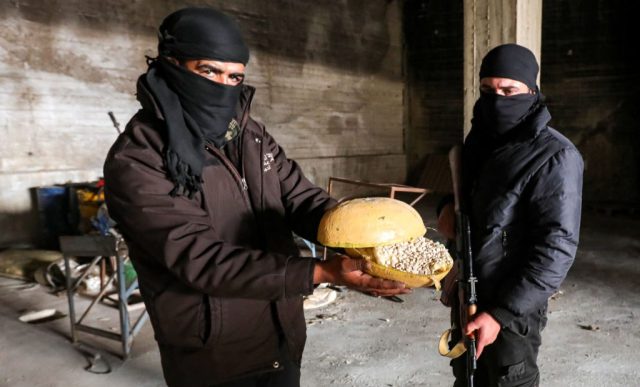
Syria’s anti-drug officers behave more like militiamen than drug-busting law enforcers, their Kalashnikovs hanging by their sides. (Bakr Alkasem/AFP/Getty)





I was meant to be shadowing the anti-drug squad. But when I call my contact in the Syrian government, as I huddle by the stove in my Damascus flat, there’s only bad news. “We’re overwhelmed,” he says apologetically, explaining that the unit I was meant to follow is busy fighting Kurds in the north. Before that, they were busy again, working to ensure that the revolution’s anniversary wasn’t disrupted by ISIS. Syria’s drug squads, in many ways, aren’t trained counter-narcotics officers at all. They’d started out as soldiers and rebels — and only later were drawn into anti-drug work. Even now, they behave more like militiamen than drug-busting law enforcers, their Kalashnikovs hanging loosely by their sides.
Almost 18 months after Bashar al-Assad fled into exile, such frantic improvisation is unsurprising. It’s also necessary. For if, by its end, his Baathist regime had transformed the country into a virtual narco-state, whose products surfaced in ports from Rotterdam and Genoa, the Syrian drug trade is alive and kicking. Indeed, one of the civil war’s most enduring legacies is that Assad’s former country has now become a major transit and drug hub, not just in Europe but across Asia and Africa too, encompassing narcotics as varied as crystal meth and liquid cocaine.
Yet it’s Captagon that truly keeps Syria’s drug empire afloat. Offering a blend of euphoria and detachment, the stimulant is popular among young Gulf club-goers and overstretched medical students seeking an edge in their exams. Over time, it’s become one of the country’s most lucrative exports. As he visits London for the first time today, President Ahmed al-Sharaa will doubtless parade a new Syria, one primed for investment and revived Western contact. The truth, though, is that Syria has become a legal black hole, a place where drugs can disappear, before reappearing elsewhere with little law enforcement scrutiny. That matters: not only for Syria and its own fragile future, but also for the region, Europe and the wider world.
Before the revolution, drugs weren’t really part of Syria’s story. There was cannabis, of course, grown in pockets around Baalbek, Homs and Latakia, and peddled by small-time gangsters and Hezbollah. But overall, Syria wasn’t known as a drug-exporting state, while dealers themselves were dealt with harshly. I remember living in a Damascus suburb and seeing funerals for local dealers who’d been killed in shootouts with police. Then, young men would smoke cigarettes like chimneys (they still do), and might have the odd drink, but it was rare to hear of drug-taking. There was a special stigma attached to its use. Captagon, for its part, was virtually unheard of. Syria did not present itself, to its neighbours, to Europe, or to its own citizens, as a country whose most lucrative export was narcotics.
Then came the war, and it turned Bashar al-Assad into a narco boss with a country attached. Captagon’s appeal isn’t hard to grasp. Over the past decade, parts of the Middle East — particularly the Gulf — have experienced a gradual loosening of social and religious restrictions. Among a young, affluent population with disposable income, ample free time, and a growing appetite for entertainment, the inexpensive stimulant has found a ready market. Easy to manufacture, easy to package, easy to move, it requires no fields, seasons or harvests.
All a would-be kingpin needs are chemical precursors — usually a mixture of amphetamines, caffeine and various fillers — alongside machinery and protection. As Assad was crushed by sanctions and the demands of an insatiable war machine, Captagon production proved to be an invaluable financial lifeline. By this stage, the regime boasted a growing ecosystem of militias and businessmen who propped up what remained of the hollowed-out state. Only trouble was, they all needed paying, and Captagon was the answer. And since the regime was now involved, they could manufacture most of those chemicals themselves, or else import them under official cover, attracting little scrutiny about their intended use. Importers like Eyad Lahham and former MPs like Amer Tayseer Kheiti were in on the racket, as was Assad’s brother Maher, who added drug running to his list of dubious accolades. Reports suggest that the Assads legally imported chemicals from India before producing Captagon from a disused potato-chip factory in the Damascus suburb of Douma.
At first, the Assad regime denied any connection to the drug. Its appearance was instead blamed on ISIS, with the “jihadi drug” supposedly used by fighters to remain calm in battle. On 1 July 2020, Italian police seized 14 tonnes of Captagon in Salerno, a port south of Naples, and initially seemed inclined to believe the shipment was indeed intended to fund ISIS. The Italians also explored links between the Islamists and the Neapolitan Camorra. No Camorra-ISIS connection was ever substantiated. What is known, though, is that one of Europe’s biggest drug traffickers, with Camorra ties, was arrested by Hayat Tahrir al-Sham — al-Sharaa’s former outfit — while attempting to cross into regime-held territory in 2022.
Assad-linked networks were, by then, the drug’s main manufacturers and exporters. Maher al-Assad is again a case in point: his notorious Fourth Armoured Division got so rich of Captagon that it reportedly maintained an $80 million cash reserve at a time when the average Syrian was surviving on just $2 a day. Maher and his associates meanwhile flaunted their wealth — supercars, watches, funds parked safely abroad — embodying the stark inequality that Assad’s narco-economy had created. All the while, this bonanza offered opportunities for ordinary Syrians. A young soldier might supplement his poor salary; a Bedouin school kid, instead of going to school, could smuggle Captagon and earn $1,000 a day.
The profits, then, were simply too hard to ignore. But so too is the social impact it’s wrought. Some weeks ago, while visiting friends in the war-scarred city of Raqqa — the former de facto capital of ISIS — my host warned me not to leave belongings in the car. Anything left behind, he said, would likely be stolen and sold to finance an addict’s drug habit. A UN employee from the city, speaking on condition of anonymity, describes the situation as an epidemic. Things are exacerbated, he adds, by the Syrian Democratic Forces (SDF), a group of mostly Kurdish fighters, whose personnel turn a blind eye to trafficking — and allegedly take a cut of the action.
In this, al-Sharaa is surely an improvement. His new government celebrated the end of the trade, partly for propaganda reasons but also sincerely. For Muslims in general, and Islamists in particular, drugs aren’t just criminal but impious. Mere weeks after his victory, in the grand setting of the Umayyad Mosque in Damascus no less, al-Sharaa announced the end of “the largest Captagon factory in the world” to a rapt audience.
All that was ultimately dismantled, however, was the regime-era infrastructure; a decentralised “cottage” industry of smaller players remain. Logistics is on their side. From there, consignments are moved towards Jordan using smuggling tactics that sound like folklore until you meet the men tasked with stopping them, with everything from livestock to drones used to hide the drugs. The real key, though, is to secure the networks through which you can move your goods — and those criminal networks didn’t go away when Assad fell.
The point, here, is that Syria’s narco-state didn’t disappear. Rather, it decentralised, its remnants scattering and grouping in enclaves where government control was weakest. Many former regime producers, as analyst Charles Lister has noted, fled to join the area controlled by Sheikh Hikmat al-Hijri, the de facto ruler and spiritual head of the Druze community in Suwayda. From 2018, the Assad regime allowed the province, not far from the Jordanian border, a degree of self-rule and a free hand in Captagon. For Hijri, handing over power to Damascus would effectively cut off the trade that funded both his militias and the autonomy they implied. Following his split from Damascus last year, and the creation of an independent enclave closely aligned to Israel, Hijri has emerged leader of what one expert calls a “narco-statelet” — one far closer to cartel-run corners of Mexico than any imagined Druze utopia.
The Damascus authorities are hardly blind to this reality. But the fact remains that anti-drug campaigns are overstretched, under-resourced and often improvisational. Yet again, this can partly be explained by the 2024 revolution. Many experienced law-enforcement officers fled after Assad’s fall. In some areas, policing has since fallen to young local men, often without much training. Responsibility for counter-narcotics rests largely with the Interior Ministry and a security apparatus still being built, all while confronting more immediate threats. The result is a nationwide game of whack-a-mole, with raids, seizures, shootouts and occasional successes — followed by the reappearance of dealers elsewhere.
Meanwhile, officials I speak to describe increasingly sophisticated smuggling methods, from hidden tunnels to the sea route via Latakia. Scarcity has driven up prices; tighter restrictions have paradoxically made Captagon more lucrative. The trade adapts because, once more, its incentives are structural. According to the World Bank, extreme poverty still affects one in four Syrians, and with basic services like electricity eye-wateringly expensive, drugs remain a tempting option. That’s clear enough online. In forums I follow, there’s a lively trade between punters and traders, discussing prices, routes and volumes with the casual tone of men selling spare parts. Sometimes an odd request for a gun or cocaine is thrown in with a picture, and the trader asks for the buyer to DM him. Users sometimes upload images to show they’ve picked up their stashes, their dealer responding with a jaunty thumbs-up emoji.
What becomes evident from these conversations is that Captagon’s reach extends far beyond the Levant or even Europe, and now encompasses far-off East Africa and the Ivory Coast. One network, operating laboratory facilities in Turkey, shared wholesale prices that illustrate this reach. A million pills were apparently sold for around $150,000, with smaller batches priced in neat increments.
And if the Syrian trade was made by Captagon, there are ominous signs that diversification is the order of the day. That Turkish network doesn’t only deal in Captagon, but also heroin, Tramadol, Ritalin, Modafinil, Lyrica, hashish and crystal meth. Of course, not every claim made online is necessarily true. But that matters less than what these claims reveal: traffickers now think globally, because the market itself is global.
Given all this, how can the authorities respond? Beyond ad hoc raids — officials recently seized a major shipment of liquid cocaine from the port at Latakia — one senior Syrian official I speak to is sceptical. Dismantling an industry built over a decade and a half, he suggests, would take two or three years of sustained effort. What with its global spread, even that estimate may be optimistic. To be fair, there are now signs of cross-border cooperation, like when the Jordanian airforce recently bombed Captagon supply lines in Suwayda. More than that, though, the Syrians themselves need help: both technical support and investment.
After all, places like Suwayda rely on Captagon because of political or militia power — but also because of poverty. And if Syria and the international community aren’t careful, this small pill may yet prove more destabilising than anything the region has seen, like a modern Pied Piper, luring its youth with the promise of oblivion. Add the networks expanding across Europe and we may soon find Captagon on the streets of Britain. Whatever al-Sharaa might claim, Syria’s civil war isn’t over yet.
Tam Hussein is an award winning investigative journalist and writer. His work has been recognised by the Royal Television Society Awards.
 tamhussein