




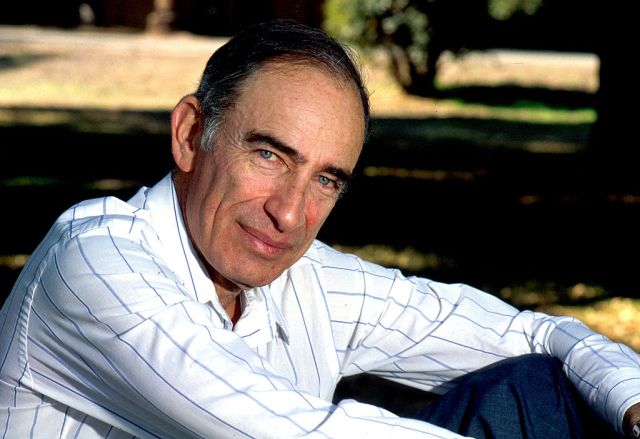
Public intellectual Paul R. Ehrlich’s mistakes have been influential. Credit: Getty





I’m something of a rarity: a liberal who is worried about declining birth rates across the West. I look at a rapidly aging and longer-living population with smaller and smaller birth cohorts, and see a future in which social spending buckles under top-heavy entitlement programs; workers struggle in sluggish economies; schools and libraries are forced to close or decay in the face of shrinking tax bases; and the national soul is harmed as more and more individuals fail to realize their desired family size.
In recent years, concerns about declining family formation and fertility have spread to some respectable center-Left quarters. Yet liberals like me still find ourselves marooned on a small opinion island. One big reason for that is the work of the biologist Paul R. Ehrlich, who died over the weekend, aged 93. Ehrlich’s anti-birth, anti-human ideology continues to shadow every conversation about demographic change.
Originally a bee specialist, Ehrlich was the author of the 1968 runaway best-seller The Population Bomb. The book argued that Earth had far too many humans, and that widespread, brutal famine was inevitable as a result; as the front cover blared in all-caps, humanity faced a choice between “POPULATION CONTROL OR RACE TO OBLIVION.” Thanks to such thinking, the bulk of American liberals, and some conservatives, remain convinced that fewer humans are better.
Ehrlich was catastrophically wrong, of course: since the book’s publication, the global population has swelled by nearly 5 billion, and no worldwide famine ensued. Ehrlich simply misunderstood the forces at play. By the time he was writing, global birth rates had already peaked and begun to dip due to growing prosperity, urbanization, and girls’ education. Major technological advances in agriculture, meanwhile, allowed for far greater crop yields, thus forestalling mass starvation.
Even so, his ideas inspired millions of forced sterilizations in India, Peru, and other countries. Americans and Europeans, meanwhile, live with a more diffuse fallout: it is exceedingly difficult to have a productive conversation about birth rates despite the US fertility decline reaching historic levels, and nations like Italy and Spain facing rates so low that each successive generational cohort will be around half the size of its predecessor.
Without an intentional effort to clean up the damage wrought by The Population Bomb, it will be nearly impossible to have a needed national conversation about births, and how we can create the conditions for as many people as possible to form the families they want, which, for many Americans, are larger than they actually have.
It’s worth reviewing Ehrlich’s actual words, which have over time become glossed into a general sense that the world is overpopulated and that overpopulation is bad. In the opening passage of the first chapter, he wrote, “I have understood the population explosion intellectually for a long time. I came to understand it emotionally one stinking hot night in Delhi a few years ago. My wife and daughter and I were returning to our hotel in an ancient taxi. The seats were hopping with fleas. The only functional gear was third. As we crawled through the city, we entered a crowded slum area. The temperature was well over 100, and the air was a haze of dust and smoke.”
Ehrlich went on: “The streets seemed alive with people. People eating, people washing, people sleeping. People visiting, arguing, and screaming. People thrusting their hands through the taxi window, begging. People defecating and urinating. People clinging to buses. People herding animals. People, people, people, people. … The problems of Delhi and Calcutta are our problems, too. Americans have helped create them; we help to prevent their solution. We must all learn to identify with the plight of our less fortunate fellows on Spaceship Earth if we are to help both of them and ourselves to survive.”
Ehrlich, in short, found teeming human life itself repulsive, and the lives of the poor, especially, as unworthy to live. His suggested solutions were decidedly radical: he wrote in the book’s prologue that “our position requires that we take immediate action at home and promote effective action worldwide. We must have population control at home, hopefully through a system of incentives and penalties, but by compulsion if voluntary methods fail.” By way of incentives and penalties, Ehrlich proposed levying a tax on American families for each child they had, rising rapidly from the third child onward; instituting luxury taxes on cribs and diapers; and offering “responsibility prizes” for married couples that went five or more years without having a child, or who opted for a vasectomy for the male partner.
Ehrlich bemoaned the fact that simply putting “temporary sterilants” into the US water supply wasn’t an option “open to us” due to technical challenges and inevitable political opposition. He didn’t even consider the moral downsides; indeed, Ehrlich wished that the West had “applied pressure on the Indian government” to implement a minister’s plan to coercively sterilize men with three children. This was not merely hyperbolic writing. Ehrlich repeated these types of assertions regularly. In a 1970 TV interview, he suggested that the Federal Communications Commission “see to it that large families are always treated in a negative light on television.”
Yet Ehrlich’s ideas didn’t repulse most Americans: instead, the charismatic, well-spoken biologist became a public intellectual of the highest rank. The Population Bomb sold more than two million copies, going through 20 reprints within the first three years of publication. Ehrlich appeared more than 20 times on The Tonight Show with Johnny Carson, won a MacArthur Foundation “genius grant” in 1990, testified repeatedly before Congress, and advised governments around the world. The environmental movement and its backers took up his ideas practically as orthodoxy.
This influence didn’t diminish even as events debunked Ehrlich’s predictions, and Ehrlich never recanted. On the contrary, he doubled down in his later years, despite the obvious failure of his predictions, telling The New York Times in 2015 that “my language would be even more apocalyptic today.”
While The Population Bomb has been subject to many academic critiques over the years, the lay public has rarely heard them. Instead, many ordinary people have been raised on similar nonsense, promoted by pop scientists like Bill Nye, whose show Bill Nye Saves The World featured an episode titled “Earth’s People Problem.” Hollywood, too, has often served as a conduit for Ehrlich-ite fantasies: witness the whales heading up the Hudson River in Avengers: Endgame, representative of Nature healing itself, after half the planet’s population is removed by a supervillain. Insofar as most people think at all about population dynamics, their instinct is that too many people is the problem, not too few.
Is it any surprise, then, that Americans are largely blasé about the declining birth rate? In a 2025 AP-NORC poll, only 28% said that the declining birth rate was a “major problem,” while a separate Pew poll found a majority of Democrats and a substantial minority of Republicans think that fewer births would either be neutral or positive for the country. One can get a glimpse into how Population Bomb-pilled the public remains by looking at Letters to the Editor from a recent New York Times piece on the birth rate: “What is more selfish?” one letter writer asks. “Restraining an urge to reproduce or having children for self-actualization on an Earth already beyond its carrying capacity?”
We shouldn’t, of course, lay the entirety of the blame at Paul Ehrlich’s feet. The so-called “pronatalist” movement does itself no favors by associating with racists and misogynists. Nor can a conversation about births be divorced from a conversation about reproductive freedoms. There is a reason why The Handmaid’s Tale costumes became a symbol of the first anti-Trump #Resistance. But Ehrlich-ism, when combined with legitimate concern with women’s rights, creates a powerful brew — and it is difficult to see clearly through the fumes.
What’s needed, then, is an intentional effort to acknowledge the mental models about population that many people hold, and to guide them to a more frank picture. That means those of us on the Left need to have honest conversations with our ideological peers, finding ways to communicate demographic truths through social and mass media. At the same time, those on the Right need to stop casting liberal reluctance to address birth rates as some inherent anti-family conceit; the negative polarization is supremely unhelpful.
As researcher Emily Klancher Merchant put it in her book on manufactured population panic, “it is only by recognizing that the anxiety we feel about future population growth is learned and not obvious that we can see that population growth itself is not a barrier to economic, environmental, and reproductive justice. Rather, it is our anxiety about population growth that distracts us from the pursuit of those urgent goals.” Loudly and publicly rejecting The Population Bomb is the best way to defuse it.