




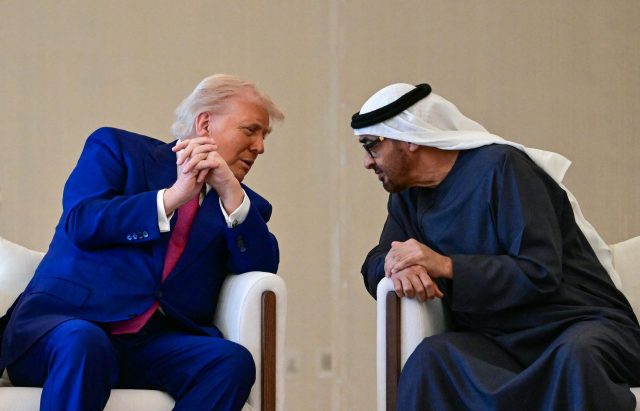
‘The UAE has a clear narrative: they did not want or ask for Trump’s war.’ (Giuseppe Cacace/ Getty)





Nowhere has war in the Persian Gulf shattered illusions quite like Dubai. After spending decades creating the impression it was an oasis of calm in a desert of conflict, this gauche, new-money city is now best-known as the tax haven from hell.
In truth, though, the erstwhile “Pearl of the Gulf” was always far more complex. Its rulers long envisaged themselves as leading a kind of Arab Switzerland, and with the UAE’s expansive and secretive finance industry, and its large population of foreign guest workers, you have to say they’ve succeeded. But where they haven’t succeeded — where, in fact, they now risk destroying the country’s whole future — is on foreign policy. For unlike the Swiss and their well-honed neutrality, the UAE has enmeshed itself in conflicts all over the region, along the way making for itself a prodigious list of enemies. And now, with their own territory under attack, they may finally be reaping what they long sowed abroad.
The United Arab Emirates is a fairly young country, and one new to the world stage. Founded in 1971 from the embers of the British Empire, it’s formed of seven semi-autonomous emirates, their respective emirs forming a Federal Supreme Council. In truth, though, the country is dominated by the two richest and most populous: by convention the Council’s president is always the Emir of Abu Dhabi, while its vice president and prime minister is the Emir of Dubai. Just as telling, the sovereign wealth funds of both these Emirates control enormous conglomerates, initially funded by oil revenue, and which are involved in a dizzying array of businesses at home and abroad. The most important of these is probably DP World, the Dubai logistics company that’s also one of the world’s largest port operators. The line between these powerful “private” businesses and the state is more or less a legal fiction.
Through the proceeds, Dubai has made itself an international city with all the style and class of Las Vegas, albeit minus the vice. It has the world’s tallest skyscraper; an indoor ski slope; man-made islands meant to look like a world map, but which were never developed and thus are returning to the sea. By reputation, the city is filled with influencers, young Russian “models”, digital nomads of all stripes, as well as various war profiteers and exiles. If, however, a recent Washington Post article refers to the city as an “oasis for business and partying” — the truth is that the great majority of Dubai’s population are foreign workers. Some are Western professionals, yes, but many more are South Asian Muslims in low-skilled jobs. In other words, the majority of people in the UAE are not spending their time partying, and indeed Muslims are banned from buying alcohol.
It’s commonly claimed that these workers are mistreated. Yet if abuse surely happens, the sheer number of foreigners who do make the trip suggests they know what they’re getting themselves into. Zakir Hussein, the younger brother of Saleh Ahmed, a 55-year-old Bangladeshi driver who was killed by missile debris, told the Guardian that following his brother’s death he did not want to return to the UAE. “But,” he added, “Dubai is the only place we know how to earn.” The scale of this is large enough that not just their families, but their countries depend on it: the World Bank estimates that remittances from the country to India, Pakistan, and the Philippines reached $47.5 billion in 2024. Besides, if you follow the law and don’t have a problem with living outside a liberal democracy, Dubai is safe and things work properly, certainly compared to the dysfunctional South Asian cities many migrants arrived from.
Yet beyond the labour laws, the ultimate myth of the UAE centres on its neutrality. The country received plenty of attention, for instance, when it refused to participate in sanctions against Russia following the invasion of Ukraine. For its part, a 2023 report from The Wilson Center fretted that the country was “non-aligned with a tilt towards China”. Yet while the country does attempt a balanced approach towards the world powers, the reality is that the UAE is a US treaty ally, hosting the Al Dhafra airbase outside of Abu Dhabi, home to 5,000 military personnel. Further, Dubai’s Jebel Ali port, though not technically a military base, is the US Navy’s largest port of call in the Middle East and commonly used by aircraft carriers. Little wonder the US State Department described the UAE as “vital” to supporting the country’s interests as late as last year.
More than this American connection, though, the UAE aggressively pursues what it says are its interests across the wider Middle East. As far back as 2011, it was a direct participant in the intervention against Muammar Gaddafi in Libya. In the aftermath, it then supported the regime of General Haftar, something that continues despite Emirati claims to the contrary. The UAE has also made enemies from Syria to Sudan, in the latter case backing General Dagalo and his Rapid Support Forces, both accused of genocide by the Biden administration. In Somalia, meanwhile, the Emiratis have entirely fallen out with the government over their support of the separatist enclave of Somaliland. The only recent intervention with any obvious national security connection to the UAE itself is Yemen, where they joined Saudi Arabia in its decade long war against the Houthis. Yet here, again, the Emiratis seem erratic at best, backing the so-called Southern Transitional Council — only for it to be defeated by a Saudi-backed alternative just days later.
The point of this hyperactive foreign policy is not entirely clear: besides a lust for gold and glory. Abu Dhabi and Dubai, after all, are both effectively private governments run by wildly wealthy businessmen. And if that explains the country’s glitzy domestic development — from man-made islands to ski slopes in the desert — its foreign stance might be understood in similar terms. To quote Dr Andreas Krieg, an expert on UAE foreign policy, the country seems to want the following: “Strategic depth, relevance, strategic autonomy, indispensability, access to resources, regional broker and hub.” In other words, the Emiratis want it all, and with basically unlimited funds they think they can get it.
Yet this frantic foreign policy is hardly without consequences. Tanzania’s Maasai tribesmen aren’t much of a threat — even if the UAE finally succeeds in taking enough of their land to build a big game hunting resort — but some of the country’s new enemies are dangerous indeed. Consider Yemen. Though it largely went unnoticed at time, when the Houthis were attacking Red Sea shipping last year, with the stated aim of harming Israel, they were also hurting their old enemy the Emiratis: who control many of the ports in the Red Sea and the so-called Suez Canal Economic Zone.
Meanwhile, the UAE has drawn the ire of anti-Zionists the world over for signing the Abraham Accords. Its relationship with Israel is overplayed, yet it has taken a reputational hit for maintaining relations with Israel throughout the Gaza War. At the same time, the UAE has what can only be described as an obsession with the Muslim Brotherhood, which it calls a terrorist organisation, and which seems to stem more from the Brotherhood’s republicanism than its Islamism. Again, this arguably hints at the way in which the country’s absolutist style intrudes into government: what the emirs fear is less ideology per se, and more the threat of modern politics to their feudal, personal system of rule.
Either way, all this offers a stark contrast to the UAE’s self-cultivated image of a safe and reasonable country. Though they can certainly justify the US alliance in the name of stability, and can’t be held responsible for this current war, it is enough to make some people second-guess their vision for the country. To be fair, I don’t think that the “Dubai Dream” is dead, as so many have proclaimed. The UAE has a clear narrative here: that they did not want or ask for Trump’s war, even if they now seem to be returning to form and demanding the US secures the Strait of Hormuz by force, while imprisoning Westerners for breaching security laws by taking photographs of drone and missile attacks.
It seems obvious, then, that despite their pronouncements of loyalty to the US, genuine neutrality might have served the UAE well. And as for the future? If there should be a major terrorist attack citing as its cause the UAE’s actions in Africa, or its “support” of Israel, it may cause citizens and guest workers alike to more seriously examine the country’s record. Just last summer, both the US and Britain issued warnings calling terrorist attacks in the UAE “very likely”. What’s more, in a society made largely of lower-class Muslim foreigners, it is nearly impossible to fully guard against radicalisation. As in other aspects of the Dubai model, it’s increasingly clear that money can’t buy you everything, particularly when your guarantor is as erratic as Donald Trump.