




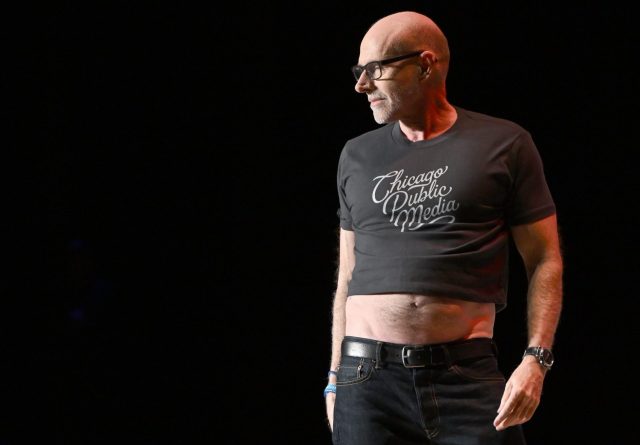
‘Big-dick energy isn’t just a nice idea; it’s fucking mandatory.’ (Daniel Boczarski/ Getty)





For years, people have been chasing a unicorn. “What if Jordan Peterson, but liberal?”, they whispered; what if there might come a messiah who would explode the “manosphere”, banish to the realm of fiction the bloodcurdling realities depicted in the documentary Adolescence (2025), and cure the world’s ills? The surprise is that it took so long for the liberal Jordan Peterson to reveal himself. The crown was lying in the gutter, and Scott Galloway has picked it up.
Galloway — investor, entrepreneur, blogger, professor, public intellectual — is as inescapable now as Peterson was in his heyday. The Washington Post bills him as one of the people shaping American society in 2026. He rears his bald head often on Instagram and TikTok; his voice is a mainstay on the podcast circuit. “I’m good at being right”, he tells Chris Williamson on Modern Wisdom; “I’m not good at being effective”. Galloway was first propelled into the spotlight back when he used to teach a brand strategy course at NYU’s Stern School of Business; to become more effective, he has created a brand of his own.
Brand Galloway promises to make young men fitter, happier, more attractive to women. Indeed, his advice is markedly similar to Peterson’s: show up early, have good manners, be a protector. Rather, the difference between Peterson’s “clean up your room, bucko” and Galloway’s “get your shit together”, is one of tone, not substance. The difference reveals something interesting about the two sides of the American culture war: conservatives want their gurus to dress up their life advice in Jungian psychoanalysis and confused allusions to the Book of Genesis; liberals want theirs to be sweary management professors who speak in the language of McKinsey slides — hardly the stuff to keep kids flocking back over the long term.
Before Galloway was a lifestyle guru, he was a finance guru — and reviewing his career, one might reasonably ask why his advice now ought to carry much weight. After all, his knack for bad analysis once caused him to become the butt of the joke. A few years ago, some finance wags came up with the Anti-Galloway Index, allowing punters to earn their fortune by betting against Galloway’s predictions. Since October 2019, the Index tells us, “tech companies that the Professor has predicted would fail have outperformed the S&P 500 and seen a whopping 61.48% return”. The greater part of this was due to the continued growth of Tesla, on which Galloway’s powers of prediction are clouded by personal animus. Galloway believes, incidentally, that Elon Musk has locked him out of X.
Galloway has long presented himself as the enemy of Musk and his ilk. In The Four, published in 2017, he made the case for breaking up Big Tech. Today he speaks with revulsion about those Silicon Valley CEOs who’ve prostrated themselves before the Trump administration, and has launched a campaign against them, called “Resist and Unsubscribe”. Recently, he seriously weighed up running for the presidency.
Life advice is the continuation of politics by other means. Galloway’s tips are spliced with political calls to action — for free education, housing reform, even national service along the lines of the IDF. These are tucked away in his books, hidden beneath a pile of snippets of fortune-cookie wisdom. His works of self-help have big font on small pages; the chapter headings often take the form of equations, like “Credentials + Zip Code = Money”, or “Car < Lion” (which means that you should invest in experiences over things). According to Galloway arithmetic, “1 + 1 > 2”. Instead of just using the English language to tell young men to drink less, we get a picture of a martini = sad face emoji. Perhaps this helps the message stick in the minds of his audience. Peterson, it must be said, always expected slightly more from his readers.
Why, then, is Galloway so popular? Why, given he once said that “taking life advice from a depressed and insane professor may not make sense”, does he get feted by liberal stalwarts on both sides of the Atlantic? The answer is simple: for all the mockery he gets from himself and from others, in truth he is one of life’s winners. He looks and sounds the part. He’s six-foot-two, well-dressed and well-spoken. He has that air of competence. Plenty of his business ventures have failed, but enough of them have succeeded. He owns a townhouse in London by Regent’s Park, a home in Florida, and a sumptuous Manhattan apartment. He reckons his lifestyle costs him $350,000 to $425,000 a month.
Peterson’s earthly successes occurred after his pivot from academia to self-help; Galloway’s were present before. The point of Peterson’s “12 rules for life” was not that young men might, by adhering to them, become more like him (and, certainly, Peterson nowadays seldom takes heed of his tenth rule: “Be precise in your speech”). With Galloway, it’s different. His breezy references to his own personal shortcomings are part of that air of humility which successful people are expected to cultivate. He knows that young men would quite like to enjoy a lifestyle that costs $350,000 to $425,000 a month. The object of Brand Galloway is to mentor young men into becoming more like Scott Galloway. In this respect, his way of keeping his audience captivated has more in common with Andrew Tate than Jordan Peterson: he is selling them his own story, a story of success with money and with women.
His story is much enhanced by its rags-to-riches element. His parents got divorced and his mum was poor; he talked his way into UCLA, despite bad grades, where he smoked weed, memorised every line of Planet of the Apes, and “majored and minored in horniness”. When he speaks of his success, he is always careful to underscore — herein his woke credentials — that he won the lottery by being born a white heterosexual male in California, and that this allowed him, along with some good old-fashioned elbow grease, to climb up the ladder. He doesn’t drop his guard on matters intersectional: when expressing concerns about the plight of young men, he is eager to add that the issues and challenges that they face are “especially acute among young men of colour”. He doesn’t believe in God, and therefore hasn’t followed Peterson down the torturous path of mystical and metaphysical speculation. Still, he prays as a mark of gratitude, especially for his mother and family. “The reason I am wealthy”, he recently told Esquire, “can be distilled down to one word: women“.
Galloway has thought hard about how his own successes can be translated into general life lessons. Everything in the Galloway universe exists to impart lessons; life is one grand preparation for that job interview where you’re asked about what challenges you’ve overcome. He pays his children to do chores, to instil them with a hunger for work; and then sometimes he mugs them on the way back to their room, “as that, too, is a life lesson”. Everybody in the Galloway universe speaks the way he does, in a series of catchy and obnoxious made-up names for complex human experiences. During the breakdown of his first marriage, he visited a counsellor, who asked him: “What city do you want to live in, Marrytown or Singletown?”. This sparked an epiphany. He had already set up shop in Singletown.
A tough-love tone permeates Galloway’s latest meditation on masculinity, Notes on Being a Man. “When Germans or Russians are streaming over the border or firing from the beach”, he declares, “big-dick energy isn’t just a nice idea; it’s fucking mandatory”. Peterson, of course, was never quite so crude. But more than that, Galloway’s point is undercut by a certain mawkishness: for it appears that one can grow one’s big-dick energy, according to Galloway, by being kind. Masculinity, moreover, is perfectly compatible with vulnerability. Like Peterson, and like much pop culture directed at young men in the last decade, Galloway is a passionate evangelist for crying. Unlike Peterson, however, he knows to hold himself together in public. It is hard, in fact, to imagine him crying, even though he says he does so often. It is so incongruous with what is ultimately a conventional, alpha persona.
And yet, despite the macho self-presentation, the title on the front cover of Notes on Being a Man appears in a noticeably feminine hand, with rounded curves and flowing loops. Here, perhaps, a clue as to how its publishers have imagined its typical buyer. “My biggest fans are young men”, Galloway tells Triggernometry; “my biggest supporters are mothers”.
The problem for Brand Galloway is this: young men do not want to read things their mums approve of. They would want to read Page 3 or Nuts Magazine, if only they still existed; nowadays they seem to content themselves with Clavicular, Nick Fuentes, Hasan Piker — and Andrew Tate, who Galloway so tentatively tried to mimic. Jordan Peterson could compete, for a time, but only because he was supposed to be subversive. It never mattered that he was telling young men what their mothers were telling them already — clean up your room!; he was popular, in the end, because he was “controversial”, went against the current on trans and gender issues, and totally OWNED Cathy Newman. There was a certain frisson to Peterson at his peak, a frisson which Galloway is unlikely to match — whatever his current popularity with the Guardian or the The Washington Post. The lady in Adolescence was never going to direct the boy in her charge to 12 Rules for Life, but it’s easy to imagine her enthusing about Notes on Being a Man. Much of Galloway’s advice for young men is right, but, in the spirit of the Anti-Galloway Index, you should bet against it being effective. The liberal Jordan Peterson eluded us for so long because it was always a contradiction in terms.
