




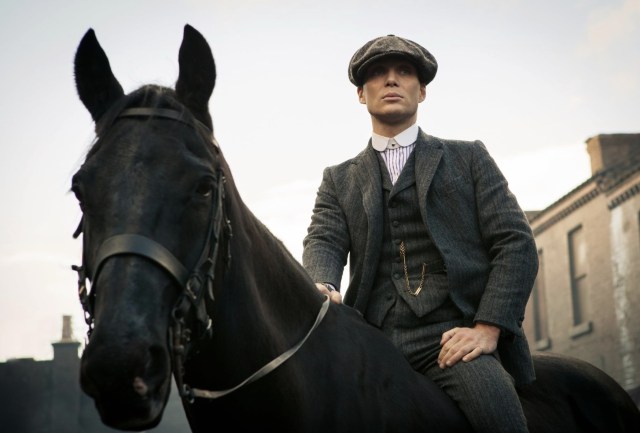
‘The film’s real victim is Birmingham, with the town trapped in an endless nightmare of flat caps and razor blades.’ (IMDB)





“Heil fucking Hitler!” The first line of the new Peaky Blinders film lets the audience know right away that it’s about Nazis — with all the subtlety of Raiders of the Lost Ark. The Mcguffin this time is not some ancient artefact, but millions of pounds in counterfeit money, with which the Third Reich plans to destabilise the country. But as much as the fate of British democracy, the film makes a casualty of Birmingham, with the town increasingly trapped in an endless nightmare of flat caps and razor blades.
It’s undeniable that Steven Knight’s creation — on both big screen and small — has brought investment and tourism to what remains England’s second-poorest local authority. The Japanese ambassador dressed in a peaked cap on a recent visit, and the show has offered opportunities for fan groups to reclaim their working-class identities. Nor does Peaky Blinders’s influence end at Birmingham’s limits. There’s a “Peaky Blinders” unit of the Ukrainian army, while in far-off Afghanistan the Taliban censured four men for dressing in costumes inspired by the show.
This influence is unsurprising. From The Godfather to the Kray Twins, gangsters have always made marketable anti-heroes. What’s not to love about immigrants escaping poverty, creating riches from organised crime, the oppressed becoming the oppressor? Naturally, the banal, brutal reality of gangsterism and its impact on victims isn’t entertaining or sexy, and so is neatly ignored. The same is true of Peaky Blinders. In reality, Birmingham’s gangs were disbanded by the First World War, and were anyway always more street thugs than globetrotting criminal masterminds. Even the titular blinder is apocryphal: early Birmingham criminals wore something closer to bowlers, with these “billycock hats” popular among the city’s working-class Irish diaspora. No razor blades were involved.
More than that, Birmingham’s demography has always been about far more than gangs. This, after all, is a town built on immigrant labour. My own great-grandparents were Ukrainian Jewish refugees who arrived here at the turn of the 20th century. I grew up in a cross-cultural environment, and married into the Birmingham Irish community in the early 2000s. The culture of my in-laws was hardly unfamiliar: like the city’s Jews, Birmingham’s Irish arrived to find work, escaping famine and hardship, and have long contributed to life in the West Midlands. They built factories and canals in the 19th century, and founded pubs in the 20th, while the second- or third-generation Irish Brummies keep the culture thriving.
There are darker connotations here too. Even today, Birmingham lives in the long shadow of the Birmingham pub bombings, especially now that Gerry Adams — who in 2004 said he “regrets” the blasts — is in the news once more. Locals still recall stories of that grim night in 1974. My dad had been in a nearby pub when it happened, and I’ve got friends who were caught up in the blast at the cinema next door. Anti-Irish sentiment in the city soon skyrocketed. Catholic schools held special assemblies to try and calm tensions, and the subsequent grotesque miscarriage of justice for the Birmingham Six forced non-Irish Brummies into a reckoning of conscience.
That perhaps explains why Irish Birmingham enjoyed such a renaissance through the Nineties. The St Patrick’s Day Parade —suspended for two decades — returned as a major event and grew to be the third biggest on Earth: until the cash-strapped council shut it down. Digbeth, long the city’s unofficial Irish quarter, was famous for its boozers, family places with names like The Spotted Dog and Hennessey’s Bar.
As that last one implies, this revival often came with stereotypes, from foam leprechaun hats to fake ginger beards. To that extent, at least, the Peaky Blinders flat caps are nothing new. Nor are Irish Brummies the only cartoon-ified community in Knight’s extended universe. Consider his movie’s Roma characters. Barry Keoghan’s Duke is a mass of uncontrolled violence, feeding victims to pigs and commandeering weapons meant for British troops. Kaulo, Duke’s aunt, is that other lazy stereotype: the magical sexy gypsy, who communicates with ghosts, uses sex to break a curse, and floats about mysteriously, all wild hair and whispers.
And if, like the Birmingham Irish, there’s a blurred line between cinema and the city streets — Birmingham City fans long blamed their team’s failures on a “curse” placed on the team’s stadium when Roma settlers were evicted to build it — neither Duke nor Kaulo do justice to the city’s genuine Roma history.
Reaching Europe from India via Egypt (hence the name), Roma Gypsies first arrived in England in 1505: after being banished from countries across Europe. They were banned here, too, due to distrust of their Catholicism and a general fear of foreignness. By 1554, thanks to the so-called Egyptian Act, simply being Roma was enough to get the death penalty. Some evaded capture or were sheltered by sympathetic residents, and over the next two centuries made a living however they could, becoming by necessity a secretive group.
In 1783 the Egyptian Act was repealed — after the diaspora finally started to be understood — though the 1824 Vagrancy Act specifically targeted Roma Gypsies in an attempt to close their settlements. Still, the travellers endured. And, by the 20th century, they’d become an established part of Birmingham’s cultural scene, providing labour or entertainment at events like Aston’s Onion Fair. A celebration centred on Michaelmas, and attracting thousands of spectators, the Roma wowed visitors with their boxing, horses and travelling menageries.
By the Second World War, Roma were designated racial enemies by Hitler, with perhaps 500,000 exterminated in the so-called Porajmos (“Devouring”). In the aftermath, and unlike Jews, Roma were excluded from postwar reparations; remarkably, the West German government argued the community was persecuted not because of their race but because they were criminals. There is no clear data on Birmingham’s current Roma population — but the 2021 census suggests 1,833 locals identified as “White Roma”, the first time the category was included. And, perhaps because they now encompass such a small minority, anti-gypsy sentiments live on in Birmingham, not least around their supposed dishonesty.
Even sympathetic observers slump into stereotype too. To promote his film, Knight did an “ask me anything” on Reddit, where a fan asked about his knowledge of the Roma. The writer’s response? That his research came from attending horse fairs with his blacksmith father as a child: a neat explanation of why, in the film’s closing scene, Tommy Shelby literally declares himself a horse. Yet like their Celtic counterparts, there is another, truer community of Brummie Roma. Certainly, that’s hinted at in the Council’s Birmingham Development Plan. It identifies the need for an additional eight pitches for “Gypsies, Travellers and Travelling Showpeople” by 2031, recognising that a lack of space negatively impacts their wellbeing, and causes conflict with landowners.
These days, of course, Birmingham’s Irish and Roma communities are relatively small, with discourse in the city more often centred on its large and growing South Asian population. While Peaky Blinders offers glimmers of these older diasporas — and provides the city’s tourism board with much-needed attention — the real Workshop of the World has better tales to tell.