




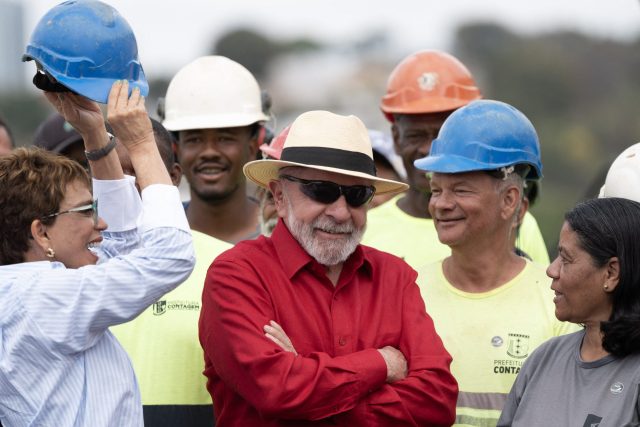
Lula poses with workers. (Credit: Douglas Magno / AFP via Getty Images)





Comebacks are perilous things in politics. So many of them end in disappointment or tragedy. In his new book on the leader of Brazil’s Left for half a century, Lula! The Man, the Myth and a Dream of Latin America, Richard Lapper runs down the list of towering political figures who stumbled on their return to the stage — or else were violently pushed off: Winston Churchill, Sweden’s Olof Palme, India’s Indira Gandhi, Argentina’s Juan Perón, Brazil’s own Getúlio Vargas in the Forties.
Luiz Inácio Lula da Silva, who turned 80 last year, took his chances when he ran for president in 2022 against Jair Bolsonaro and won by a whisker. It was a remarkable renaissance: he had gone from wildly popular as president in the 2000s to jail in the late 2010s with his party in tatters. But he was given far less room to manoeuvre this time, and while it seemed for much of last year that he would coast to victory and a fourth term in office in elections this October, now polls show him tied with Bolsonaro’s son Flávio. There is still time for him to end up as a Brazilian Biden.
Regardless of how his career ends, Lula will be remembered as an epochal figure by his enemies as much as his friends. While his politics were forged in the great social transformations and political shifts of Brazil’s 20th century, it was in the first decades of the 21st that he left his own mark on the country.
Lula was born in 1945, in the scorched hamlet of Caetés on the edge of Brazil’s northeastern sertão, a drought-stricken world little altered in many ways since the 17th century. When he was seven years old, he and his family joined the millions from their part of the country who migrated to the industrialising southeast of the country in the mid-century. This great movement of rural people from Brazil’s poorest region to its richest — and from the area most shaped by the legacy of plantation slavery to one defined more by recent European immigration — mirrored a simultaneous shift in the US: the Great Migration of black Americans from the South to the factories of the Midwest and Northeast.
Dropped into the “hellish cauldron” of the workers’ shanty towns of greater São Paulo, Lula lost a finger operating a lathe and rose to the presidency of a metalworkers’ union that made history with a bold strike under the military dictatorship in the Seventies. His wife died, eight months pregnant, of undiagnosed hepatitis. His communist brother was tortured by the secret police. And the Workers’ Party (PT) that he helped found in 1980 took shape amid the legendary stuff of 20th-century Latin American history: the guerrilla fighters and radical priests of the Sixties and Seventies. The story of Lula’s rise has almost the character of a picaresque novel — with the caveat that he built his career not on the street smarts of the pícaro, but on a combination of stubbornness and openness to negotiation he learned in the union hall.
It’s ironic, for a party so often tarred in recent years as communist and anti-family by a rising Christian politics of the Right, that it was the Catholic Church that gave the PT its start. Founded in 1980 as a non-communist labour party under constrained elections during the military dictatorship, the PT spread from the car factories of the São Paulo suburbs by taking advantage of groups like the Mothers’ Clubs — where upper-class women taught poor mothers how to knit — that the church had organised during the period of pastoral verve and laity mobilisation that followed the Second Vatican Council. No other organisation, public or private, had networks that went into so many poor areas. But soon, the PT did, too.
As the party grew, it picked up survivors from the guerrilla movements of the Sixties and early Seventies, which had failed completely to win support from rural populations and were easily and brutally destroyed by the military dictatorship. Many of these veterans of the armed struggle took surprisingly well to Lula’s pragmatic attitude, bent less on revolution than on winning more for workers and the poor.
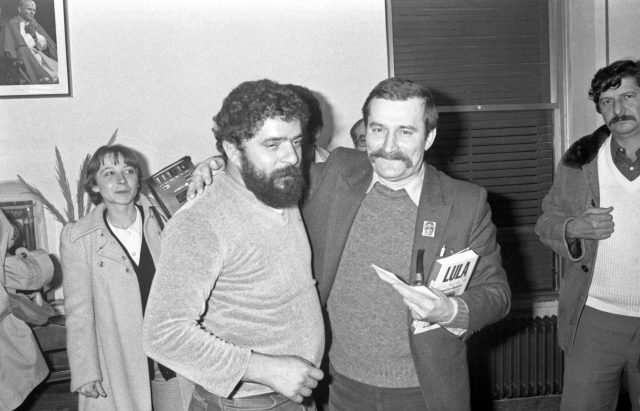
After the end of Brazil’s military dictatorship, in the late Eighties the PT began winning important mayoral elections, burnishing its credentials as a party that could govern. And it added new elements to its political portfolio, including environmental causes, such as the struggle of rubber tappers’ unions in the Amazon, represented by union leader Chico Mendes, to fend off illegal loggers.
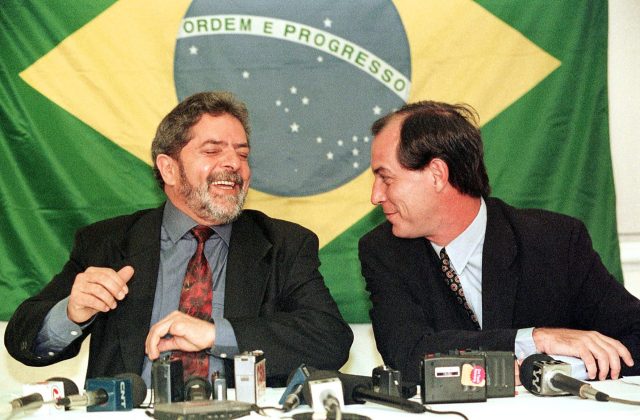
In the early Nineties, Brazilian politics looked almost proto-Trumpian. President Fernando Collor was a flashily wealthy leader whose lifestyle had a certain aspirational appeal, and his political style involved creating and then abandoning successive controversies. But after Collor resigned in 1992, Brazilian politics became a contest of a sort that would strike envy into Left-of-centre hearts in the developed world: one between the market-friendly social democracy of Fernando Henrique Cardoso (president 1995–2003) and the more old-fashioned, state-centric Leftism of Lula — as if elections were fought between Blair and Benn, or Clinton and Sanders, Lapper argues.
By the turn of the millennium, pundits were dismissing three-time presidential loser Lula as a relic of a vanished age of strong unions and strong states, in an age when privatisation was a kind of religion for political elites. He proved them wrong in 2002 when he beat Cardoso’s handpicked successor. Amid a commodity boom powered by the rise of China, he oversaw the expansion of social programmes — cash transfers for poor families and university scholarships are some of the best-known — that lifted millions from poverty without making sweeping changes to Brazil’s economic model. That, plus his success in combating deforestation, made Lula a global celebrity, drawing envious comments from Barack Obama.
Still, as Lapper notes, drawing on work by Brazilian sociologist André Singer, there was a grain of truth in the idea that Lula’s old-school social-democratic union politics was a mismatch with what was possible in the 2000s. Between his first term and his second, the core of Lula’s base shifted from the heavily industrialised southeast to the poor northeast, where a “subproletariat” showed its gratitude for the cash from social programmes and newly available credit. As Lapper writes:
“Visiting poor areas in the north-east of Brazil ahead of the [2006] election it was easy to find enthusiastic support for Lula. ‘Lula is the only one who’s done anything for the poor,’ Ivandro Santos, a 33-year-old street trader told me, as he sold fruit juice and coxinhas — a minced chicken savoury — in a run-down corner of Itapuã. He, his wife, and their two children were receiving monthly payments under Bolsa Família and other income-transfer programmes. Helenita Santana, who earned a couple of hundred dollars a month working as a domestic servant, had been convinced to support Lula because of the broader availability of credit. She proudly showed us around her humble house in a down-at-heel neighbourhood adorned with new items: a flat-screen TV, a fridge, and a DVD player that she had been able to buy in the previous couple of years.”
Lula took on a different image from that of the union leader — something more like the father of the poor, like that cultivated by contemporaneous “pink tide” Left-wing Latin American politicians like Argentina’s Cristina Kirchner or Venezuela’s Hugo Chávez, though Lula’s style was always different from theirs. But that involved a slackening in his appeal to the middle classes and the rich southeast — providing an opening the right would later seize.
Things fell apart under Lula’s successor Dilma Rousseff, who presided over the ugly end of the 2000s commodity boom and the first stirrings of a new Right-wing politics. Corruption investigations that Dilma herself encouraged boomeranged against the PT, which still bore the stigma of scandals dating from Lula’s first term in office. Dilma was impeached in 2016, and by 2018, Bolsonaro was elected and Lula was in jail, swept up in an anticorruption drive over a luxury apartment he was said to have received as payment in kind. Even Obama turned out to be a fair-weather friend, sniping at Lula’s “scruples” in a 2020 memoir.
These developments, serious as they were, proved temporary. The anticorruption drive fell apart after it was revealed that judges had collaborated with prosecutors, and Lula, freed from jail, returned to beat Bolsonaro in 2022 — perhaps the only politician who could have done so, and by a minuscule margin.
More permanent were the deep social, cultural and political changes, long in the making, that had brought Bolsonaro to office in the first place and still threaten to undo so much of Lula’s legacy — or otherwise make the country unrecognisable to the Brazil of his youth and middle age. These form the subject of Lapper’s previous book, Beef, Bible and Bullets (2021), named after three of these forces: the rise of agribusiness and the cattle-ranching frontier in and around the Amazon— a genuine Wild West, with uncontrolled violence, sumptuous fortunes to be won and nation-altering population shifts — plus evangelical Protestantism and the security lobby (along with broad concerns about crime).
Together, Lapper’s books form a kind of inverted diptych of Brazilian politics, facing its future and past respectively. In Lula!, Lapper adeptly entwines the political blow-by-blow with the economic and social context, combining his theoretical training as a sociologist with years of experience as Latin America editor at the Financial Times to construct a highly approachable yet learned overview.
In an excellent late chapter, Lapper discusses the ways Brazil’s economy and culture have shifted towards the individual in recent years. The unionised industrial workers that formed the original core of the PT have lost relevance as Brazil deindustrialises and pivots to a service-sector model where informal and gig work is more common. Factories accounted for a third of Brazil’s output in 1980, when the PT was founded; today, the figure is only 13%.
The three biggest delivery apps counted a total of over a million workers in Brazil in 2021 — the figure is surely far larger now — and Lapper shows that working for a delivery app is often more lucrative than the minimum-wage formal jobs available to low-skilled workers. The average app worker makes over 2,500 Brazilian reais a month, about $500, while minimum wage is only 1,600 reais, a little more than $300. Lula’s plan to rebuild the country’s battered industry, construct new ones and organise app workers has come to little, as he faces a Congress dominated by the Right, and that has been empowered (since his last stint in office) to bypass him in dispensing patronage. The PT hovers on the brink of irrelevance in local politics outside its northeast fortress, depriving it of new policy ideas to scale up to the national level.
Everywhere the culture seems to be running in directions that bode ill for Lula and his party. Evangelical Protestantism is taking over the poor communities where the PT and militant Catholicism once thrived — preaching not solidarity but entrepreneurship, self-sufficiency and the “prosperity gospel”. The agribusiness boom and accompanying cowboy culture, epitomised in the wildly popular sertanejo country-music genre, have proven irresistible for young people, even in the bastions of environmentalism. In an especially striking moment, Lapper speaks to the cousin of slain rubber tapper unionist Chico Mendes in Acre state and discovers that these iconic defenders of the forest — the tappers — are now themselves cutting down trees in the reserve named after Mendes, in order to tend cattle: the very thing they had fought against for decades.
For Lapper, international diplomatic blunders accompany the mounting obstacles on the domestic front. He raps Lula’s knuckles for condemning Israel over slaughter in Gaza and assigning part of the blame to the Ukrainians for war with Russia. From the remove of 2026, this seems unfair. The Ukraine comments, however clumsy, reflected Lula’s hopes of mediating the conflict — and on Gaza, Lula was nearer to the mark than Europe wanted to admit. International consensus is only now starting to catch up to him.
The question on many observers’ minds as October’s election approaches is whether Brazilian politics will continue to track US politics on a two-year lag, as it has done (very roughly) for much of the last decade. In 2018, two years after Donald Trump was elected in the US, Jair Bolsonaro won the presidency in Brazil. In 2022, two years after Biden’s victory, Lula narrowly beat Bolsonaro, whose reputation was damaged during the pandemic. In 2023, two years after January 6, 2021, Bolsonaro supporters invaded the seat of government in Brasília.
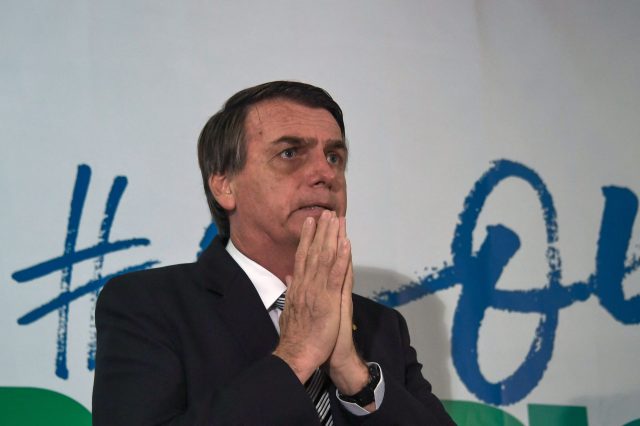
Last year, Brazil diverged from the American script. Lula struck a bargain with Brazil’s political establishment in other branches of government — including Right-wing heads of Congress and the Supreme Court — to insist on firm rejection of bolsonarismo’s anti-democratic drift. Where the cases against Trump fell apart, one after another, clearing the way for his triumphant return, Brazilian authorities pressed the cases against Bolsonaro, sentencing him last September to 27 years in jail.
Since then, many liberal Americans have looked to Brazil as an example of what their country should have done with Trump when they had the chance. “Brazil Just Succeeded Where America Failed,” argued two professors in the New York Times after Bolsonaro’s sentence came down. Last month, Vox published a major feature by Zack Beauchamp on “How one country stopped a Trump-style authoritarian in his tracks.” Many Brazilians are happy to agree.
But the story in Brazil is hardly over. Things may still go the way they did in the US — and on schedule. War in Iran jeopardises Brazil’s vital fertiliser imports and could tip the country into recession if the conflict drags on (although higher gas prices stand to benefit the country, a major producer). At home, a major scandal over ties between Brazilian institutions and an alleged fraudster who headed up a liquidated bank is battering the Brazilian Supreme Court, including the reputation of the justice, Alexandre de Moraes, who led the efforts to block election meddling and punish Bolsonaro and his allies for plotting a coup. Should Moraes fall, the anti-Bolsonaro bargain that took shape in 2022 could collapse.
Victory for Flávio, amnesty for his father and their allies, and an overall Trump 2.0 scenario for Brazil — i.e., return of the populist Right, strengthened and bent on revenge — all of it looks distinctly possible. Much of the progressive legislation on the books in Brazil, some of it thanks to the PT, some the product of the 1988 constitution itself, could go on the chopping block. The chaos and impotence of the Bolsonaro administration may be remembered as a mere foretaste of more serious things to come, in an inversion of Marx’s dictum — first as farce, then as tragedy (for the Left, at least).
Or Lula may win a fourth mandate this October, beating out Bolsonaro’s son Flávio and ensuring their family remains on the sidelines of Brazilian politics for another four years. He is more vigorous than Biden was at the end of his term — as he is eager to demonstrate in carefully arranged videos showing him jogging, beachgoing and partying at Carnival. The economy is doing relatively well. Lula has been dismissed as a walking museum piece before and has proven his doubters wrong. But the longer-term future still looks bleak for the Left, which has few, if any, potential successors with comparable stature and electoral appeal. Barring an unforeseen shift, one vision of Brazil will be buried with Lula, and a very different one is already waiting in the wings.
Nick Burns is associate editor at The Hedgehog Review and was previously editor at Americas Quarterly.
 NickBurns