




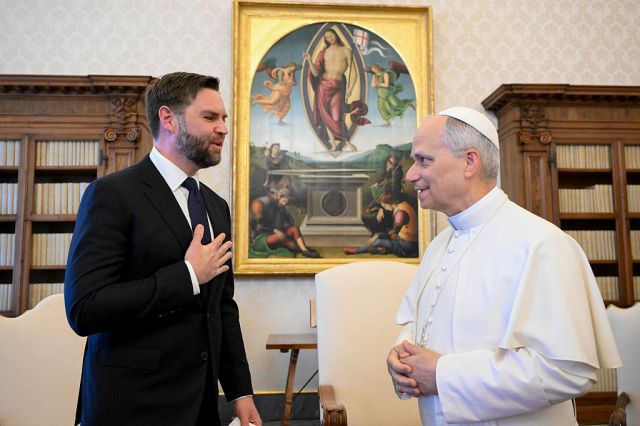
Vance is a Catholic convert. (Simone Risoluti Vatican Media via Vatican Pool/Getty Images)





Is the Pope subtweeting the US Secretary of War? Celebrating Mass in Rome, on Palm Sunday, Leo XIV used his homily to denounce those who claim that war may be waged in the name of Jesus. “Brothers and sisters, this is our God,” he said. “Jesus, King of Peace, who rejects war, whom no one can use to justify war.”
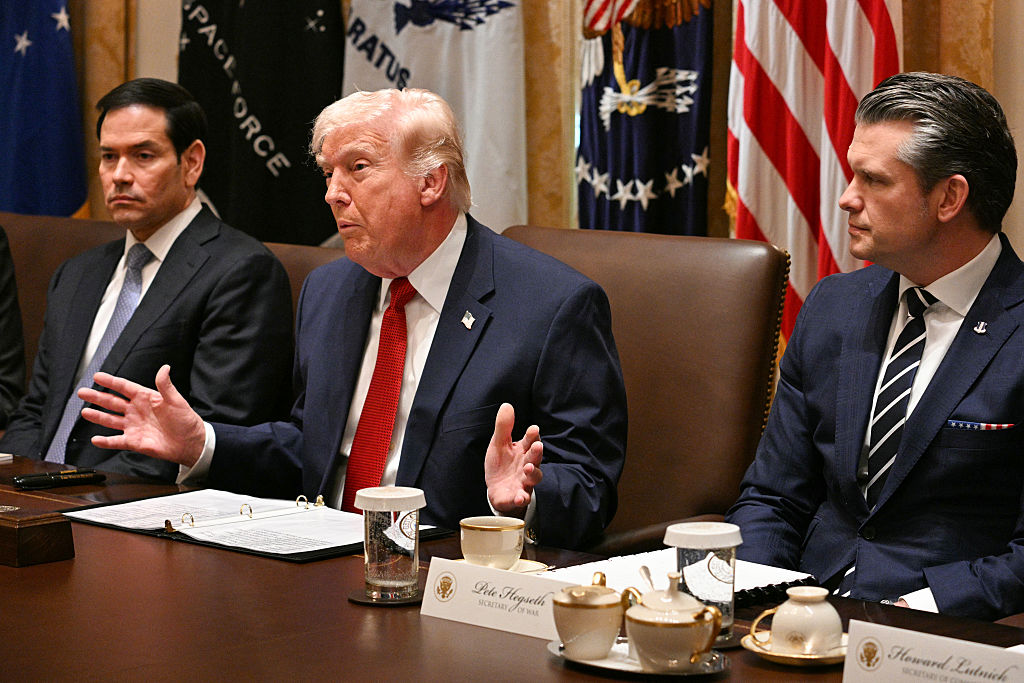
Leo has been increasingly explicit, over recent weeks, about condemning the conflict in Iran. His Palm Sunday words have been interpreted as a rebuke specifically to those within the Trump administration who seem keen to accord the conflict a religious edge. I can see how people might think so when Secretary of War, Pete Hegseth, was recently reported praying: “Let every round find its mark against the enemies of righteousness and our great nation”, and imploring God to grant his soldiers “wisdom in every decision, endurance for the trial ahead, unbreakable unity, and overwhelming violence of action against those who deserve no mercy”.
Was this what prompted the Pope to tell the crowd in St Peter’s Square, on Sunday, that “Christ, King of Peace, cries out again from his cross: ‘God is love! Have mercy!’”? In other contexts, the Pope has been happy to address military personnel, such as Italy’s Military Ordinariate; Roman Catholicism also has a lengthy and well-developed theory on what comprises “just war”.
But several notable Catholic Americans, considerably more Right-aligned than Pope Leo, have also expressed concerns over the justice of this war: either reserving judgement, or outright condemning it. What, in turn, this points to is a fairly recent but important change, internal to a bloc that American secular liberals used to treat as monolithic and also, they hoped, moribund: conservative Christians. Specifically, the growing influence of Catholics on the American Right — and in particular, theological differences that risk widening into real-world political fissures, catalysed by the war in Iran.
The relationship between Roman Catholicism and America has never been entirely comfortable. The original Pilgrim Fathers were Puritan radicals, and the newly founded United States inherited their aversion to papal authority. Tensions reached boiling point in the 19th century, with a large influx of Catholic migrants to the USA from Germany and Ireland, leading to animosity and some anti-Catholic violence. Though this later eased, an era of relative indifference to Catholic Americans arguably just reflected their largely working-class status, and hence comparative lack of political clout.
More recently, though, elite conservative America has grown steadily more Catholic, both in its politicians and also its intelligentsia. Vice-President JD Vance is a Catholic convert; Secretary of State Marco Rubio is a cradle Catholic. Six of the nine sitting Supreme Court justices are Catholic. A number of the influential New Right thinkers whose ideas have powered the Trumpist caucus, such as Patrick Deneen and Adrian Vermeule, are also Catholic.
And as highly educated, politically agentic Catholics have grown more numerous and influential in the USA, so the most influential Catholic of all is now also American: Leo XIV. But this sense of tentative rapprochement between the Church of Rome and the most constitutively Protestant of modern polities is now showing signs of tension — especially as it encroaches on the political instincts of the nation’s heartland Evangelical Christians.
This faultline has been thrown into relief by the war in Iran. From the outset, that conflict has been a joint US-Israeli operation, founded on the longstanding alliance between these nations. And while this is surely driven partly by resource and security concerns, in the view of many Evangelical Christians it also has a religious dimension, due to what is understood as Israel’s special prophetic significance.
The suggested real-world corollary of this varies accordingly, but has often helped to underpin American support for Israel. Perhaps most prominently, the Dispensationalist method of Biblical exegesis, popularised in the 19th century by John Nelson Darby, interpreted the nation of Israel as a key centrepiece in the prophetic narrative of Jesus’ second coming.
There are variations on dispensationalism, but the core of it is that Scripture should be interpreted literally, and God’s plan for the world is twin-track: one destiny for the elect of the church, and another for the nation of Israel, which will unfold once the elect are taken up in the Rapture. After this, a great struggle will ensue with Antichrist, in which the existing geopolitical nations will play an important role — especially Israel. This epic final struggle will end in the return of Jesus, with his already-raptured saints, to lead a thousand-year earthly reign as prophesied in the Book of Revelation.
It’s hard to say how many American Christians hold to some part of this worldview. The secular liberal press is clearly keen to associate Pete Hegseth with such beliefs, presumably in the assumption that this will paint him as a zealot and hence discredit him. But however far Hegseth himself holds this view, the key point is that the most part this broader strain of Christian thought tends to view Israel as both a legitimate state and people, with a right to exist, and also as having sacred significance.
A great many real-world political consequences flow from this. For example, in 2018, Hegseth suggested that a Jewish temple might one day be rebuilt on Temple Mount in Jerusalem. It was statement clearly referencing prophecies in both Jewish and Christian traditions — but challenging to Muslims given this is currently the site of Al-Aqsa mosque, a sacred site in Islam. Prophecies concerning the destruction and reconstruction of temples in this location form an ongoing religious backbeat to conflict in the region. Hegseth has reportedly moved away from dispensationalism, toward more “postmilennial” views, but is likely to be aware of such narratives.
By contrast, the Roman Catholic view on Middle Eastern geopolitics tends to take a less prescriptive, or literalist line. As formalised in the Catechism published after the Second Vatican Council (1962-1965), a special theological link exists between the historic peoples of Israel and the Catholic Church. But, importantly, within Catholic thought the theological descent from Judaism has not generally been taken to imply specific political obligations, or prophecies concerning events in the temporal world. The modern Church is emphatic about condemning any policy that might legitimise antisemitic bigotry but stops short of the prophetic account of Israel embraced, for example, by dispensationalists.
Thus, there is often more reticence among Roman Catholics than Evangelicals on the matter of active political involvement in the Middle East. I don’t think it’s a coincidence, for example, that JD Vance is widely viewed as the most sceptical voice in Trump’s administration as regards ongoing American involvement in Iran.
This is where Pope Leo appears to be coming from when he speaks out against the war. Explicitly: that Christians ought to aspire to peace and brotherhood, not war. And, perhaps, implicitly: that there is nothing of special Biblical significance about this war. It’s just a war, and peace is better.
The challenge for faithful Catholics in this context is treading the acutely politicised line between questioning the Biblical inflection on real-world politics, and allowing such questions to slip into conspiratorial or anti-semitic territory. (Leo XIV has spoken out repeatedly against giving harbour to antisemitism). This is particularly difficult in today’s polarising online environment: for example Candace Owens, a Catholic convert, appears to have gone all the way down the conspiracy rabbit-hole.
Recently, too, the former Miss USA Carrie Prejean Boller, a recent Catholic convert from Evangelical Christianity, was removed from Trump’s Religious Liberty Commission after a heated argument with a Jewish commission member on Zionism. Boller was later taken to task by the conservative American bishop Robert Barron, also a member of that commission, for her intemperate behaviour — and for suggesting that Catholic fidelity entails blanket opposition to Israel. The bishop’s rebuke to Boller also spelled out the tension at issue: the Catholic stance on Zionism, he explained, is that “all forms of antisemitism are to be unequivocally condemned; the state of Israel has a right to exist; but the modern nation of Israel does not represent the fulfillment of Biblical prophecies and hence does not stand beyond criticism.
Perhaps in a spirit of seeking to resolve these tensions, not long after the Boller brouhaha Jay Richards, a Heritage Foundation fellow (and another Catholic convert) published a careful effort at disambiguation, in a DC Catholic publication, on the various types of Zionism. If this all sounds too inside-baseball for words, the takeaway should be that an American Right that was once overwhelmingly Evangelical or WASP is now adapting, on the hoof, to the presence and considerable influence of homegrown American Catholics, whose perspective on long-settled matters interacts in sometimes surprising ways with existing currents of American Christian belief.
Careful bridge-building of Richards’ kind may yet achieve a new accommodation. But one thing that seems likely as a consequence of this is ongoing internal disagreement within the American Right on how literally, or indeed militarily, Biblical prophecy should be pursued in the Holy Land. In his article on Zionism, Richards suggests the apocalyptic account of Israel that emerged from dispensational cultures is viewed among other Christian denominations as “over-reading, if not misreading, of often cryptic biblical texts”. This careful phrasing, by a seasoned Washington philosopher-politico, is the kind of muted admonition that can translate down the line into substantial differences of view on the best course of action.
Historically, as a majority-Protestant nation, America has not accorded much weight to what the Pope says. Should Catholic influence continue to rise within the Land of the Free, might that change? Would this even count for much, set against the calculations on resources and trade routes empires have to make to preserve their might? Who knows.
But it’s not impossible that, should the balance of power continue to shift between Catholic and Evangelical decision-makers, so too in time the American diplomatic stance in relation to the Middle East may also become less interventionist. In the meantime, the bombs keep falling; and I dare say, in Rome, Leo XIV will continue to pray for peace.
