




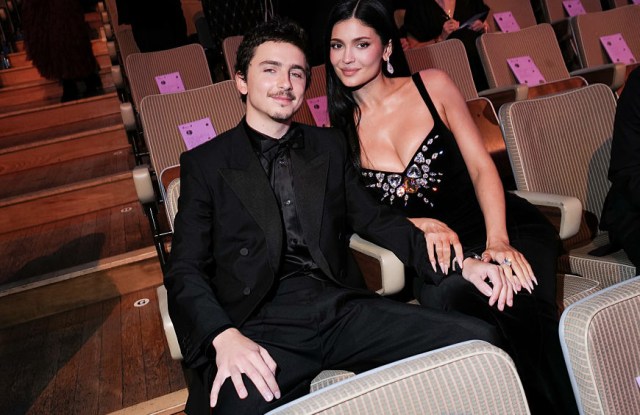
Chalamet with girlfriend Kylie Jenner, hardly a soft-boi choice, in 2026. Credit: Getty





The culture war has come for Timothée Chalamet. Days before the Academy Awards, a clip went viral of Chalamet — nominated for best actor for his performance in Marty Supreme — telling a TV audience that he didn’t want to work in fields like ballet or opera: “things where it’s like, ‘Hey, keep this thing alive, even though no one cares about this anymore.’” He caught himself mid-sentence, adding with a laugh: “All respect to the ballet and opera people out there. I just took shots for no reason.”
Within hours, the Metropolitan Opera and others posted pointed response videos, and media critics and TikTokers decried him as an “absolute fool” or a “closet Kardashian”. Some commentators even floated the notion that Chalamet had somehow talked himself out of Best Actor, and somewhere on social media, a meme circulated titled “How to Lose an Oscar in 10 Days”. Others angrily recirculated the young actor’s comments from Vogue’s December 2025 cover story, in which Chalamet described watching an interview with someone “bragging” about not having children and called it “bleak”, adding that “procreation is the reason we’re here”. On Tuesday, the BBC wondered aloud if “Hollywood golden boy Timothée Chalamet lost his shine.”
Yet Chalamet was right on the money — on both counts: the high culture of old is truly in its death throes, and there is nothing particularly noble or interesting about being childless. The controversy tells us less about his Oscar chances than about the culture’s growing discomfort with the newly bold, distinctly masculine version of Timothée Chalamet.
Consider what Chalamet represented to a certain slice of liberal millennials in the 2010s. From roughly the time he starred in the gay romance Call Me By Your Name (2017) through his donning of ill-fitting Willy Wonka garb in 2023, Chalamet served as the patron saint of the soft-boi era of masculinity. He was wispy, gentle-featured, androgynous in his fashion choices, conspicuously unthreatening, and seemingly designed to be appreciated by the female gaze without demanding anything uncomfortable in return. These qualities also made him the right choice to play Paul Atreides in the first installment of Denis Villeneuve’s Dune trilogy, released in 2021, which depicts the sci-fi protagonist in the soft-boi phase of his journey — before tragedy makes a man out of him.
Chalamet cried beautifully on screen. Like Harry Styles, he wore pearls and ruffled blouses to red carpets without apology and seemed like someone who might carry Rebecca Solnit books in his “The Future Is Female” tote. Critics loved him. Feminist publications swooned for him. The industry adored him for embodying a certain vision of what sensitive, non-threatening maleness could look like.
The soft-boi era emerged from a moment when the cultural critique of bratty and boorish male behaviour had widened into suspicion of all masculinity. “The Patriarchy” was treated as an omnipresent force, lurking in corporate offices and smoke-filled boardrooms, sure, but also in frat houses, subways, and in the suspicious motives of men both powerful and ordinary. Today’s man-spreaders would become tomorrow’s C-suite tyrants, trading promotions for sexual favors — or at least, keeping the office AC way too cold.
“Bro” became a knowing insult, and the language of feminist theory spilled from Tumblr and gender-studies seminars into mainstream culture — the campus-to-Condé Nast pipeline. In the liberal professional world, especially, the ideal man was portrayed as sensitive, meek, and seeking apologies or consent for nearly everything he did. The soft-boi was less a man than a customer-service version of one.
The drastic vibe shift of the mid-2020s has been well-documented. With the decline of #MeToo and “peak woke,” the soft-boi began to be derided as the “performative male”: the man whose sensitivity was seen as a self-righteous personal-branding exercise rather than what, in liberal Millennial culture, was deemed allyship. Starting in 2024, the backlash culminated in Performative Male contests, in cities and college campuses where men dressed in oversized cardigans and sipped matcha while making land acknowledgements or talking about how they loved “queer spaces.” Gen-Z men’s backlash to their ultra-woke elders began to be reflected in lifestyle choices, especially in the emergence of two distinct types: churchgoing trads who want children; and resentful caricatures of the old versions of manhood: Andrew Tate and Barstool-brained wing of crypto gambling, lookmaxxing, podcast swagger, and overt misogyny worn almost proudly. Think of it as holy versus unholy.
Chalamet, however, has drifted into a third lane. No longer a boy wonder at age 30, he’s looking less like a Parisian art-film star. He has been photographed in streetwear and baseball caps, guest-starring in rap videos and confidently appearing on ESPN football broadcasts. And he’s dating Kylie Jenner, a figure overtly, even aggressively feminine enough to demand a properly masculine counterpart — her exes are mostly rappers. He is now laden with swag, as the kids used to say. It’s unclear whether he sensed the seismic shift in the culture wars and made a market correction or simply evolved or matured with age. But the upshot is that these days, the king of Performative Males is performing a different species of man.
This new persona is interesting because he’s neither Tate nor Matt Walsh; neither a cartoon reactionary, a chest-thumping podcast bro, nor a trad husband looking for a wife with whom to attend a Latin Mass. He isn’t particularly religious or political. He became something unexpected and, in its own way, more old-fashioned: an unapologetic striver. At the 2025 Screen Actors Guild Awards, accepting the best-actor award for the Dylan biopic A Complete Unknown, Chalamet openly declared that he was “in pursuit of greatness” and wanted to be “one of the greats.” It was one of those rare celebrity lines that sounded both faintly absurd and refreshingly honest, something you’d hear from professional athletes, not artists. Some bristled at the fact that he’d violated the current code of prestige modesty, in which everyone is supposed to present success as an accidental side effect of sincerity.
This attitudinal shift has been reflected in his recent work. In A Complete Unknown, his Dylan is a difficult young man shaped by ego, self-invention, opportunism, and a refusal to remain defined by the people who loved him first. His mid-1960s Dylan goes electric, over and against the objections of his fanbase, essentially telling the folk world that their ownership of him was not his problem. And then came Marty Supreme, in which Chalamet plays a swaggering, self-mythologising table-tennis prodigy — a film explicitly about the American drive for greatness, for dominance, for being the best at something even when the something in question is defiantly small, like ping-pong.
The film isn’t uncritical of this drive. That’s the point. Marty director Josh Safdie uses Chalamet’s character to examine the specifically American pathology of wanting to be legendary and how ambition curdles into ego, how ego can hurt the people around you, and how the pursuit of mastery isolates those whom it elevates. It is a complicated film about a complicated type. Both movies ask whether you can separate the art from the artist, and whether greatness can be pursued without vanity and collateral damage. The critics now writing their concern pieces about Chalamet are, without realising it, providing a one-note answer to those questions: no, and they’d prefer you stop asking.
Ironically, this controversy is a bizarre mirror image of the time when actresses were tut-tutted by male critics for being messy, outspoken, and lacking a demure personality. That dynamic had a name — the difficult woman — and we got reasonably good at recognizing it. We are less practiced at recognising its male obverse. This time, it has to do with the specific cultural discomfort that arises when a man who was useful as a symbol of sensitive, non-threatening masculinity starts suggesting that he is no longer interested in being a symbol of softness and passivity at all. That he wants to be what history once called a man.
What comes next is uncertain. Chalamet may or may not win the Oscar on Sunday. The ballet controversy broke too late to affect the vote, and his awards momentum had already dwindled before any of this. But regardless, in today’s American culture — one that endlessly sermonises about art, authenticity, and excellence but is unnerved when a straight male star hungers for it — here’s hoping that the new Chalamet-ism endures.
