




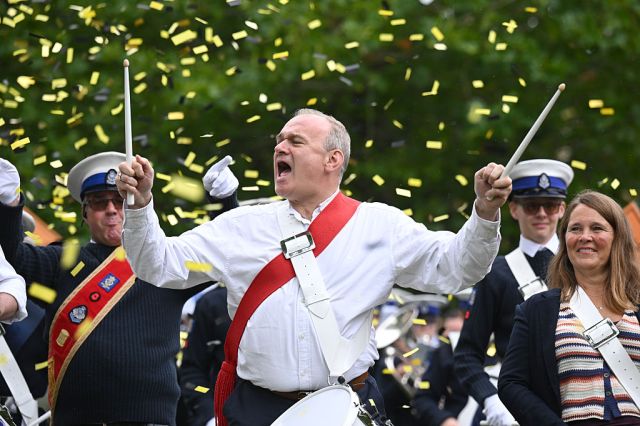
“Perhaps Davey habitually affects a jocular manner because liberalism itself has become an unserious worldview.” (Photo by Finnbarr Webster/Getty Images)




There’s a compelling argument that Ed Davey is the most successful Liberal Democrat leader of all time. While it’s true that Nick Clegg became Deputy Prime Minister in 2010 — the first time his party held power in Westminster — that came after electoral disappointment. Less than a week earlier, the Liberal Democrats had lost five seats, despite gaining almost a million votes. Under Davey’s stewardship, though, the party stormed to more than 70 MPs in 2024, its best ever performance. The last time its Liberal forebear had done that well was back in 1923, when Herbert Asquith was calling the shots.
Davey, one might conclude, had joined illustrious company, becoming an heir to the venerable tradition of Lloyd George and the young Churchill. Yet few would associate the weighty hand of history with today’s MP for Kingston and Surbiton. Remember, Davey’s most noteworthy moment at the last election wasn’t a striking policy proposal or a clippable statement of principle, but his repeated tumbles off a paddle board. Over the weekend, at his party’s spring conference in York, the Lib Dem leader continued his unique brand of guerilla marketing. Taking to the stage to “Daddy Cool”, the former Secretary of State was later seen “dad dancing” to Chappell Roan. Forget Keynes and Beveridge; even the hinterland and gravitas of Charlie Kennedy now feels as distant as the Edwardians.
More to the point, and given the meteoric rise of both Reform and the Greens, one might ask: why does Davey persist with the slapstick persona? A decade ago the Lib Dems, past masters of the by-election upset, would have fancied their chances in Gorton and Denton. Last month, by contrast, they lost their deposit. It feels, in short, like almost everything in British politics has changed over the past year and a half — except for the Liberal Democrats.
Advocates for Davey’s brand of leadership might reply that whatever one’s views on his style, the results speak for themselves. Beyond his party’s success at the last election, Nowcast and YouGov predict further gains at the next one, the latter putting them on 85 seats.
But is that really so impressive given that the Lib Dems have long been Westminster’s third party, and that the big two are in freefall? While it’s true that Davey made hay in 2024, cruising home in Tory strongholds like Chichester, Witney, and Guildford, he has not managed to make comparable inroads into Labour territory. Instead, it seems that everyone but the Lib Dems is ready to feed on the carcass of Keir Starmer’s majority, from the Greens and SNP to Reform and Plaid Cymru. Rather than dancing to Gen Alpha bangers, Davey should be asking why Farage and Polanski are making the political weather instead of him.
One explanation is that such ambition is institutionally off-limits. The Lib Dems have learned the hard way — principally from the doomed SDP-Liberal alliance of the 1980s and Clegg’s disappointment in 2010 — that conservative gradualism is better than radical failure. In 2024, Davey delivered on the former, and then some, with a relentless focus on Tory seats in the south of England, especially those that contain a Gail’s bakery. But given the sudden rise of Zack Polanski, who has taken the Greens to more than 200,000 members and a by-election win for the first time in their history, that now feels like a limited strategy.
Perhaps Davey habitually affects a jocular manner because liberalism itself has become an unserious worldview — so much so that any Lib Dem leader would struggle embody gravitas. Liberalism is bereft of thick ties across society; nor does it offer a deeper sense of meaning to its devotees, something one certainly can’t say for Reform or the Greens. Today’s liberals, in short, believe in little beyond the dying status quo. Their post-Cold War triumph was so utterly overwhelming that, almost two decades after the Global Financial Crisis, they lack the tools to change course.
Adrian Wooldridge, author of Centrists of the World Unite!, provides an insightful explanation of how liberalism conquered all while losing its mojo. As he wrote for UnHerd, liberals “reaped the benefits of the past 40 years of economic and moral deregulation”, yet are “now incapable of running the world which they have made.” It should therefore be little surprise that, over the last decade, the Liberal Democrats have been perennially negative: stop Brexit, stop Corbyn, stop Boris — and now stop Farage. They can’t stand for anything because this is the world they wanted. And it sucks.
That applies to both pillars of what Wooldridge persuasively labels “double liberalism”. Why double? Because it combines the excesses of economic neoliberalism, increasingly pervasive since the early Eighties, with the dismantling of any conception of a shared moral universe, a change that goes back to the 1960s. It is the combination of these two liberalisms that political and media elites have in mind when they talk about the “centre” — an increasingly meaningless concept, not least because it is neither the middle ground of public sentiment nor popular. “The strength of the post-liberal argument,” Wooldridge notes, “is that it recognises this synthesis is now producing more problems than benefits.” What is presented by elites as a politics of moderation often animates resentment and even hatred. The leadership class of the Long Nineties, Tony Blair more than anyone, appears incapable of grasping that.
Yet, left to itself, post-liberalism also gives rise to wantonly self-destructive pathologies. If Davey is incapable of taking himself seriously, then Kemi Badenoch and Nigel Farage can, on a range of issues, appear outright deranged. How else do you explain the allure of the MAGA-sphere for so much of the British Right? We can ascribe some of the blame to the demise of an ideologically curious liberalism. As a result of this intellectual seppuku, politics on the extremes have become ever more puerile. I say this as a socialist: a historically literate politics of the actual centre only serves to refine my own views.
Consider the economy. For all the fanfare around Elon Musk’s cost-cutting DOGE unit, the Brookings Institute recently suggested that America’s fiscal situation is actually deteriorating. In other words, Trump, for all of his radical, disruptive rhetoric, has retained the default platform of the Republican Party since Reagan: deficit-funded tax cuts and rising public debt. As long as the petrodollar exists, that strategy might remain viable for Washington. But it certainly isn’t for the Europeans and Brits, because we don’t benefit from having the world’s reserve currency. That Reform is still barking about a British DOGE — even now — should terrify us all. The enthusiasm underscores the extent to which we are the backwater franchise for a political operation already discredited across the Atlantic. And because liberals at home are ideologically bankrupt too — or, worse still, don’t actually care about ideas — imitation of the Americans still passes for radical, cutting-edge thinking.
It’s a similar story with foreign policy. The radical Right is becoming progressively unmoored from reality over Iran and the wider region, partly because the centre has no credible blueprint of its own. At the end of February, Farage was as eager as anyone to become embroiled in yet another overseas conflict, a position he quickly disavowed. The same was true of Badenoch, who initially demanded strikes in the Middle East. Matt Goodwin, who finished second as the Reform candidate in Gorton and Denton, said he was willing to pay more to fill up his car if that was the cost of depriving Iran of a nuclear weapon. Such opportunism has been exposed only because, on this one occasion, centrists — specifically Keir Starmer — took a position founded on reason rather than complacent liberal interventionism. As a result, and unusually for his time in government, Starmer finds himself aligned with public opinion.
Perhaps a decisive position on the war in Gaza would have achieved something similar — especially had that position been taken earlier on. Yet the Iran response remains instructive. On the one occasion that Labour has broken with the liberal default of recent decades, Labour has Farage on the back foot. It’s strange indeed to see both Richard Tice and Tony Blair knocking a Labour prime minister. This may also be part of a wider pattern, or at least the start of it. Before dancing the Macarena last weekend, Davey argued that the entirety of Britain’s nuclear deterrent should be built at home. It’s important to remember that our Trident missiles are actually from a “shared pool” housed across the Atlantic. Green shoots of pragmatism? Maybe.
Don’t expect a transformation, though. It’s often suggested that contemporary Left-wing politicians aren’t as talented as Tony Benn, and that their Right-wing counterparts are less erudite than Enoch Powell. But why wouldn’t they be, when the ideological school that reigned supreme in recent decades has been so disinterested in ideas? Peter Mandelson is perhaps the most grubby example here, but there’s also Justin Trudeau, who led a country afflicted by a drug epidemic while insisting on the gender-neutral term “peoplekind”, and Kamala Harris — whose presidential bid was a series of meandering speeches and clips of her dancing on social media.
Looking back on his rivals, it is obvious why Trump prevailed not once but twice. While trying to lean into the attention economy, rather than defend politics as a serious vocation, centrists were a handmaid to the very populism they claim to abhor. Trump’s endless, shambling monologues — despite being occasionally funny — were only captivating because what the alternative was a world of clipped soundbites devoid of personality or political substance. Ironically, this also fuelled the rise of Barack Obama, whose singular ability to speak capsized the Clinton campaign ahead of 2008. But Obama was the outlier, and Clinton the default for double liberalism. Even then, there was little of substance to what the senator for Illinois actually said.
All of this helps explain the allure of Mark Carney. The Canadian PM’s recent Davos speech was both brave and intellectually coherent. Notably, Carney acknowledged some of liberalism’s failings over recent decades. But his words were conspicuous precisely because liberalism so rarely produces politicians of substance. For Wooldridge, there is little to read into this shortage of great statesmen. But there’s an argument that it’s structural, emerging from the inherent contradictions of the tradition. Carl Schmitt, a critic of liberalism, claimed it seeks to “dissolve the political into ethics and economics”. Should it really surprise us, then, that given the culmination of the liberal project meant the abolition of politics, competent exponents of the craft would gradually vanish too?
So what might a reanimated liberal politics for the mid-21st century actually look like? First, instinctive complacency would be replaced by an acknowledgement of what has gone wrong. In Europe, particularly, we may be in the foothills of our own Century of Humiliation.
On the level of politics, the priorities should be clear: sovereignty is a tool for solving problems — and national identities matter. People want a state that protects them and that stands as a source of authority; if it fails to be either they view it as a useless, wasteful encumbrance. The national community is real. That doesn’t mean forsaking your fellow man in other parts of the world, but it does mean accepting the nation-state as the primary locus of political action.
The policies of a new liberalism should be an extension of such thinking. The wealthy should do their duty to others and their country by accepting the need for a new economic settlement. Wealth is, essentially, collectively produced — and a liberalism that is indifferent to exploitation deserves to die. A renewed liberal politics, retaining its old aim of allowing individuals to be the authors of their own lives, must also ensure that access to the basics is guaranteed: cheap housing, transport, cheap energy. Nobody is reading the collected works of Jane Austen, or learning Mandarin, when they are living in their overdraft.
A great advantage of democracy, of course, is that systems can self-correct. Yet even here there are warning signs. Some centrist commentators have claimed that the Westminster system should become less, rather than more, democratic. Unconvinced by the merits of party primaries, which keep politicians on their toes, they argue for a political class that is even more insulated from the public. It’s ironic that advocates of a worldview built on reason, public deliberation and Enlightenment values often argue for the kind of decadence you might associate with the Hapsburgs or the late Ottoman Empire.
Fortunately, however, such voices are becoming quieter. Given the benefits that serious-minded liberalism has brought to all of us — from defending the rule of law to upholding freedom of expression — its reinvigoration, in a form fit for the present day, would be a welcome one. Just don’t expect Ed Davey to lead the charge.
Aaron Bastani is the co-founder of Novara Media, and the author of Fully Automated Luxury Communism.
 AaronBastani
Join the discussion
Join like minded readers that support our journalism by becoming a paid subscriber
To join the discussion in the comments, become a paid subscriber.
Join like minded readers that support our journalism, read unlimited articles and enjoy other subscriber-only benefits.
Subscribe