




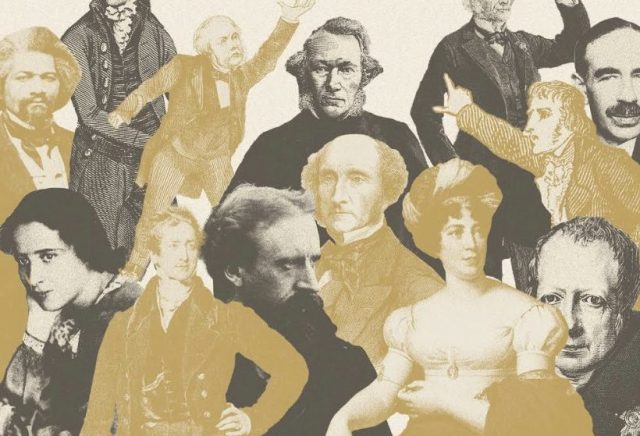
Ignore the siren voices talking about postliberalism. (Credit: Allen Lane)





The signs of liberalism’s senescence are everywhere. In Britain, Keir Starmer won a historic mandate in the 2024 election, only to rapidly turn himself into the most unpopular prime minister on record. Only last week, his party came a poor third to two revanchist parties, the Greens and Reform, in the Gorton and Denton by-election — a constituency that Labour had held since 1931. Over in Germany, Friedrich Merz looks like a Starmer in-the-making, while France’s Emmanuel Macron is in the twilight of his presidency.
And yet the problem is so much deeper than bad candidates. It’s the problem of a decrepit regime — a collection of functionaries and placeholders, who’ve reaped the benefits of the past 40 years of economic and moral deregulation and are now incapable of running the world which they have made. Like all elites, they developed the habit of backscratching and logrolling. And, like all elites, they soon lost touch with the people beneath them.
That explains the striking number of destructive liberal policies, which have wreaked havoc across the West. San Francisco, a bastion of social liberalism, is so addled with homeless encampments on the streets and drug addicts snorting fentanyl in public, that even progressives have had enough. Sweden, once a by-word for social harmony, now suffers from the highest rate of death-by-shooting in Europe, thanks to the proliferation of immigrant gangs. The British northern cities that powered the Industrial Revolution are plagued, in their ethnic enclaves, by cousin-marriage, honor punishments and grooming gangs. The response of all too many liberal intellectuals to these tragedies is to demand more of the policies that led to them in the first place. The triumphalism of the Nineties has been the common man’s loss.
This has provoked a growing number of intellectuals on both the Right and the Left to proclaim the death of liberalism. The most familiar argument is the Marxist one that liberalism is a ruling-class trick, and that the harsh realities of exploitation and imperialism underlie their treacly words about “freedom” and “democracy”. A more interesting, and more influential, argument is being made by the New Right — many of whom call themselves “postliberals”. They argue that liberalism proved a disaster, not because good ideas were badly applied, but because liberalism contained the seeds of its own destruction.
In his 2018 book, Why Liberalism Failed, the political theorist Patrick Deneen wrote: “Liberalism has failed because liberalism has succeeded. As it becomes fully itself, it generates endemic pathologies more rapidly and pervasively than it is able to produce Band-aids and veils to cover them.” Liberal regimes succeeded when they were disciplined by traditional ideas about virtue and civility. But their core belief — that we are all rights-bearing individuals, answerable primarily to ourselves — inexorably destroyed the civilizational constraints that gave it strength. Liberal individualism generates self-indulgence and anomie. Equality of opportunity produces a new meritocratic aristocracy that has all the aloofness of the old aristocracy with little of its noblesse oblige.
The bulk of these postliberals are headquartered in the United States. A group of followers of Leo Strauss, based in the Claremont Institute in Southern California, relentlessly expose the faults of the “liberal regime”. Adrian Vermeule, a professor of constitutional law at Harvard Law School and a leading exponent of the idea of the “unitary executive”, argues that the job of the state is to promote good government rather than to protect liberty as an end in itself. The US vice-president declares himself to be a postliberal. There are so many products of the Claremont Institute in the White House, the administration, and Congress that they are fondly known as “Claremonsters”.
Postliberalism has plenty of supporters in Britain, like James Orr, a Reform advisor and Cambridge philosopher of religion, and the Reform MP, Danny Kruger, who propose a faith and flag-based conservatism as a solution to the disillusionment of modern life. Both are devotees of Roger Scruton, the late conservative intellectual, who fulfills a similar role to Leo Strauss in British postliberal circles. Far more belong to the Blue Labour tradition, like Maurice Glasman, Adrian Pabst, John Milbank and Philip Bond. (John Gray, the most intellectually significant of this group, has retreated from postliberalism of late.)
Their critique predominates at a time when the current liberal establishment is the most decadent it’s been — when, in the words of the American historian John Patrick Diggins, “few live for liberalism, but many live off it”. This all comes at a time when the forces of illiberalism are stronger than they have been at any time since the Thirties. The world’s second-biggest economy, China, is ruled by a Marxist dictator; its biggest democracy, India, by an illiberal strongman; its most battle-tested war machine, Russia, by a man who wants to bury the liberal order; and its most important liberal power, the United States, is, at best, an uncertain friend of the liberal order that it created after the Second World War. Donald Trump is an instinctive rather than a cerebral politician, but almost all his instincts are illiberal, sometimes astonishingly so. Trump has declared, like an absolute monarchy, that the only constraint on his actions lies in his own conscience. He has not even bothered to pay lip-service to international law in his wars of choice in Venezuela and now Iran and the wider Middle East.
Yet the postliberal influence owes much more to luck than substance. They fail to address the material problems that plague the post-industrial wastelands that they excoriate: Deneen’s follow up to Why Liberalism Failed, called Regime Change: Towards a Post-Liberal Future, is notably short on workable policies. They have no answer to the question: what happens to populism when it’s undisciplined by liberal constraints? The experience of the Thirties suggests nothing good. It is time to mount a defense of liberalism before it is too late.
***
It’s impossible to defend liberalism without starting with a definition of what we are defending. Over the past 40 years, liberalism has been associated with the shrinking of the role of the state when it comes to both markets and morality. Bill Clinton and Tony Blair produced a widely admired bourgeois-bohemian (BoBo) synthesis by combining the Thatcherite deregulation of the economy with the Sixties deregulation of morality. The strength of the postliberal argument is that it recognizes this synthesis is now producing more problems than benefits.
But the BoBo synthesis is only one possible manifestation of liberalism. You can have big government liberalism as well as small government liberalism, moralizing liberalism as well as permissive liberalism. (John Maynard Keynes was no less of a liberal than Friedrich Hayek.) All are linked by three core beliefs: that society starts with the individual rather than the collective; that truth is only reached through open debate; that power is so dangerous that it must be divided and constrained. Anything that prevents individuals from flourishing, ideas from clashing, and power from being constrained, is illiberal.
During its long history, liberalism has suffered from several near-death experiences, but it has always revived. It has done this by addressing new problems in new ways while staying true to its fundamental principles. One example is particularly germane to our current predicament — namely, New Liberalism, which emerged at a time in the late 19th century, when the laissez-faire liberalism of the Victorians risked being swept aside by the emergence of a new world of organized trade unions, mass political parties and authoritarian nation states. A group of intellectuals, such as T.H. Green, Leonard Hobhouse, and Graham Wallas, dreamed of a liberal state — more interventionist while not sacrificing the principles of individualism and divided power. A remarkable group of New Liberal politicians followed — such as David Lloyd George, R.B. Haldane, and Winston Churchill, who revived the moribund Liberal Party and built the foundations of the welfare state. The First World War and the rise of Labour eventually led to the Liberal Party’s “strange death”, but liberal ideas were absorbed by both ascendant parties under the influence of John Maynard Keynes and William Beveridge.
In the Twenties and Thirties, liberalism risked being stamped to death by jack-booted fascism or communism. “The liberal state is destined to perish. All the political experiments of our day are anti-liberal,” proclaimed the socialist-turned-fascist Benito Mussolini. But the Allies proved him wrong by defeating the Axis powers in the Second World War, constructing the Iron Curtain, and remaking the world according to a new collection of liberal principles. In the Seventies, the postwar regime gave way to stagflation and bureaucratic sclerosis only to revive under the influence of the neoliberal revolution.
It’s understandable that people are angry with the liberal establishment and disillusioned with centrist promises. But the alternatives from both the Right and the Left are certain to be worse. During his first term, Trump catered to his billionaire friends, entrenching crony capitalism and passing big tax cuts, while providing his populist base with rhetorical puff balls. He didn’t even make significant progress with his “beautiful wall”. During his second term, with the old Republican establishment sidelined and both postliberal and illiberal thinkers in the ascendant, he is creating chaos in the Middle East, sending stock markets into a tailspin. Meanwhile, in Britain, Reform’s economic policies are an unsustainable mixture of Thatcherism and Left-wing statism.
The radical Left is even more impractical. The Green Party’s policies, so entreatingly presented by Laura Spencer, the victorious candidate in Gorton and Denton, are a JCR laundry list of wishes: spending funded by taxing billionaires, the legalization of drugs and pornography and, almost as an afterthought, nice things for the environment. Not only that, but the radical Left is also blind to the problems created by mass immigration, half-hearted integration, and the development of parallel societies. Spencer not only brushed aside worries about immigration as “racism” but also distributed pamphlets in Urdu and extracted political capital by posturing over the war in Gaza. The noisy fight between the far Left and far Right is often a distraction from collective problems like fixing governments that require concerted effort and careful thought.
The only way forward is to reinvent liberalism just as thoroughly as previous generations of liberal reformers did to address new problems, while discarding established shibboleths if they happen to get in the way. If we fail, we will be swept aside by the radicals of the Left and Right; if we go off half-cocked, we may end up making the problem worse. The last attempt to revive the radical center was made by Emmanuel Macron, who only entrenched and deepened France’s divisions. His failure is not only the result of his divisive, vain and self-glorifying character, but — more importantly — because, as a creature of the neoliberal revolution, he focused on yesterday’s solutions, economic deregulation, rather than addressing today’s problems: the tensions between the center and the periphery, and the failure to assimilate immigrants. Liberals must be bolder and more self-critical than the Man in the Élysée. We must also be more consistent. Such a reinvention must start with three strategies: rethink, reposition, and re-articulate.
First: rethink. Today’s liberals need to break with their four-decade fixation on economic and moral deregulation. The Epstein affair should provide both a reason for such a break and a spur to self-reflection. The Epstein Files have not only exposed how many neoliberal heroes, from tech-billionaires to illustrious economists, have feet of clay, but also the moral hollowness of a philosophy of self-indulgence and self-gratification that lies at the heart of the BoBo culture.
Today’s liberals must also reapply the core principles of liberalism as they encounter old sins in new forms. The tech giants are not only amassing market dominance of a sort that we haven’t seen since the robber barons, but are also using that dominance to misinform and manipulate individual citizens. Left-wing identitarians are offending the basic principles of individualism by treating people as members of groups rather than as unique individuals, even applying different selection standards to different groups, or by canceling people with what they deem to be heterodox opinions.
The biggest weakness of today’s liberals is that they have become the establishment — the heads of Oxbridge colleges, Quangos, the BBC — and they have all the attendant weakness of an establishment. Radical liberals must challenge this establishment with the same vigor with which the Greens and Reform challenge it, but in the name of liberal principles rather than identitarian ones. Why have the heads of universities betrayed the sacred principle of free speech? Why has the grooming-gang inquiry been bogged down in procedure and vacillation? Why is groupthink spreading in NGO circles?
Every successful reformulation of the liberal creed, from the New Liberals, through the managerial capitalism of the Forties, to the neoliberal revolution of the Eighties, has involved the sweeping away of a decadent elite and the creation of a new cadre of reformers. Today’s radical liberals must muscle aside the existing liberal establishment — that is, the Davos establishment — before the populists do it for them. Radical liberals also need to be willing to forge alliances with groups that their elders have made a career demonizing. Conservatives such as Roger Scruton turned out to be right about pornography and libertinism. Some socialists were right about the dangers of the over-concentration of economic power. Liberalism has a wonderful history of reviving itself through unexpected alliances.
Third: re-articulate. One reason why liberals were so successful in the past is that they were so good at communicating. John Stuart Mill was a master of clarity. Lincoln wrote like an angel. Gladstone held his audiences enthralled for hours. Today’s liberals have entirely lost the art. Officials sound like Soviet-era bureaucrats, with wooden phrases about diversity being our strength taking the place of “the laws of dialectical materialism”. Eurocrats have invented their own language of “attestation” and “decommitting”. Academics write for constipated referees who hold their fates in their hands. Corporations produce bureaucratic blather. The current leader of the Liberal Democrats, Ed Davey, is better known for his theatrical stunts than any particular argument or opinion.
There are two reasons for this failure: being the establishment, liberals largely talk to each other rather than to the public, academics to academics and Eurocrats to Eurocrats. Being a decadent establishment, they don’t really believe what they are saying. They are repeating formulaic phrases in much the same way as Soviet bureaucrats repeated such phrases — to protect themselves from criticism and curry favor with the even more powerful. The simple fact of breaking with the establishment should be enough to take care of the dead-prose problem: once people start believing what they say, and once they start speaking to the public rather than experts, they discover the language that they need.
Once they’ve recovered their spirit, our reformed liberals need to take to the public square. Diplomats need to be willing to advance the case for open societies and religious toleration in the UN and other such forums. Politicians need to speak out more loudly against illiberal practices such as shouting down speakers in universities, persecuting people who “blaspheme” against Islam in schools, or practices such as arranged or cousin marriage.
What often passes for liberalism today is a ghost of its former self. But liberalism has revived from near-death experiences in the past— and it has revived precisely because liberals have rediscovered their ability to reapply their philosophy to fresh problems and put their arguments into new world. Liberalism properly conceived is the only reasonable solution to the great problems of modernity: how to live together in a pluralist society and how to preserve social cohesion while unleashing individual talents. Ignore the siren voices talking about postliberalism. Resist the superficial glamour of the twin populisms of the Left and Right. It is time to begin the patient but exhilarating work of renewing liberalism for a new age. Centrists of the world, unite!
Adrian Wooldridge is the author of Centrists of the World Unite! (2026) and The Aristocracy of Talent (2021). He worked at The Economist for 32 years and is now the global business columnist at Bloomberg Opinion.
 adwooldridge