




Mojtaba Khamenei and Donald Trump. (Credit: J.G. Fox)





Historians these days doubt that Sir Walter Raleigh ever laid down his cloak to stop Queen Elizabeth I from stepping in a puddle. They do agree, though, that he understood the nature and benefit of maritime power. “Whosoever commands the sea commands the trade,” he wrote in A Discourse of the Invention of Ships in the early 17th century. “Whosoever commands the trade of the world commands the riches of the world, and consequently the world itself”.
Raleigh lived in a different era, of course — one that most of us imagine as a time of swashbuckling sailors and risk-taking pirates, when control of the High Seas was a competition between the European states building empires in both the New and Old Worlds.
This was also an age when geography mattered every bit as much as resources. Many of the first European footholds overseas were chosen less for what lay in the ground than for where they sat along the great sea routes that were beginning to bind the world together. The Portuguese seizure of Malacca in 1511 was not about spices growing nearby but about controlling the narrow maritime gateway between the Indian Ocean and the South China Sea through which much of Asia’s trade passed.
The same strategic logic shaped the expansion of the British empire. Outposts were established above all because of their position along the world’s shipping arteries. The British occupation of Gibraltar in 1704 secured control over the entrance to the Mediterranean and the vital route between the Atlantic and Europe’s inland sea. In the Caribbean, islands such as Jamaica — seized from the Spanish in 1655 — were major naval and commercial hubs sitting astride the shipping lanes linking the Americas and Europe. Likewise, further south, control of Cape of Good Hope allowed Britain to dominate the maritime passage between the Atlantic and Indian Oceans.
The empire that Raleigh’s generation started building was not only created through conquest and extraction: it was built through the control of the sea lanes and strategic points that allowed commerce, information and manpower to move across the oceans. The same ports that handled cargo could shelter naval squadrons, repair ships and project force across vast distances. Britain’s empire was fuelled by sugar, silver, slaves and more; but it was built on being able to move these at will across the oceans, and on the islands, harbours and strongpoints that underpinned maritime, economic and imperial power.
These days, we have become used to future-gazers insisting that the future belongs to those who control data and algorithms, or satellites and space rockets, or rare earths and critical minerals. Ships, shipping, and transport networks do not sound quite so exciting, so fresh or so unknown. To a historian, though, in a world that is hyper-connected, logistics are king.
In its heyday, Britain’s reach rested heavily getting the basics right. At Gibraltar, ships entering or leaving the Mediterranean could refuel and undergo repairs, while Malta secured British control of Mediterranean shipping routes. Further east, Aden functioned as a crucial coaling station at the mouth of the Red Sea once steam navigation transformed long-distance travel; or there was Singapore, which, from the early 19th century, grew into a key naval base guarding the approaches between the Indian Ocean and the South China Sea.
Each of these places mattered less for what they produced than for the services they provided: coal, water, repairs, provisions, intelligence and protection. Ships could not roam the oceans indefinitely; they required an interconnected chain of harbours capable of maintaining hulls, repairing sails or (later) overhauling, to provision with fresh food and water. Maritime power was not just about ships, captains and crews — but about a dense mesh of locations that were spread out around the world and reinforced each other.
Over time, however, it became easy to forget just how central these routes and nodes were. In the decades after the end of the Cold War, the world entered a period of globalisation underpinned by overwhelming American economic, political and military power — and by the mantra of free trade being the engine of prosperity and the bedrock of the international world order. Attention shifted elsewhere, and strategists and commentators forgot about shipping lanes. Yet as geopolitical competition intensifies and the world moves into a more multipolar era, the importance of the arteries of global commerce has once again become startlingly clear.
Maritime transport moves over 80% of goods traded worldwide. Around 11 billion tons of goods are transported by sea each year — roughly one and a half tons per person. Ships carry around two thirds of global oil production, as well as around a fifth of natural gas, moving energy to places where they are most needed. Without global shipping networks, computers can’t be switched on, assembly lines can’t work, and houses can’t be heated.
While the crisis in Iran and the Gulf have focused attention on oil, liquefied natural gas (LNG) and petroleum products, global shipping is fundamental in almost every aspect of daily life. Seaborne trade moves almost two billion tonnes of iron ore per year, with major exporters in countries like Australia, Brazil and South Africa being matched with demand in China, Japan, South Korea and elsewhere. Hundreds of millions of tonnes of bauxite and alumina are sent by sea from mines and processing plants in Guinea, Indonesia and Australia, as are tens of millions of tonnes of copper ores from Chile, Peru and south East Asia.
Global shipping is not just the backbone of international trade; it is crucial in keeping the world fed. According to the Food and Agriculture Organisation, a UN body, international trade plays a crucial role in supporting global food security by linking food surplus with deficit areas and enabling access to basic food products. 80% of agricultural commodities are transported by sea, with shipping again playing a crucial role in matching “breadbasket regions” with those that suffer from food production deficits.
As Sir Walter Raleigh would have recognised, globalisation makes control of the seas more, not less important; as peoples, regions, goods and resources get moved from one part of the planet to another, dependencies rise — and so, therefore, do vulnerabilities. Things that we take for granted are always ones that we should pay special attention to, not least since it never seems to cross people’s mind that small shocks can have major implications.
*****
In the summer of 2011, Thailand experienced catastrophic flooding as a result of unusually high levels of rainfall, which had an enormous impact on global car production. At the time, Thailand was one of the world’s leading producers of hard-disk drives and wiring harnesses for cars, as well as electronics modules. As factories closed because of flooding, the effects spilled over into the global economy. Hard drive prices doubled in a matter of weeks; shortages of parts crippled automotive production not only in Thailand, but across Asia, North America and even Europe. The associated costs ran to tens of billions of dollars.
If that gives one example of the risks that come from the assumption that supply chains are dependable, then another comes from Covid-19. Lockdowns and collapsing industrial demand caused an immediate decline in maritime activity. Global maritime trade volumes fell sharply, with estimates suggesting a reduction of as much as 10% in the first eight months of 2020, representing cargo worth at least $225 billion in trade value — if not considerably more, precipitating an unprecedented logistics crunch.
In the past few days we have seen another classic case of the risks posed by pressure on supply chains. Energy markets have been spooked by the implications of attacks on infrastructure in the Gulf following US and Israeli strikes on Iran, with oil prices almost doubling in a matter of days. But it is shipping prices that have truly gone through the roof. Spot charter rates for LNG carriers are six times larger than they were before 28 February — a rise some industry experts refer to as “unthinkable”. Some charterers are paying as much as 10 times the rate they paid before the attacks on Iran began to secure prompt tonnage because of the scale of the shock.
The Strait of Hormuz is one of the world’s key chokepoints, a narrow stretch that connects the Gulf with the Arabian Sea and Indian Ocean, a crossroads where geology and geography dovetail to create perfect opportunities for disruption.
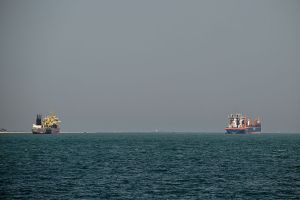
Bordered by Iran to the north and Oman and the United Arab Emirates to the south, the Strait is one of the world’s most strategically significant waterways. At its narrowest navigable point, the shipping lanes are only a few kilometres wide in each direction, meaning that at a time of conflict — such as today — the ability to restrict shipping is considerable. Considerable volumes of goods pass through the Strait — something that is clear from the fact that Jebel Ali in Dubai is the ninth-busiest port in the world. But Hormuz is more crucial to global energy markets, with around 15 million barrels of oil passing through each day, equivalent to about one-fifth of global petroleum consumption. Other chokepoints are significant; but Hormuz is the most important oil chokepoint in the world.
At the moment, almost no shipping is transiting the Strait, with an estimated 1000 vessels waiting for the conflict with Iran to pass. A small handful of ships have sailed through, with several others reported to be trying their luck by either claiming to be Chinese or by turning off transponders that reveal both their location and their true identities. More than a dozen ships have been damaged so far, with Iran saying that British ships are “legitimate targets”.
Political leaders have tried to project confidence. Donald Trump said that merchant crews and shipowners simply needed to show “some guts” if they wanted trade to keep moving through the Strait. Yet the reality suggests that courage alone is rarely enough to keep maritime commerce flowing during wartime. Guts are one thing; a US Navy ship being damaged by Iranian mines, missiles or attacks from land is another. For now, then, such are the risks to crews, cargo and hulls that shipping in the Gulf is at a standstill.
Just how high the strategic stakes have become is clear from the military deployments now underway. That message has not been lost on Greece, Italy or France — all of which have dispatched warships towards the Gulf to secure maritime traffic and monitor the Strait, although it remains unclear whether or how they will solve the problem of getting traffic moving again. In Britain, there has been fierce criticism of the Royal Navy’s absence from the Eastern Mediterranean and the Gulf, but the absence is not imminently solvable. It is the result of the British government’s catastrophic lack of foresight, decades of not investing in the sort of naval forces one needs in this century.
Trump has insisted that the shutdown in the Gulf is temporary and that oil, gas and more besides will soon start to flow again. It is typical fighting talk from a president who chose to start a confrontation with Iran because he was not able to understand why the regime in Tehran had refused to “capitulate” to American demands regarding nuclear enrichment, ballistic missile programmes and more.
Trump came to office promising never to drag the US into “forever wars”, sneering at the “so-called nation-builders, neocons or liberal nonprofits” from who had inflicted disaster on the Middle East. Now, while Trump and his team work out how to stop Iran from inflicting damage on its neighbours, others must pay the price. India imports the overwhelming majority of its oil and gas by sea, partly because it has access to a limited network of pipelines. So the collapse of shipments from the Gulf is producing an existential crisis: although the US has granted a “temporary waiver” to allow Delhi to buy Russian oil, the facts that the rupee has weakened sharply, and that authorities are reportedly speeding up customs procedures to allow faster unloading, are signs that compression of logistics at sea is already having ripple effects. Moscow emerges as an unexpected beneficiary of the crisis, as the spike in oil and gas prices will provide much-needed relief to a beleaguered economy. Russia’s geopolitical role could be additionally bolstered by the country’s purported long-standing “security concept for the Persian Gulf” as an off-ramp for the US intervention in Iran.
The consequences of the current crisis, however, extend well beyond the coming days or even the coming weeks. What we are witnessing is not simply a temporary disruption in the Gulf, but a reminder of a deeper truth about how power works in the modern world. Maritime routes remain the arteries through which prosperity, security and resilience flow. Data, algorithms, satellites and artificial intelligence may dominate the language of the 21st-century economy, but they still depend on the movement of physical goods across oceans. Microchips require minerals, energy and specialised manufacturing equipment that must be transported. Data centres require copper, aluminium, rare earths and vast amounts of energy infrastructure. Without ships and secure sea lanes, even the most advanced digital economy quickly runs into very practical limits. Power is and always has been about logistics.
For Britain in particular, this requires a series of profound shifts. The protection of shipping routes is already a central strategic task. The Gulf is one theatre where the risks are currently obvious, but it is far from the only one. The North Atlantic and the High North are rapidly emerging as arenas of growing geopolitical competition as melting Arctic ice opens new routes and as submarine cables, energy infrastructure and shipping lanes become ever more exposed to interference and disruption.
These are not challenges that can be addressed through strategy documents or policy papers; they require investment in ships, in platforms, in training and in the infrastructure that allows maritime forces to operate effectively across long distances. They also require the rebuilding of the kind of interconnected networks of ports, facilities and partnerships that once underpinned Britain’s global reach. In an increasingly multipolar world — one in which predation, risk-taking and opportunism are often rewarded — maritime resilience will become a defining measure of national strength.
In that sense, the current crisis offers a glimpse of the future. Control and protection of shipping routes is key to stability, to reduction of risk and to long-term national resilience. The resources on which new economies depend may have changed, technologies may have evolved and ships may look different. But the underlying reality remains exactly the same as when Raleigh wrote four hundred years ago: whoever commands the sea commands far more than the sea itself.