




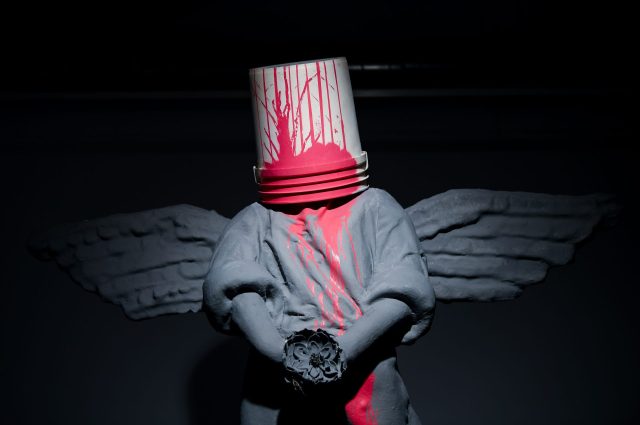
‘Banksy has been given an opportunity: to say and make things under his own name.’ (Credit: Joe Maher/Getty)





Banksy has been unmasked, yet again. The latest investigation appears to confirm the theory that he is called Robin Gunningham, though now goes by the name David Jones. The Times suggests that Britain’s favourite vandal lives in a village in the West Country, keeps chickens and grows vegetables, and sometimes goes to Methodist chapel. The Sun offers possible portraits of the artist as a 50-something man.
The fashionably jaded thing to say when you hear all this is “Didn’t we already know who Banksy was?”. In my case, though, it wouldn’t be true. I vaguely thought it was that bloke from Massive Attack, and it seems I wasn’t alone. While Robert Del Naja is relieved at the clarification, the man identified as Banksy seems to have been irritated by the fresh exposure, protesting via his lawyer that he does not “accept that many of the details contained within [the] enquiry are correct”.
Banksy also says that the reporting will interfere with his ability to make art in future, though I find this unlikely. On the contrary, I predict that the wielding of stencils and spray paint will continue unabated, assuming that their owner still manages to get up and down a ladder. Such is the cult built around the Scarlet Pimpernel of street art over the years, few passers-by are going to believe it is really a middle-aged geezer in a Barbour jacket.
Philosophers of language love such cases, finding that they raise an interesting question about proper names and belief. Say that, unaware of the new reports, I had continued to believe that Banksy was both a world-renowned visual artist and a famous trip hop star, while separately believing that Robin Gunningham was a scruffy non-famous person pottering around his allotment. In that case, it seems, I would be holding contradictory beliefs, quite rationally: both that Banksy was a famous celeb, and that he wasn’t. Yet the combination of contradictory beliefs and rationality is often supposed to be impossible.
In 1979, Saul Kripke made basically the same point with respect to an imaginary French man, Pierre, who learns from books that Londres est jolie, and then “through unfortunate or fortunate vicissitudes” moves to the English capital. More specifically, he moves to “an unattractive part … with fairly uneducated inhabitants”, where apparently nobody possesses the language skills to tell the by now London-loathing Pierre that “Londres” is the very same place. Pierre, seemingly unable to visit other parts of London, now believes of London as a whole that is both pretty and ugly. Depending on your politics, this text seems either presciently Reform-friendly or horribly dated — though perhaps not as dated as the old logic primer which gave readers the example of not knowing that Gary Glitter was identical to Paul Gadd.
The puzzle in question arises on the assumption that the names “Banksy” and “Robin Gunningham” directly refer to the same person at all times, irrespective of what users of the names believe about their bearer. But perhaps this isn’t true of “Banksy” anyway, despite the revelations in this week’s papers. Helped by deep anonymity for most of his career, his is a name that seems to have become essentially tied in its reference to a set of public artworks, rather than to a particular person.
Another counterfactual illustrates the point. If we found out tomorrow most of Banksy’s famous works were secretly done by Damian Hirst, not Robin Gunningham, wouldn’t “Banksy” start to refer to Hirst not Gunningham? This was roughly the view of Michel Foucault about authors generally — or, more pedantically, the view of whoever it was that wrote Discipline and Punishment and Madness and Civilization. As that person once wrote: “the disclosure that Shakespeare was not born in the house that tourists now visit would not modify the functioning of the author’s name”. But things would be quite different, he suggested, “if it were proved that he had not written the sonnets that we attribute to him”. Equally, Foucault argued, when people say that Homer never existed, they don’t mean to ascribe non-existence to a particular man, but only to indicate that the famous works had more than one author.
Even leaving aside such semantic arcana, the anonymity of Banksy does seem crucial to his legend. Giving interviews with shaded face and electronically distorted voice, as if in a witness protection scheme for crimes against buildings, he left viewers free to project their own entranced imaginings into the void. The mystery became integral to the perceived meaning of his pieces. And as he got more popular, the original reason given for secrecy — namely, fear of arrest — became less credible. It seems more likely that he started to fear arrest precisely because it would make future revelation of identity more likely, rather than the other way around. (Indeed, that is how the new investigation caught up with him, using old NYPD arrest records.)
Without the vagueness, it is obvious there would have been little drama around the appearance of new works, and a lot less public interest. In this respect, Banksy’s work differs from that of another famously secretive creative, Elena Ferrante. The lack of knowledge of Ferrante’s true identity is fairly superfluous to her artistry and prestige. In contrast, supposedly iconic Banksy works like “Girl with Balloon” and “Flower Thrower” would have been quickly recognised as naff and sentimental — albeit technically well executed — had they been openly done by a Bristolian called Robin sporting Nineties shades and a cheerful expression. But conceived of as emanating from an elusive superhuman, they became po-faced and solemn, full of big, capitalised feelings: Hope, Innocence, Peace.
By far the best thing Banksy ever made was his brilliantly quirky film Exit Through the Gift Shop, about an otherwise talentless French superfan who Astro-turfed his way into the street art pantheon and became known as Mr Brainwash. Here, for once, the director’s well-known anonymity hindered perception of his work’s many virtues rather than covering up its vices. Most viewers concluded the story was too improbable on its own terms, and — given the reticence of the man who made it — must be a tricksy artworld hoax.
Indeed, I can’t help wondering if ultimately Banksy won’t feel liberated by this week’s reporting: his creative persona rescued from the cage of other people’s projections, placed back within an ordinary mortal body thoroughly incapable of bending the space-time continuum. Since his artistic identity could only be defined in relation to an existing corpus of work, the well-known style could not evolve much at all. Effectively untethered from a human body with a known biography, recognition of any new work as a Banksy depended on it existing in traceable visual relation to the famous ones which went before it. The man got stuck in the Nineties and needed rescuing.
I sometimes think similar things about anons posting on the internet. Being anonymous online can be liberating — sometimes too liberating, apparently. Not all self-expression is good. But equally, anonymity can be limiting. When a public identity gets traction in a particular social world, tied to a particular kind of posting content or style; when it lacks a traceable relation to the living, breathing, more multi-faceted person who is its originator; then there is less chance for meaningful reinvention of one’s persona. You can’t hope that your readers will trust you while you metamorphose into a new and less restrictive shape; for they don’t have any idea who “you” are. For them, you are just the old shape with a made up name.
In Banksy’s case — though perhaps it doesn’t feel like it right now — he has been given an opportunity: to say and make things under his own name. That is personal liberation of a kind. He has been handed the chance to reclaim his famous past, and join it up with present and future. His expressive acts have been publicly reconnected to the self that actually made them, as a heart-shaped balloon is connected to a hand by a piece of string. In retrospect, the works now ascribed to Robin Gunningham may look more earthbound; but equally, Banksy will no longer be made entirely out of paint.
