




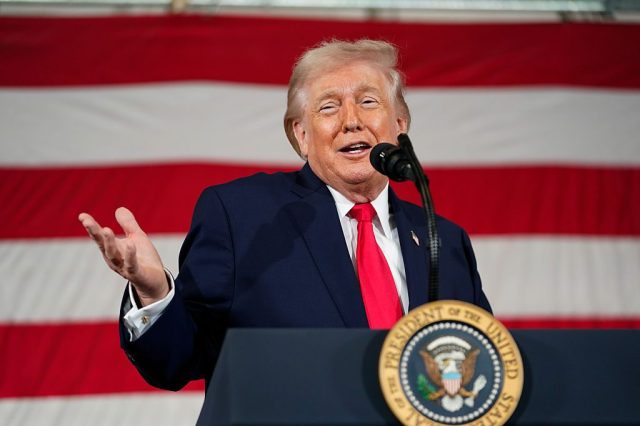
‘Trump may no longer have his tariff gun, but an economic bazooka remains’. (Nathan Howard/Getty)





Before we all start celebrating, it is worth reflecting for a moment on what the Supreme Court’s tariff ruling did — and what it didn’t. The only positive I can see is that it takes us outside the realm of threat. Donald Trump will no longer be able to point a tariff gun at the rest of us. The era of the tariff tweet, too, will end. Yet amid the bluster and the late-night posts, nothing of substance will change.
After all, virtually all the tariffs will survive unaltered. In the short-run, the President is covered. On Friday night, immediately after the Supreme Court ruling, he invoked Section 122 of the 1974 Trade Act, signing an executive order to impose an immediate 10% tariff on the rest of the world. On Saturday, he raised that figure to 15%, the maximum allowed under the Act. The tariffs will kick in tomorrow — but despite what some journalists have claimed, none of this is “defying” the judges. On the contrary, Trump is merely implementing their ruling.
The catch is that Section 122 has a time cap of 150 days. That takes us until late July. At that point, Trump could get Congress to extend the period further. It may be possible, and legally more risky, for him to reset the clock. Or he could let the tariffs lapse before applying a new 150-day batch. Whether or not this holds up in court, it will buy him time to get ready for his real tariff fightback.
The point, here, is that all the Supreme Court did on Friday was tell the President that he should have picked a different legal basis for his tariffs. This is still a big deal — but not quite as big as you might imagine.
To understand exactly what happened requires a deep-dive into US trade law. When, on 2 April last year, Trump stepped into the White House Rose Garden to declare “Liberation Day”, he used a law dating from the Jimmy Carter era. The 1977 International Emergency Economic Powers Act, or IEEPA, was a response to the two oil crises of that decade. IEEPA gave the president unprecedented rights to act in response to a crisis, from freezing foreign assets to confiscating foreign property.
Importantly, though, IEEPA says nothing about tariffs. Yet Trump picked it as the legal basis for his Liberation Day tariffs — and this is what the Supreme Court objected to. In essence, the Court ruled that the US faces no immediate emergency, unlike in the Seventies. In any case, tariffs fall under a different set of laws. The Court decided against the US administration with a majority of six to three, with Brett Kavanaugh one of the dissenting justices, and the legal disagreement essentially about who decides what constitutes an emergency.
In his minority opinion, Kavanaugh made one point that is not contested: that the ruling would have little effect in real life. As he puts it “numerous other federal statutes” allow Trump to impose tariffs legally — “albeit perhaps with a few additional procedural steps”.
What are those procedural steps? Quite simply the two big trade acts through which presidents normally levy tariffs on other countries. They’re hardly arcane: Joe Biden used them too. The first is the Trade Expansion Act of 1962, specifically Section 232 on national security. It allows the president to levy tariffs on products he deems to be a potential threat to national security. The Trump administration already levied tariffs on several products under this act — cars and trucks, steel and aluminium. There is also copper, furniture, lumber, and timber. The Supreme Court ruling has no effect whatsoever on these Section 232 tariffs, and indeed the Trump administration may yet use it to stick tariffs on foreign airline parts and pharmaceuticals. If this happened, the Canadians and the Europeans would suffer most.
Section 232 tariffs only concern goods for which a national security argument can be made: notably critical raw materials. Dolls imported from China, or French luxury handbags, clearly do not fall into that category. The heavy lifting that yielded most of America’s tariff revenue before Trump’s Liberation Day announcement came from Section 301 of the 1974 Trade Act. That’s also where most of the action on future tariffs will come from, now that the Court has blocked the IEEPA route. Section 301 is about unfair trading practices, like violations of trade agreements, or any policies that are deemed to discriminate against US businesses. Trump will have little difficulty here, with Section 301 playing into his rhetoric that foreign trading partners are out to cheat America.
That, of course, still leaves one question: why did Trump go down the IEEPA route to start with, when he had these other laws at his disposal? The answer involves understanding the President himself. Trump is a man of transactions, not procedures — and both the 1962 and 1974 acts are heavy on procedure, typically taking about a year to enact. In the case of Section 232, the Department of Commerce must first investigate the effects of the relevant imports on national security. There are maximum, but no minimum, time limits. There are no formal appeal procedures, but there are legal safeguards in place to prevent the process from being cynically short-circuited. The investigation takes at most 270 days, after which the president has 90 days to decide whether to act. In practice, the process is a little faster, but not much. Back in 2017, Trump’s tariffs on steel and aluminium took almost a year to enact.
Section 301, too, requires a formal procedure, in this case by the US Trade Representative. A typical 301 investigation takes 6-12 months from start to finish. Those investigations come with depositions and hearings, and end with a long report. After four years, the tariffs must be reviewed.
Bureaucracy, in short, intrudes. This explains why Trump first chose IEEPA as the legal basis for its tariffs: for its speed and what we might therefore call its “threat factor”. Not for nothing did Scott Bessent, the US treasury secretary, once refer to tariffs as the gun on the table.
Yet if the 1962 and 1975 acts are big on paperwork, Kavanaugh is again right that Trump will ultimately be able to get his way — and Congress will be unable to stop him. Another advantage of both laws, after all, is that they are firmly in the president’s gift to enact.
Here, then, is the timeline: the temporary 15% tariffs will kick in this week, buying Trump the space to impose the bureaucratic procedures that make them permanent. He could even end up raising the total level of tariffs if he so wished; I myself foresee a scenario where tariffs on cars from the EU and the UK go up by a tenth. That is even as he uses the law to bolster his broader argument about America’s economic position. “They rip us off,” he said of the EU a year ago. Well, that is precisely what Section 301 is about.
So if you hate Trump, you may well celebrate the Supreme Court ruling as a symbolic defeat. If, however, you hate the tariffs, you have no reason to cheer: the powers of the President to impose tariffs unilaterally are not affected at all.
Why, then, are people celebrating? I’m reminded here of the lawfare against Trump ahead of the 2024 election. I remember the BBC in particular expressing gleefully confidence that the New York criminal case against Trump would deprive him of the means of launching an effective campaign. In that particular case, the US Supreme Court came to Trump’s rescue. What has always helped Trump is a tendency by his opponents to overestimate the effect of legal games.
A deluded German commentator described the ruling as an “embarrassment of historic proportions”. There is an awful lot of “peak Trump” commentary about. Statements such as these may be designed to make us Europeans feel better, but they just don’t hold up to scrutiny. The tariffs were Trump’s most important economic policy decision — and they will stay, even as he has almost three more years of his four-year term.
The real problem with Trump is not that he is a buffoon, but that he learned how to game the political system. Not all of the mud he throws will stick. But a lot will. The President may no longer hold his tariff gun, but an economic bazooka remains, and it is pointing at the rest of us.
