




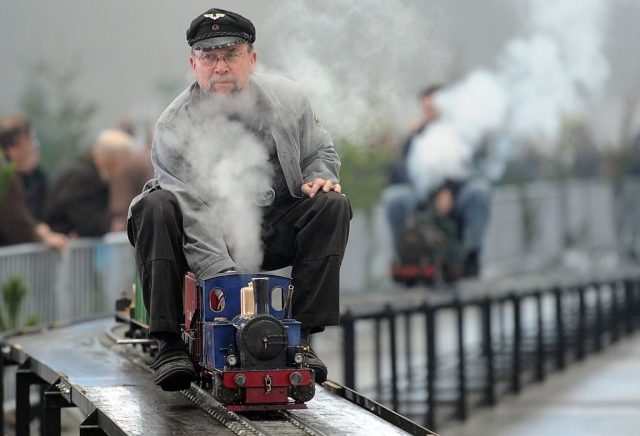
‘A true eccentric does not announce himself as such.‘ (Uli Deck/DPA/AFP/Getty)





There used to be a man on Railton Road in Brixton who fixed bicycles outside his house. A great sprawl of frames spilled out onto the pavement, rusty wheels and chains jutting out like some Mad Max sculpture. Pedestrians wordlessly negotiated the obstacles, cars gave him right of way, neighbours defended him in the abstract without ever engaging with him directly. The entire street bent around his presence. He was reclusive, sometimes abrasive, and entirely unbothered by whether anyone understood what he was doing.
Then one day, late last year, the bikes disappeared. The bloke still lives there but the road is now clear. No one remembers an argument, there was no scandal, no crackdown. The man’s presence was suddenly intolerable to someone.
This is something I’ve noticed a lot in London — in Britain— in recent months and years. For just as the Railton Road bike man has gone, there is less room for such eccentrics nationwide, not because they’re explicitly discouraged, but because the conditions that once allowed them to flourish have quietly disappeared. And as annoying as they might sometimes be, their demise should give us pause. For when a country loses its eccentrics, it is also losing something else: its ability to tolerate difference.
When people talk about eccentricity, they tend to reach for caricature: the bow tie, the tatty tweed jacket, the outlandish hobby. But British eccentricity, at least in its pre-digital form, was never about whimsy or self-display, and certainly not about being noticed. If anything, it depended on the opposite: the right to be left alone. Eccentricity meant being deeply, obsessively into something without having to explain why, or seeking approval, or converting it into a story about yourself. It meant taking up space, physical and social, sometimes psychic too, and assuming the world would adapt around you. It was unselfconscious, often impractical and almost entirely offline.
There are BBC archive clips from the middle of last century that capture this perfectly: grainy footage of men explaining why they spent every weekend racing pigeons, or cataloguing train numbers, or building elaborate model villages in sheds that have swallowed entire gardens. There were women, too, who religiously swam in freezing reservoirs or organised WI sub-groups for competitive jam-making or would catalogue local wildflowers.
The tone of these interviews is crucial, because nobody asked these people what it said about who they were, or whether they worried if it looked strange. The camera observed, a bit bemused, then moved on. Eccentricity, in other words, once sat alongside fair play and self-deprecation as a cliché of the English character. Like all clichés, it pointed to something real: a social contract in which oddness was tolerated, even cherished, provided it did not demand attention or recognition.
This “live-and-let-live” attitude didn’t come from nowhere. Rather, it sat in the English liberal tradition that treated privacy and nonconformity as basic civic goods. As John Stuart Mill put it in On Liberty, “the tyranny of opinion” makes eccentricity a reproach, and that a society in which “few now dare to be eccentric” is in cultural danger. Postwar outsiders said something similar. The Hungarian writer George Mikes, after making Britain his home, made a running joke of how his adopted country seemed to run on the right to be a bit odd without explanation.
This broad societal and political culture has been fertile ground for eccentricity in practice. For much of the 20th century, London possessed both an artistic, global population and the kind of slack in which eccentricity could flourish: lock-ups, squats, empty sheds, permissive pubs, and landlords who didn’t much care what you got up to so long as the police weren’t involved. Informal arrangements flourished. You could be known without being managed, tolerated without being processed.
The city was full of small, semi-hidden worlds like this. Railway modellers, for instance, often built vast, painstaking layouts in the back rooms of pubs, hauling their trestle tables out once a week. Economics mattered here as well. For much of the 20th century, London was not just culturally permissive but materially forgiving. In the Fifties and Sixties, a room in an inner London bedsit might cost a few pounds a week — cheap enough to be covered by casual work or a small stipend. That affordability created time, the essential precondition of eccentricity. When your rent did not demand total optimisation of your life, you could literally afford to be odd.
Over the past 30 years, however, London has undergone a near-total elimination of this slack, with every square foot expected to perform, to generate predictable value, to make sense to someone who has never stood in it and never will. Rooms are monetised; lock-ups become storage units, pubs turn into developments — since 2001, the capital has lost over a quarter of its boozers — and anything that cannot justify itself economically is considered a problem to be addressed.
This process is usually described as regeneration, a word that carries an implicit promise of improvement while carefully avoiding the awkward question of what, exactly, is being economised out of existence. The death of eccentricity is a story about space: who owns it, who controls it, and what kinds of behaviour are now considered acceptable within it.
Private equity, rumoured to own over 10% of all London real estate, has played its part in this transformation. Not because it harbours any particular hostility to oddness, but because its logic is fundamentally incompatible with it. When housing blocks, shopping parades and entire neighbourhoods are owned by distant entities, whose primary relationship to place is financial rather than lived, the public space around them becomes something that must be managed and smoothed of irregularities. Anything that might unsettle a potential buyer, deter a tenant or complicate a valuation is ironed out.
The eccentric, with his rusty bikes and muttered conversations, becomes a liability. He isn’t dangerous or even especially disruptive; he is unquantifiable. London once had room, both physically and psychologically, to absorb these people. Now it does not. Or rather, it has chosen not to.
You can see this most clearly in London’s spread of privately managed space. Places like Paternoster Square may look open, but they operate more like shopping centres, patrolled by private security with the power to move on anything out of the ordinary. Photographers, skateboarders, street performers, even people lingering without purpose — all have been challenged or removed.
There is also a deeper cultural unease at work, one that has less to do with economics than with how we now understand difference itself. Britain has become oddly uncomfortable with unlabelled strangeness. In theory, we live in an age of radical individualism, an unprecedented freedom to be oneself. In practice, we are far more tolerant of difference that comes with a narrative attached. You can be different, provided you explain yourself. You can be strange, provided you reassure everyone that you are harmless and intentional. What you cannot easily be is odd without commentary, absorbed in something that makes little sense to anyone else.
This is also where the Americanisation of British culture comes in. Identity politics, imported wholesale from across the Atlantic, is organised around what people are rather than what they do: fixed categories of race, sexuality, or background, rather than the eccentric, often inexplicable pursuits that once defined a person socially. Difference is no longer something that emerges accidentally through habits and hobbies, but something that must be declared.
A true eccentric, though, does not announce himself as such. He does not perform his oddness for an audience or curate it into something shareable. He simply goes about his day, often oblivious to how he appears to others, which is precisely what makes him unsettling in a culture that expects every deviation from the norm to come with a press release.
There is a related shift in how society imagines itself. Since the Nineties, Britain has increasingly been described not as a shared civic culture but as a collection of “communities” — a language borrowed from American multiculturalism and now ubiquitous in politics and public life. The paradox is that while this has expanded recognition at the group level, it has narrowed the margin for individuality within it. When everyone is encouraged to speak as something, there is less room to simply be odd on one’s own terms.
Eccentrics are often described as outsiders, but that isn’t quite right. An outsider knows he is outside. An eccentric rarely thinks about his position at all. In one BBC clip from the Sixties, a middle-aged man stands beside his pigeon loft, calmly explaining that he spends every spare hour training birds to race long distances. Asked why, he looks briefly puzzled, then shrugs: he enjoys it; that is explanation enough.
Today, people learn early to smooth their own edges, to translate interests into identities, hobbies into side hustles, curiosity into content. The modern cult of individuality has produced so few true eccentrics. To call yourself an eccentric, to present it as an identity, is already to misunderstand the thing itself. The internet has accelerated this misunderstanding to the point of extinction. Online, every interest is instantly contextualised, aestheticised and monetised. There are no obscure fascinations, only underdeveloped niches.
This is why so much contemporary “weirdness” feels hollow, all surface and no substance, a series of costumes and gestures designed to signal difference without ever actually testing the limits of tolerance. Trilby hats and barefoot running and astrology, reactionary affectations worn with a self-conscious Shoreditch wink. This is not eccentricity but its imitation, a way of looking different without risking the social consequences of actually being so.
And so Britain can now tolerate tattoos, lifestyle signalling, curated weirdness, endless micro-aesthetics and self-descriptions, while struggling profoundly with strange routines, uncommercial obsessions and people who occupy public space in odd ways.
But a culture that cannot tolerate such oddness risks becoming narrower, more brittle, more obsessed with control. It may be more efficient, more predictable, more easily navigated by those who already understand its rules, but it is also less forgiving, less surprising and ultimately less interesting.
You can feel this narrowing in small ways. In the officiousness of public places: the endless announcements telling you to mind the gap, mind your step, stand behind the yellow line. In policing that increasingly prioritises order and compliance over discretion, and treats mild oddness as a potential risk rather than a harmless quirk. In politics, too, where cultural taste has become something to be focus-grouped rather than confessed, and where even ministers seem wary of admitting to liking the wrong book, the wrong band, the wrong thing altogether.
London still produces creative people, strange characters, oddballs of every description. But they are increasingly forced to sanitise themselves, perform themselves, or leave. Railton Road is easier to walk down now. It is cleaner and quieter. But something inarticulable has been lost.
When people talk about the death of eccentricity, they imagine the characters disappearing one by one, fading out like figures in an old photograph. But what actually vanished first was the space around them.