




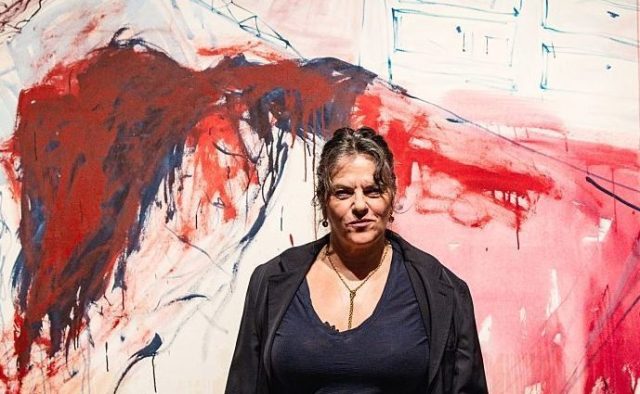
Tracey Emin posing beside “The End of Love”. (Adrian Dennis/AFP/Getty)





I am old enough to remember when everyone except Charles Saatchi hated the art of Tracey Emin. In 1999, she was nominated for the Turner Prize for “My Bed”, her iconic unmade bed, which was duly exhibited at Tate Britain and which is the centrepiece of her new retrospective at the Tate Modern. The artwork was a snapshot of her dissolute “slut” lifestyle — the phrase “slut-shaming” didn’t exist in the Nineties — complete with stained sheets, underwear, condoms, lube and empty vodka bottles. The media absolutely hated it. The Evening Standard’s Brian Sewell declared that he “would not waste his breath on that woman”, but a year later his resolve faltered, and he called her a “self-regarding exhibitionist” who was “ignorant, inarticulate, talentless, loutish and now very rich”. Even the Guardian’s down-with-the-kids art critic Adrian Searle said she was “endlessly solipsistic” and called her “a bore”.
Her other signature work, “Everyone I Have Ever Slept With 1963–1995”, from 1995, fared little better. A camping tent with the names of her lovers sewn inside, it was a sardonic riff on the art historical tradition of the mausoleum and war memorial. But even the softly-spoken Martin Gayford, biographer of Michelangelo, Van Gogh, Constable and others, politely suggested it was “pretty nondescript to look at”. Members of the public joined in. The BBC reported that a South Wales housewife, Christine de Ville from Swansea, drove 200 miles to London to the Turner Prize show in 1999 and attempted to tidy up Tracey’s bed.
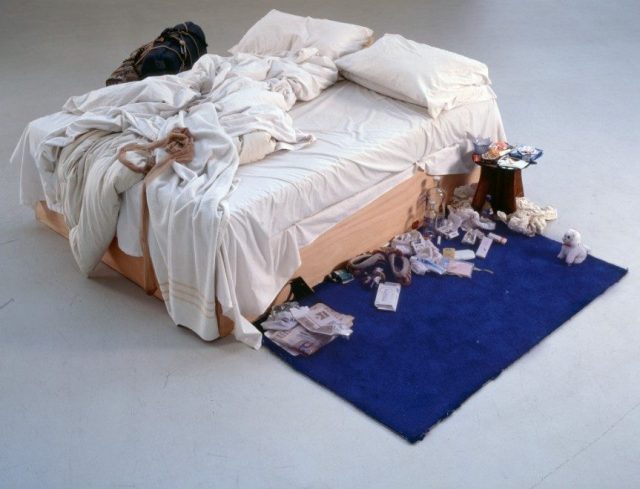
There was no let-up. In 2003, Spectator art critic Philip Hensher described Emin as “thick”, “half-witted” and “gormless”. With her copious artworks about her libido, abortions and masturbation, it was easy to slag her off for being a slag. She had a semi-famous boyfriend, Billy Childish, who was a Stuckist, and it was a miracle no one called her a Sluttist. Perhaps it was only Charles Saatchi and a few others who noticed that in “My Bed”, Emin had taken the classic still-life painting and reimagined it as a real-life installation, artfully arranged, meanwhile channelling Marcel Duchamp’s early 20th-century invention of the “readymade” artwork — the urinal, wine rack, bicycle wheel on a stool, etc — in tongue-in-cheek fashion. Here was an “unmade”. Saatchi bought the bed for £150,000 and reputedly set it up in his own dining room.
And now, look how far we have come. Emin is the subject of a major retrospective at Tate Modern — and note that this is Tate Modern, not Tate Britain, where the apparently lesser Cornelia Parker and Sarah Lucas had their retrospectives. Tate Modern tends to be where the foremost contemporary artists have their grand surveys, including Damien Hirst at the height of his influence in 2012.
The art critics have duly changed their tune. In a review of her 2011 exhibition at the Hayward, Searle found “a far greater range of tempos and registers of feeling than we might expect”. In 2024, in a video made by her gallery, Jay Jopling’s White Cube, Gayford called her “a painter absolutely at the top of her game”, which I am sure was a sincerely held opinion, rather than one purchased with a cheque from the gallery. In 2007, Emin was appointed professor at that conservative bastion of the British art establishment, the Royal Academy — only the second woman to attain the position. That same year, she had the British pavilion at the Venice Biennale. In 2014, that bed was auctioned for £2.5 million at Christie’s. In 2018, she emblazoned the Eurostar station St Pancras with one of her neon sentences, each of which packs a sigh-inducing, or heart-quickening emotional story into one line. “I want my time with you”, this one says. In 2024, she was knighted: it’s Dame Tracey Emin to you now. She’s gone from Enfant Terrible to Grand Dame to national treasure. She is the Lady Di of contemporary art.
All of this makes Emin the most admired and — alongside Hirst — the best known of the YBA generation, the punky Young British Artists who emerged in the Nineties. They were a bunch of brash pop conceptualists mostly from Goldsmiths, who included Damien Hirst, Gary Hume, Gillian Wearing, Michael Landy, Jake and Dinos Chapman and Sarah Lucas. At Goldsmiths, under the tutelage of Michael Craig Martin and Richard Wentworth, they were encouraged to make artworks like adverts and to act as provocateurs. Emin was at one remove from this crowd. She wasn’t at Goldsmiths, she was at the Royal College of Art, by this time an entirely post-graduate institution. Where Goldsmiths emphasised concept, the RCA emphasised craft. Emin found it traditional to the point of alienating. “I felt very lost at the RCA. It was very conservative, non-experimental and non-political.”
In terms of fame and income, she brought up the rear. At the beginning of the Nineties, Hirst was already famous for his formaldehyde animals, cigarette butts and medicine cabinets, the Chapmans for their arrangements of naked mannequins, Gary Hume for supermodels painted with tubs of Dulux, and Wearing for her photos of people holding signs. Emin’s first solo show came in 1993 at White Cube, memorably featuring a crumpled packet of cigarettes that belonged to her dead uncle. However, she only really made a major impact when her tent was shown in Charles Saatchi and Norman Rosenthal’s epoch-defining Sensation show at the Royal Academy in 1997.
Emin wasn’t really part of the great art boom of the YBA era, either. You could buy a Hirst Spot Painting at the beginning of the Nineties for around a grand; by the mid-Nineties, you’d pay almost £30,000; by the early 2000s you could sell it for six figures and in 2008, someone paid a record price of $3.48 million for one at Phillips de Pury & Company in London. Likewise, you could pick up a work by the Chapmans for under £50,000 – but in 2000, Saatchi paid £1 million for an entire exhibition of their work at White Cube. However, Emin came from behind and overtook her rivals on the final stretch. The value of Hirsts in the art market has halved since the 2007 peak of his “Beautiful Inside My Head” auction at Sotheby’s. Few have anything good to say about his recent work, whether it is the paintings full of colourful dots (“Veil Paintings”, 2018), the mock-shipwreck trophies (“Treasures from the Wreck of the Unbelievable”, 2018), or the crypto stunts (“The Currency”, 2021). Little is heard of Gillian Wearing. Reviews of Hume’s shows are dutiful. No one wishes to be reminded of the Chapman’s mannequins of children with genitals attached to their faces in the age of Epstein — so I apologise for reminding everyone. Meanwhile, the reputation of Emin has only grown over the past two decades and her auction prices have done similar. Charles Saatchi bought her bed for £150,000 in 1998, and it sold at auction for £2.5 million in 2014. In February 2005, one of Emin’s paintings went for £722,000 at Christie’s, but in October 2022, it auctioned another for £2.3 million.
Full disclosure: I have long been a fan. In 2009, I reviewed Emin’s hand-drawn animated film of a woman masturbating, “Those Who Suffer Love”, stating that henceforth “no museum exhibition about feminist art, art about the body or sexual identity in art will be complete without this work”. Yes, even in those pre-social-media days, wildly exaggerated statements got you the readers’ attention — but it was my genuine opinion. In those days, with the wide-eyed enthusiasm of youth, I used to think she was good, but now, as I approach dotage, I think she’s Britain’s greatest living artist.
I can hear the disgruntled murmurs of outraged readers, who remember how she appeared drunk on a late-night TV talk show (Is Painting Dead? Channel 4, 1997) or recall reading in various interviews in the 2000s how she had to pop off to the toilet to vomit. And, no doubt, some cynics will put the great Emin reappraisal down to the age of wokeness. It’s because you can’t criticise a public figure like Tracey Emin. She’s a woman from a working class, immigrant background, and a victim of sexual abuse. That’s what explains all the positive reviews her shows have been getting over the past 15 years. Then there is her generous philanthropy in her hometown of Margate, which shields her from negative press. Emin returned there in 2017 to set up her studio. Since then, she’s turned dilapidated buildings into artists’ studios, bought cheap flats for them to live in and funded residencies. Now, she’s building community centres, gyms and restaurants. Other hardened anti-Eminites might put it down to her narrow escape from death. Her bravery is undeniable and who wants to knock a cancer survivor?
But there’s more to Emin than her bravery or philanthropy. She is an artist, not a social worker or medical miracle — and it’s her art that makes her great. In an era when so many contemporary artists have built an entire career on one method, like cast the undersides and insides of things, mentioning no names, there’s a dazzling, restless variety to her work, as the Tate show reveals: paintings, photos, quilts, videos, sculptures (some in bronze, others knocked up with wooden planks and nails), all sharing the same aesthetic of opposites held in tension, tenderness and bolshiness, self-pity and empathy, victim and victor, lust and love.
Every great artist should be a little ahead of their time, and from today’s perspective, Emin’s self-obsessed, sex-obsessed, confessional art anticipated our era of public intimacy, of sex positivity, of talking about one’s mental health: even of victimhood.
She is unapologetic about enjoying sex, a proto-Charli XCX in this respect, but equally frank about her experiences of rape — a frankness that has, in time, helped to destigmatise other women who have come forward with stories of male sexual violence. The Tate show opens the week after Gisele Pélicot published her memoir about the banality of male sexual violence, and with the horrific details of Jeffrey Epstein’s sexual exploitation of young girls still emerging. It includes her video “Why I Never Became a Dancer” (1995), in which she recounts how as a young teenager she had sex with men in their twenties: “the reason why these men wanted to fuck me, a girl of 14, was because they weren’t men, less, less than human”. Also present is “How it Feels” (1996), about Emin’s experience of abortion.
In short, all the things we used to think were gross about Emin’s art now appear to be intrinsic to and prophetic of the times we live in. But at the same time, unlike most influencers’ TikToks, Emin’s oversharing does not feel curated or calculated. There is a convincing naivety and directness in the stories she tells.
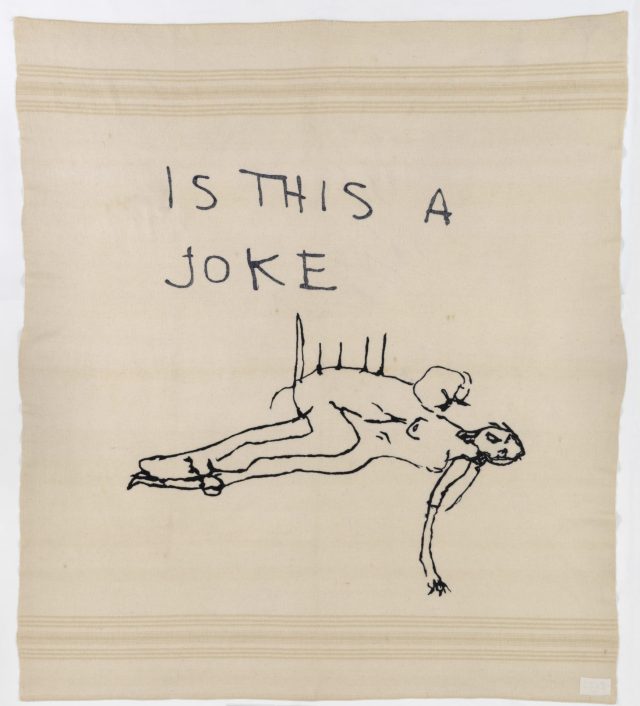
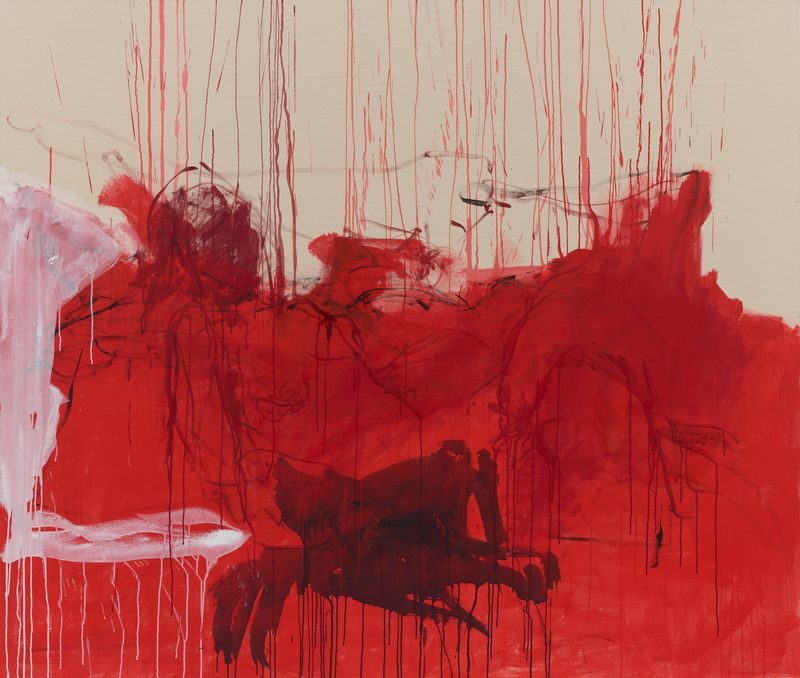
Art critics and historians can rightly complain that there is a shamelessly derivative quality to Emin’s art — as if she were shoplifting tins of postwar artistic formulae from a supermarket shelf. Her collections of framed mementos and sketches are pure Sophie Calle; her quilts fit right in with those of Judy Chicago’s and Faith Ringgold’s; and her neon texts come straight out of the Bruce Nauman playbook. But in each instance, Emin has made them her own. Her paintings are a good example of that. Those drips, mulched nests of brushstrokes and scrappy fields of colours owe an obvious debt to Joan Mitchell and Jean-Michel Basquiat. The ghostly muted palette comes from the Nineties’ “bad painting” movement led by Luc Tuymans. Her brushwork is scrappy, yes, but if you peer at those quick messy lines, they capture emotions, poses and identities. You can often identify distinct outlines of her own face in her wan black brushstrokes, and detect on her face her recurring vocabulary of emotions — sadness, agony, desire. Trust me, it’s quite a skill to appear that clumsy yet communicate with such precision. Not every picture is a winner (nor indeed, every kind of art work; I don’t care for her blobby sculptures blown up from little clay maquettes), but Emin’s washes of pinks, greys and blues, from which the outlines of bodies begin to emerge, evoke the delicate and tentative effort to express feelings. All her own.
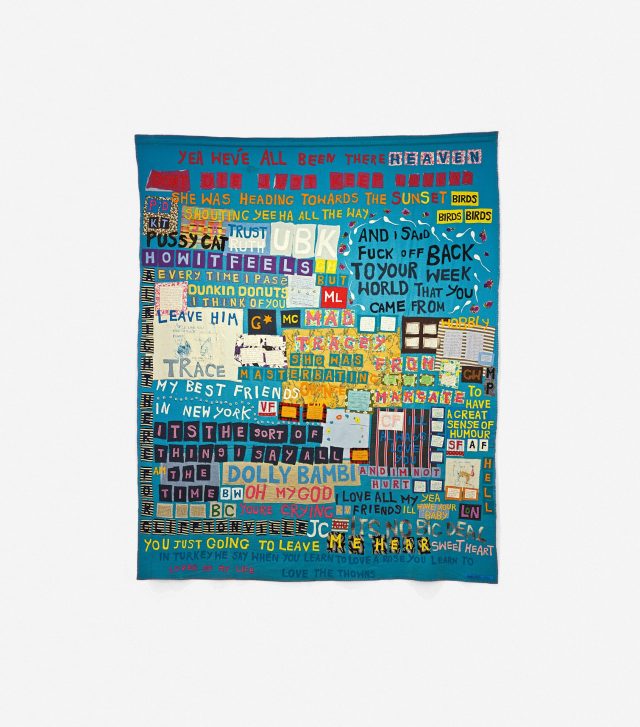
Emin is also an artist rooted in place: in her beloved Margate but also in her Britishness. (By contrast Hirst, Gary Hume’s, and the Chapmans’ art could have been made anywhere.) In one of her early provocative videos, she runs down streets half-naked, trailing a Union Jack. The beach huts, drunkenness and classic vernacular phrases like “fuck off and die you slag” place her art in a working-class experience of Britain in the Nineties and ever since. She is part of a “kitchen sink” tradition of British culture, tracing back to the plays of John Osborne in the Fifties and forward to Mike Leigh, Irvine Welsh and the films of Andrea Arnold and Clio Barnard. Unlike most contemporary art of the past 20 years, there’s nothing shiny and glitzy about Emin’s art. As she wrote on one of her quilts, she’s Tracey from Margate. Always was, still is.