




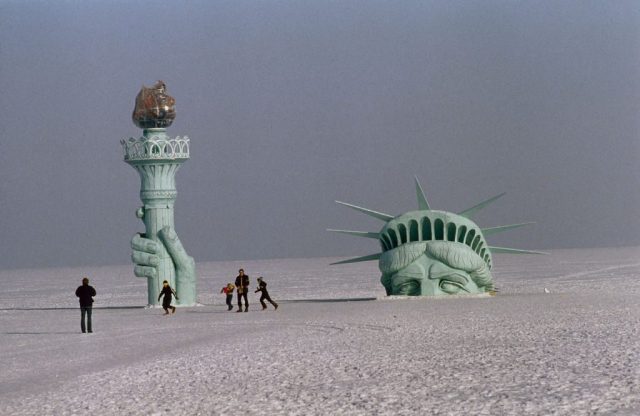
The battle for Western authenticity is fairly recent. (Credit: UPI/Bettmann Archive/Getty)





On one thing, President Trump and the woke Left can agree: the West is a mess. And we are indeed witnessing a crisis of Western civilisation — all three versions of it that emerged in the wake of World War II. It’s a good thing, too, because all three are ahistorical, noxious to varying degrees, and ultimately out of step with what most ordinary people believe about the West.
The three rival conceptions can be identified as creedalism, multiculturalism, and pan-white tribalism. For creedalists of the centre Left and centre Right, the West is a supra-national community of individuals who, regardless of race or religion, share a personal devotion to a universal creed of human rights and liberal democracy.
For Left-wing multiculturalists, meanwhile, the West is made up of European and North American countries with shared legacies of white supremacy and colonialism, countries that ought to be internally remodelled into multicultural societies in which “culture” is used as a synonym for biological race: to fulfil this model’s promise, whites must be deposed; “black and brown folks” lifted up.
Finally, for many, though not all, conservatives and Right-wing populists, the West is an ethno-religious community defined by pan-ethnic white racial identity and pan-Christian or Judeo-Christian religion. Some edgier varieties exclude either Protestantism, Catholicism, Judaism, or more than one of the three. Still more exotic ones hark back to paganism, viewing Christianity as a Jewish imposition on Viking vitality.
Partisans of all three visions have struggled to reconcile their preferred model with the actually existing political communities of the West, and they view this failure as a “crisis” of the West. It isn’t. Rather, demographic reality simply defies their neat, ideologised picture. Culture and nationhood still matter, but what anchors them are shared language and customs — not Enlightenment philosophy (as the creedalists would have it), not anti-European resentment (as the multiculturalists would), and not blood-and-soil devotion (as the ethno-sectarian Right would).
Start with the creedalists. In April 2016, then-President Barack Obama warned that if UK citizens in the Brexit referendum voted in favour of leaving the European Union, Washington would collectively punish them, sending Britain to “the back of the queue” for any future trade deals.
In the language of trans-Atlantic centrist creedalism, Obama praised the European Union as one of “the international institutions” that enabled those in its sphere “to institutionalize and internationalize the basic values of rule of law, and freedom, and democracy, that … benefit our citizens as well as people around the world.”
These warnings notwithstanding, a decisive majority of Britons voted to leave. Today, returning to the European Union is the quixotic fantasy of a minority, often belonging to the upper professional classes. Creedalism has suffered many other defeats, including the backlash on both sides of the Atlantic against the disastrous global crusade for democracy of Tony Blair and George W. Bush, who in his messianic second inaugural address declared: “America’s vital interests and our deepest beliefs are now one…. Advancing these ideals is the mission that created our Nation … now it is the urgent requirement of our nation’s security, and the calling of our time.”
Then there is Left multiculturalism, which mounted its strongest showing during the Black Lives Matter protests that erupted in 2020 in the wake of George Floyd’s death in Minneapolis. Although policing and race relations in Britain and the rest of Europe are very different from American conditions, BLM spread beyond US shores, underscoring the movement’s (anti-)civilisational ambition.
Inspired by the American Left, activists in European countries vandalised or pulled down civic monuments, rewrote university curricula and museum exhibits, and demanded racial preferences. The BLMUK manifesto parroted the rhetoric of Left-wing American activists: “We’re guided by a commitment to dismantle imperialism, capitalism, white-supremacy, patriarchy, and the state structures that disproportionately harm black people in Britain and around the world.”
Yet this version of Western “civilization” likewise failed to take hold and exhausted itself. Today, Americans look back on that period — so-called peak woke — almost as a bad (if also oddly humorous) dream. And while such trends take longer to dissipate in the imperial periphery than in the core, it’s unlikely that European-style woke-ism will last much longer. Indeed, in Europe the crises of immigration and assimilation are, in some ways, far more acute, and are likely to discredit the multicultural model for a generation or more.
The Right’s answer to the creedalism of the liberal centre and the race-based multiculturalism of the Left is a kind of trans-Atlantic nativism, in which the West is defined as a civilisation by racial and religious “heritage”. In 2025, for example, the Trump administration implicitly argued for an ethno-religious definition of the West in its National Security Strategy.
The document contains lines about the importance of Europe as a military ally and a trading partner that could have appeared in any American state paper. But it weaves these into a lurid narrative of Europe and the United States as parts of a single embattled trans-Atlantic ethno-religious community, with shared ancestry and culture as a basis for US-European relations — a concept that would have startled generations of Americans who drew a sharp distinction between the Old World and the New.
Using apocalyptic rhetoric common on the far Right but hitherto unknown in American state papers, the NSS warns that Europe faces “civilizational erasure”. According to the NSS: “Should present trends continue, the continent will be unrecognizable in 20 years or less.” The NSS gets as close to outright racism and anti-immigrant white nativism as an American state paper can go: “We want Europe to remain European.”
The subtext: Europe doesn’t look European any more, with all those dark-skinned invaders like former British Conservative Prime Minister Rishi Sunak, current Tory leader Kemi Badenoch, and former Irish prime minister Leo Varadkar.
According to the Trump administration, the good news is that the “growing influence of patriotic European parties” — that is, Right-wing nationalist parties opposed to mass immigration and the European Union “indeed gives cause for great optimism.” Implicitly identifying “America” with white Americans of European descent, the document states: “America is, understandably, sentimentally attached to the European continent — and, of course, to Britain and Ireland.”
This would be news to many Americans, including many British- and Irish-Americans, whose ancestors fled poverty or persecution and have no interest in this or that old country. And the idea that sentimental Europhilia is an important part of American culture is hard to square with the intense resistance on the part of many Americans to US involvement in the two world wars.
The language of Trump’s NSS reflects the worldview of pan-Western American paleoconservatives who idolise the likes of Prime Minister Viktor Orban of Hungary. Orban has described his ideal as “illiberal democracy” and, in July 2022, declared: “We [Hungarians] are not mixed-race: we are simply a mixture of peoples living in our own European homeland.… We are willing to mix with one another, but we do not want to become peoples of mixed-race.”
Religion-mixing, rather than race-mixing, is the target of other defenders of an ethnic conception of the West. In 2025 Andrew Beck, a fellow of the Claremont Institute, which has sent dozens of fellows and staffers into the two Trump administrations, denounced the construction of a Hindu “idol” in Texas and asked in The American Mind: “Are we permitted to determine whether the foundation we build upon remains a distinctly Western, Christian civilization that assimilates outsiders into its mold?”
Another Claremont fellow, Jeremy Carl, may have doomed his chances to be confirmed as Trump’s nominee to be assistant secretary of state for international organizations with his past statements about the Civil Rights Act of 1964 as an “anti-white weapon”.
During a hearing on his nomination, Sen. Chris Murphy (D-Conn.) asked Carl to define “white culture”: “You have made several statements about your worry regarding the erasure of white culture in America,” Murphy said. “You know, I understand Irish-American culture. I understand Italian-American culture. I maybe don’t understand white culture, as well. Tell me the values, the white values, that you believed are being erased by the current American government or the prior American governments.”
Carl, Trump’s nominee, mumbled and struggled to respond, before finally thinking of an example unrelated to immigration and based on race: “I would say that the white church is very different than the black church in terms of its tone and style on average.”
OK, good luck to the populist Right in the quest to frame the black church as the big civilisational threat. Indeed, it’s pandering to the likes of Carl and those further to his Right that will likely break apart Trump’s diverse coalition in the 2026 midterms and beyond.
As Carl’s statement suggests, moreover, while uniting fellow adherents in the United States and Europe, each of the three conceptions of the West is used to divide people within countries between “Westerners” and “non-Westerners.” For the ethno-religious nationalists, American society is divided between “authentic” Americans, who are white and Christian, and Hindus and blacks and many others, who will always be outsiders, even if technically they are US citizens.
For their part, American multiculturalists agree that “Western” means “white” by the US Census definition, so that “decolonizing the curriculum” can mean the inclusion of black American authors who by definition are “non-Western”, even though their native language is American English, their religion is Protestant Christianity, and their ancestors have lived in the United States for centuries.
For creedalists, meanwhile, racists and religious nativists are “un-American” because they don’t share a universalist, ideological conception of Americanism. Belonging to the liberal centre, creedalists also typically reject Left multiculturalism, albeit usually with much less vehemence than they reserve for the racial Right.
What’s notable about these three versions of “Western civ” is that none has a deep historical pedigree. Rather, all three coalesced in the aftermath of World War II, during the civil-rights revolution of the Fifties and Sixties. Before then, America’s elite tended to define the American nation as an Anglo-Saxon Protestant community, an offshoot of the Germanic Protestant family of nations.
Of the three versions, the only one that resembles what most Americans for most of American history thought is today’s white nationalism. But here’s the irony — by including white “ethnics” like Irish-, Polish- and Italian-Americans in the category of authentic Americans, contemporary American white nationalism is by historic standards liberal, inclusive, and diverse.
In contrast to what might be called the new nativism, adherents of the old American nativism assumed that the white race was composed of distinct sub-races with hereditary cultural and personality traits. Anglo-Americans (the majority of US citizens until around 1900) were thought of by leading scholars and politicians as members of a Germanic tribe that was superior to barbaric Celts like the Irish, hot-blooded Latins like the French and Italians, and primitive Slavs like the Russians and Poles.
For two centuries after the Founding, this was the elite view, not an eccentric one. For example, in 1776, Thomas Jefferson proposed that the Great Seal of the United States depict “Hengist and Horsa, the Saxon chiefs from whom we claim the honor of being descended, and whose political principles and form of government we have assumed”. Like the radical Whigs of 18th-century England, Jefferson believed that Anglo-American ideals of freedom and self-government originated with Dark Age Germanic tribes. Later in 1825, Jefferson, the co-founder of the University of Virginia, established the first course in Anglo-Saxon in the United States, which he considered the language of liberty. Up until World War I, historians like Columbia’s John W. Burgess continued to promote the “Teutonic germ [seed] theory” of American liberty.
US immigration policy from the beginning was based on a racial conception of membership in the American nation. The Naturalization Act of 1790, passed by a Congress that included many of the drafters of the Constitution, outlawed the naturalisation of immigrants who were not “free white persons”, a prohibition on citizenship for nonwhite immigrants which lasted until the mid-20th century.
In 1923, the Supreme Court, in the case United States v. Bhagat Thind Singh, ruled that a Punjabi immigrant from India was not a “white person” and therefore was ineligible to become a naturalised US citizen. Writing on behalf of a unanimous court, Justice Sutherland rejected the claim that Singh was a “Caucasian” or “Aryan” by anthropological standards: “The words of familiar speech, which were used by the original framers of the law, were intended to include only the type of man whom they knew as white. The immigration of that day was almost exclusively from the British Isles and Northwestern Europe, whence they and their forebears had come. When they extended the privilege of American citizenship to ‘any alien being a free white person’ it was these immigrants — bone of their bone and flesh of their flesh — and their kind whom they must have had affirmatively in mind.” The test was the viewpoint of America’s Founders, and every member of the Supreme Court agreed that the Founders would not have considered Mr Singh “white”.
America’s white-only immigration policy was tightened up by a series of Asian exclusion acts in 1882, 1892, and 1917. The Immigration Act of 1924 made all Asians ineligible for US citizenship (Arabs were “white” and eligible, but Iranians came from the “Asiatic Barred Zone”) and created the national quotas to favour Northwestern Europeans among white immigrants. The 1924 Act was signed by President Calvin Coolidge, who, as governor of Massachusetts in 1921, had explained to the readers of Good Housekeeping magazine: “Biological laws tell us that certain divergent people will not mix or blend. The Nordics propagate themselves successfully. With other races, the outcome shows deterioration on both sides. Quality of mind and body suggests that observance of ethnic law is as great a necessity to a nation as immigration law.” Coolidge and many other old nativists would have taken a look at some contemporary American nativists like part-Mexican Nick Fuentes and shaken their heads.
After World War II, needless to say, equating Americans with Anglo-Americans and describing them as a Teutonic nation sounded Hitlerian. By then, under pressure from the civil-rights movement at home and competition with the Soviet Union for the favour of former European colonies in Africa, Asia, and the Middle East, the American establishment, still dominated by WASPs, hastily promulgated a new definition of American national identity, the “American Creed”, based on natural rights (the Declaration of Independence) and a term rarely used before the Cold War, “liberal democracy”. Anti-Catholic and anti-Jewish quotas in the WASP-dominated Ivy League universities were gradually eliminated (though legacy admissions remained to favor the right sort of WASPs). The 88th and 89th Congresses enacted the 1965 Civil Rights Act, the 1965 Voting Rights Act, and the Immigration and Nationality Act of 1965, which abolished nearly two centuries of official white nationalism.
During the Cold War and the civil-rights revolution, the liberal centre rewrote American history to claim that the American Revolution had been fought not only for the universal ideals of human rights and popular sovereignty, but also for the ideals of colour-blind immigration and civil and political rights for people of all races. Liberal creedalists airbrushed out embarrassing details like Jefferson’s Anglo-Saxonism and the support for colonising freed black ex-slaves abroad shared by Jefferson with James Madison, Henry Clay and Abraham Lincoln.
For example, in 2017, Daniel Fried, an arch-creedalist, declared that “we are not an ethno-state, with identity rooted in shared blood. The option of a White Man’s Republic ended at Appomattox.”
Fried quoted an 1858 speech in Chicago, in which Abraham Lincoln noted that “perhaps half our people” were (white) immigrants who shared no blood with what was then the Anglo-American majority. Nevertheless, he said, they have the right to claim the ideals of the Declaration of Independence “as though they were blood of the blood, and flesh of the men who wrote that declaration, and so they are”.
According to Fried, this proves that “Lincoln defined Americans as a nation formed by belief, by faith, a credo nation and a new nation, truly ‘novo ordo seclorum.’” Lincoln was indeed sincere in arguing that the Declaration of Independence was relevant to “the happiness and value of life to all people, of all colors, everywhere.” But “everywhere” was not necessarily the United States. In a debate with Stephen A. Douglas on Oct. 15, 1858, Lincoln called for America’s western territories to be “an outlet for free white people everywhere the world over” and named as examples “Hans and Baptiste and Patrick”.
In 1864, as president, Lincoln signed an act to encourage immigration that was limited to recruiting immigrants from Europe who, unlike nonwhite immigrants, could become naturalised citizens under existing federal law — “voluntary white labor” in the words of the bill’s author, Sen. John Sherman of Ohio.
In August 1862, during the Civil War, Lincoln, a long-time advocate of colonizing freed blacks abroad, met with a group of black leaders and urged them to lead free black Americans out of the United States to Liberia in Africa, or else to Central America, telling them: “You and we are different races. We have between us a broader difference than exists between almost any other two races. Whether it is right or wrong I need not discuss; but this physical difference is a great disadvantage to us both, as I think.”
Lincoln exhorted them to sacrifice their personal comfort to the heroic mission of leading their fellow black Americans out of the country: “General Washington himself endured greater physical hardships than if he had remained a British subject, yet he was a happy man because he was engaged in benefiting his race….” (Whether Lincoln completely abandoned support for colonization by his death is disputed by historians.)
There were black and white reformers at the time like Frederick Douglass who argued in public for a multiracial and mixed-race American nation and a non-racist immigration policy. Abraham Lincoln was not one.
The mid-20th century creedalist conception of American identity invites an obvious question: if the ideals of the Declaration of Independence really require a colorblind society and race-neutral immigration policy, why did almost nobody realize this until the 1960s? Like it or not, until the mid-20th century, many educated and well-intentioned white Americans without contradiction could believe that slavery and tyranny were evil and also that all human beings have the same basic human rights — but nonwhite people should seek to realize their human rights in other countries, not in the United States, a “white man’s country.”
Notwithstanding the falsity of its historical narrative, from the 1960s until the 2010s, public schools and political oratory spread the new interpretation of American identity as a creedal nation whose membership is defined solely by subjective personal belief in 18th-century Enlightenment liberalism. But postwar liberal creedalism was contested from its origins after World War II by racialist identitarians on both the Left and the Right.
Naturally, creedalism was rejected by Marxists, for whom the United States was just the biggest capitalist country. But their influence was negligible. More important was the split among black leaders between liberal integrationists like Bayard Rustin and proponents of Black Power like Malcolm X and Floyd McKissick (Martin Luther King, Jr. was strategically ambiguous). In the 1970s and ’80s, Jesse Jackson, the most influential black American leader, promoted race-based quotas in jobs and hiring, and the redefinition of America as a “rainbow coalition” whose colors implicitly did not mix. He led a demonstration against a Western civilization course at Stanford University, chanting, “Hey, hey, ho, ho, Western Civ has got to go.”
Black Power served up the template for future identity-politics movements in America, including radical feminism, the Left wing of the gay-rights movement, and the trans movement. “Multiculturalism” means “multiracialism.” Instead of having a common identity, the United States is envisioned as a multinational state, whose several permanent, unmixing “cultures” are the official races defined by the US Census beginning in the 1970s: black Americans, so-called non-Hispanic whites, Hispanics/Latinos, Asian and Pacific Islanders, and Native Americans. Instead of getting a separate-but-equal realm of their own, under the post-1970s racial preference, in defiance of the intent of Congress when it passed the color-blind Civil Rights Act, non-Hispanic white Americans have been penalized by design in college admissions, job applications, and government grants.
Like multiculturalists, American conservatives after World War II rejected the idea of the United States as a creedal nation (that is, with the exception of some neoconservatives who were former midcentury liberals or socialists). Many on the Right defended Jim Crow in the South until the mid-1960s but usually avoided crude racism. Barry Goldwater invoked federalism (it was about the states’ right to discriminate against blacks, you see). And William F. Buckley, Jr. invoked “civilization,” notably in 1957 in the pages of National Review, in his essay “Why the South Must Prevail,” in which he defined black Americans and Kenyans as part of the same uncivilized group. “The question, as far as the White community is concerned, is whether the claims of civilization supersede those of universal suffrage,” he wrote. (To be fair, Buckley also proposed that the suffrage should be denied to the uneducated of all races).
The passage of the Civil Rights Act in 1964 put an end to such talk on the mainstream Right. Such was the dominance in public discourse of post-1964 liberal creedalism that for half a century, many multiculturalist Leftists and pan-white Christian conservatives alike strategically engaged in double talk. Both the identitarian Left and the crypto-racist right invoked the universalist ideals of the American Creed in statements intended for broad public audiences, while appealing to their constituencies and audiences on the basis of racial tribalism. Creedalism in the streets, racialism in the sheets.
On the Left, multiculturalists claimed that race-based preferences — camouflaged by bureaucratic euphemisms like affirmative action, goals and timetables, and diversity, equity, and inclusion — were nothing more than temporary remedial measures that were perfectly compatible with the American Creed. Meanwhile, following the demise of Jim Crow, racial preferences were attacked by the mainstream conservatives, like those around Buckley’s National Review, as betrayals of the ideals of Martin Luther King, Jr. — as though the Right hadn’t vilified those very ideals just a few years earlier.
From the Sixties onward, Buckley and other gatekeepers of mainstream conservatism purged blatant white supremacists and overt anti-Semites like Pat Buchanan and Joe Sobran, who became known as “paleoconservatives.” But the exiled paleocons said aloud what many respectable “movement conservatives” thought. After all, the single most influential public-policy thinker on the American Right in the last quarter of the 20th century was Charles Murray of the American Enterprise Institute, whose books Losing Ground (1984) and The Bell Curve (1994), co-authored with Richard Herrnstein, provided pseudo-scientific support for what many conservatives, mainstream and paleo alike, already believed — that the welfare state encouraged the government-dependent and disproportionately black poor to outbreed taxpayers, and that blacks are intellectually and genetically inferior to whites.
By the second decade of the 21st century, the post-1945 creedalist orthodoxy has weakened to the point that the racialist Left and the racialist Right have felt empowered to drop their masks. In How To Be An Antiracist (2019), Ibram Kendi declared: “The only remedy to racist discrimination is antiracist discrimination. The only remedy to past discrimination is present discrimination. The only remedy to present discrimination is future discrimination” — that is, permanent and society-wide discrimination against white Americans, including those born long after the end of Jim Crow.
Around the same time, in the 2010s and 2020s, the racist and antisemitic Right learned to use Twitter and podcasts to circumvent the gatekeepers of establishment conservatism and infiltrate the Republican Party at the highest levels. For example, in February 2025, Marko Eliz, a 25-year-old staffer who shared pro-eugenics, anti-racist and anti-Indian material online, was forced to resign from DOGE — and was then reinstated. In January 2025, the Department of Labor posted a video with the text evocative of Ein Volk, Ein Reich, Ein Fuehrer: “One Homeland. One People. One Heritage. Remember who you are, American.”
Another Labor Department social-media campaign depicted American workers as heroic, idealised white men — and only white men. An ICE recruitment post on X (formerly Twitter), meanwhile, portrayed a lone cowboy on the frontier beneath a stealth bomber with the phrase “We’ll have our home again,” the title of a white-supremacist song, “By God, we’ll have a home again.”
Despite their differences, both the multicultural Left and the racialist Right tend to equate race and culture. Both have racialised Latin Americans and Muslims as “brown”. For the nativist Right, Latin Americans and Muslims belong to the brown and black hordes besieging the pan-white Judeo-Christian West. For the multicultural Left, they are part of the nonwhite global majority oppressed by Europeans and Euro-Americans beginning with Columbus in 1492.
Fortunately, both the racialist Left and the racialist Right are doomed by demographic trends on both sides of the Atlantic. Increasing rates of interracial marriage are blurring the stripes of the rainbow coalition. As mixed-race Americans increase as a share of the population, the elaborate post-1970s system of official races and race-based preferences is likely to collapse as a result of its own incoherence, if it isn’t swept away by the courts and Congress first.
Thanks to demographic change, the racialist Right’s definition of “real” Americans as part of a trans-Atlantic white Judeo-Christian West is already anachronistic. Among Americans under the age of 18, only 47% are non-Hispanic whites. Only around 40% percent of Americans are non-Hispanic white Christians. And only 48% of Americans between 18 and 24 in 2023-4 identify as Christians. Post-white, post-Christian America is here.
Elsewhere in the West, Christianity is already a minority religion in Britain (46%), Germany (42%), and France, where 51% are areligious “Nones.” In the world as a whole, the largest group of Christians are Africans, followed by Latin Americans, with Europeans in third place. Will European and American conservatives advocate re-Christianising Western civilisation by importing fellow believers from Nigeria, Congo, Tanzania, Uganda, Kenya, and Ethiopia to the United States and Europe?
Don’t count on it. Shortly after bombing ISIS in Nigeria in the name of protecting Nigerian Christians on Christmas Day 2025, the Trump administration froze visa processing for immigrants from 75 countries outside of North America and Europe, including Nigeria. Earlier, in October 2025, Trump slashed refugee quotas and prioritised them for white South Africans, so the majority of new refugees to be admitted by the United States will be white.
In theory, a racial and religious national identity in the United States and Europe might be fabricated, in the same way that the Judeo-Christian identity was invented in the middle of the 20th century to accommodate Catholics and Jews alongside the former WASP regency. Perhaps self-described white Hispanics and “white-adjacent” Asian Americans might informally be included in a neo-white racial identity. Islam and Hinduism could also be included, to make a new category of “theism” (mono- and poly-). But defining American or Western identity as “neo-white” and “theist”, leaving out only black people and atheists among others, is so remote from the self-perceptions of ordinary Americans and Europeans that it would be unlikely to be effective as a Right-wing rallying cry.
Can creedalism be revived as a unifying force in 21st-century America? Probably not. Creedalists are right to object to claims, like those of The New York Times’s 1619 Project, that anti-black racism has been the central factor in all of American history. But the creedalist fairy tale, in which American history is a series of tragic lapses from the supposed colour-blind idealism of 1776, is just as bogus.
Creedalism offers illogical political theory as well as bad history. It answers the question of how Americans should govern themselves, but not the question of who Americans are. American identity can’t be defined merely by belief in the Enlightenment ideals of the American founding. The ability to passionately recite the Declaration of Independence and the Gettysburg Address does not entitle foreign nationals to US passports. Conversely, law-abiding Americans cannot be stripped of US citizenship and deported if they reject the American Creed for illiberal ideologies like communism, fascism, or Islamism; an American monarchist is still an American.
A nation is a bounded, particular community, not a multicultural hotel for permanent foreign diasporas or the creedal base camp for a global democratic ideological revolution. And contrary to the nativist agenda, the cultural boundaries that distinguish one nation from another need not be racial or religious — and, indeed, can’t be in a diverse and religiously pluralist nation.
Fortunately, little is necessary to distinguish a modern cultural nation from others beyond a common language and a few national customs and mores shared by otherwise different subcultures. Most countries wisely prefer to forget their awful political histories and controversial dead politicians and to base national identity instead on a national language and widely-shared customs.
The idea that people will not fight and die for such a “thin” linguistic-cultural nationalism is based on the mistaken idea that citizen-soldiers fight to promote this or that abstract ideology, including the American Creed, rather than to avoid dishonour in the eyes of family and neighbours or government punishment. In the US conflicts widely regarded as the “good wars” — the American Revolution, the Civil War, the world wars — state or federal military levies and drafts were required, because there were not enough volunteers to risk life and limb crusading for American ideals, however defined.
The best replacement for creedalism, multiculturalism, and pan-white tribalism might be called “melting-pot multi-faith nationalism”. Government policy would be strictly neutral with regard to religion and race. The Census would stop labelling Americans on the basis of arbitrary, pan-ethnic official races. Race-based affirmative action would be abolished.
In foreign policy, crusading liberal creedalism would be rejected, but so would the manifestly false idea that the 21st-century world is divided among homogeneous “Western,” “Oriental,” “Muslim,” and other “civilisations.” Relations between Washington and countries in Europe and elsewhere would be based on mutual national economic and security interests, not ties of blood or faith or belief.
As for religion, politically motivated attempts to pulverise different denominations and religions and blend them into a single synthetic identity — pan-Protestantism, pan-Christianism, pan-Judeo-Christianism, pan-Abrahamism — would have no place in a melting-pot multi-faith America. All creeds in the United States — including variants of Islam, Hinduism, New Age sects, neo-pagan heathenism, and organized atheism — would be guaranteed autonomy, within basic legal limits: kosher and halal meat yes, human sacrifice no.
Views of religion in post-Christian America might resemble those that were held in pre-Christian Rome, according to Edward Gibbon: “The various modes of worship which prevailed in the Roman world were all considered by the people as equally true; by the philosopher as equally false; and by the magistrate as equally useful.”
Unlike creedalism, multiculturalism, and pan-white Judeo-Christian tribalism, this vision of American identity is aligned with what most Americans actually believe. According to a Pew Research poll in 2017, 70% of Americans believe that to be considered a true member of the American nation one must speak English; and around half of both Republicans and Democrats say that sharing national customs and traditions is important. But only 32% believe that being born in the United States is part of being American, while a mere 29% of all respondents — and only 43% of Republicans — think that being Christian is part of being American.
A more recent (2025) Pew survey found that only 26% of Americans, including 62% of white evangelicals, believe that only one religion is true, while 48% think that many religions may be true, and 25% believe there is little or no truth in any religion (1% did not answer). Sixty-one percent of all Americans, and 62% of white Americans, say that the declining share of the white population is neither good nor bad.
Maybe American policymakers and public opinion leaders should adopt the conception of American national identity that most Americans already share.