




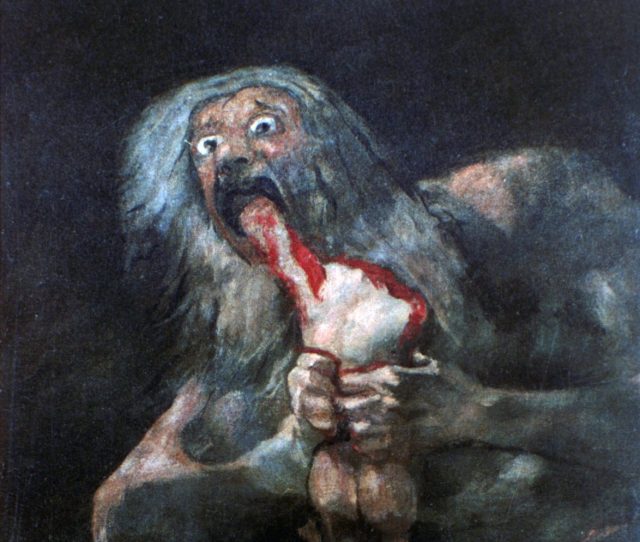
Cannibalistic cults aren’t just a quirk of the Pacific Northwest. (Credit: Universal History Archive / Getty Images)





There are two main ways of understanding the case of Jeffrey Epstein, whose shocking correspondence with hundreds of celebrities, politicians, and businesspeople and academics has been giving its readers a mild form of schizophrenia for the past three weeks. The first holds that Epstein was a serious flaw in a basically just system — a virtuoso corruptor of well-meaning public servants who, through his sheer charisma, managed to commandeer our precious liberal institutions for his own ends. Viewed this way, the story is almost tragic: we should pity the men and women who, when forced to pick between private jets, island getaways and sex with underage girls on the one hand, and civic rectitude on the other, made the wrong choice. It is also strangely hopeful: after all, the rot has now been scoured away; Epstein has taken his life, his co-conspirators are being diligently tracked down by the law, and if we all work hard and pay our taxes and vote for the right candidate in the next election, a new era of public trust will dawn once again.
This article is about the second way of understanding the Jeffrey Epstein case.
In 1886, a young German anthropologist named Franz Boas landed in British Columbia, with the intention of studying the indigenous peoples as they began their ritual preparations for winter. He had seen similar preparations before, on Baffin Island in the frozen north, but the scale of these preparations was different: almost nightly, the Kwakiutl gathered in their long, rectangular houses to dance into the small hours of the morning, until the sun showed itself again. They prepared special masks for these ceremonies, and wore complicated insignia made of cedar bark; at many gatherings, there were complicated stage magic techniques, even rudimentary pyrotechnics. The longer Boas spent among the Kwakiutl, though, the more he became convinced that the strangest and most shocking rituals were held behind closed doors, only accessible to those with considerable wealth and long periods of purificatory seclusion behind them. He asked a few villagers about the rumours though: no one seemed to want to talk. They did have a name, though, for the select group of men in the village who were allowed to attend them: the “Hamatsa” — meaning, the “cannibals”.
Boas spent the next decade exploring the Pacific Northwest region. The more indigenous peoples he visited, the more he became convinced that all of them had equivalent, secret brotherhoods. There were “Cannibal Societies” among Kwakiutl, the Bella Coola, and the Tsimshian peoples, not to mention “Grizzly Bear Societies” and “Wolf Societies” who were rumoured to eat human flesh, too. What was more, studying the cedar bark insignia of the different brotherhoods, Boas began to suspect that they were all connected: what other anthropologists had believed were multiple different peoples were perhaps better thought of as just two different groups: a scared, confused rank and file, and a secretive, cannibalistic elite.
For several decades, Boas’s discovery languished in the pages of relatively obscure ethnographies. Those anthropologists who encountered it tended to treat secret, cannibalistic cults as a quirk of the Pacific Northwest: a strange outgrowth of the totem religions of the region, and certainly not something with any wider sociological significance. Boas himself was an advocate of what he called “historical particularism” — the notion that societies should be treated on their own terms, according to their own internal logic, and certainly not extrapolated into any kind of grand, sweeping theory of human nature. Then, in 1902, a colonial administrator named P.A. Talbot began to notice some strikingly similar patterns in the region he had been tasked with governing in British Nigeria.
Talbot was first alerted to the fact that there might be a strange, second power system operating in his fiefdom by the road closures. Masked figures kept appearing on public highways and demanding they be shut for unspecified, ritual purposes. Soon they began to commandeer other public spaces: markets, town squares. Attending one of them, Talbot witnessed a masked man kill and eat a baby, only to “resurrect” it for the crowds of cooing onlookers (Talbot himself suspected the real explanation was that there were two different babies). Over time, he uncovered the truth: the masked men belonged to a shadowy group known as the “Ekkpo,” or “Leopard Society”, which had “usurped practically all the functions of government”, regulating trade, adjudicating disputes, imposing fines, and executing people they found guilty of non-observance of public rites, or having witnessed private ones. They had established a virtual monopoly on palm oil nuts, the main agricultural staple of the region.
Talbot published his findings in 1923, in a rather sensational book titled Life in Southern Nigeria. The Leopard Society was a kind of state-within-a-state, their power maintained by a vast network of secretive rituals: mock beheadings, staged resurrections, feats of bodily invulnerability — not to mention, of course, cannibalistic sacrifices. Within a few years, colonial officials across West and Central Africa had begun to notice similar features in their own territories: in Liberia and Sierra Leone, the secretive Poro society wormed its way into just about every important political position with initiates sacrificing their own first-born sons to reach the highest ranks; in Rwanda, the Kubwanda Society maintained secret lodges outside villages where they plotted techniques for taking over political power. By 1950, anthropologists were discovering secret societies on every continent on the planet: the Suque in Melanesia, with their mass sacrifices of pigs; the clown-fraternities of the American Southwest, with their black-and-white body paint; the “bear cults” among the Ainu of Japan, with their hidden feasts of ursine flesh. What Boas had thought was a relatively isolated phenomenon confined to a few fishing peoples in British Columbia was starting to look like a human universal.
What did this all mean? For a while, the discipline of anthropology could not agree. Certain esoteric interpreters liked to think that the sheer preponderance was evidence of some hidden, perennial truth, accessible only to a select few in each society — that the Hamatsa and Ekkpo and Poro and Suque were privy to the same, occult wisdom as the Rosicrucians, the Freemasons, or the Hermetic Order of the Golden Dawn. But, as other anthropologists quickly pointed out, it seems that the “wisdom” guarded by the secret societies was pretty variable — and in many cases, initiates didn’t even really seem to know what the secret they were guarding actually was. In fact, what all human societies seemed to require was not a particular kind of secret ritual or rite, but an excuse for secrecy itself.
The next breakthrough came in the Nineties, when archaeologists in France and Italy began to notice some strange patterns in the Palaeolithic cave dwellings that littered the Northern Mediterranean. With surprising regularity, they noticed, there would be smaller caves, positioned a little way away from the main dwellings with hidden apertures, with unusual concentrations of cultic artefacts, and — entirely unheard of in other dwellings from the period — evidence of cannibalistic human sacrifice. What was more, such dwellings tended to belong to very specific types of peoples. The cannibal cults invariably seemed to emerge in “transegalitarian” societies — that is, societies who were caught somewhere between flat, egalitarian hunter-gatherer bands and stratified, feudal societies with established hereditary classes. In such societies, the archaeologist Brian Hayden explains, everything was up for grabs: greedy “aggrandisers” needed to recruit deputies and cronies, and quickly; but in the absence of standing armies and sophisticated ruling-class ideologies about the importance of giving tithes to the local baron or paying back one’s student loan, they needed to get creative. Perhaps, the archaeologists began to suspect, all the machinery of terror was simply a way of solving a technical problem of government: how to cleave apart a group of people who formerly believed themselves to be bound together in structures of reciprocal obligation. Masked ceremonies and mock-beheadings to terrify those excluded. Cannibalistic ceremonies to lock in the initiates. After all, were you really going to go crawling back to your family for forgiveness when you had just sacrificed your first-born son?
It is a surprise, then, that despite the question of the origins of social inequality having bedevilled political, social and legal thinkers since Rousseau, the ubiquity of such grisly, occult rituals isn’t better known. Secret societies are not just a vestige of older, quirkier times; they remain one of the most empirically sound explanations we have for why groups that have hitherto been bound together by bonds of community and family suddenly explode into hierarchy. Indeed, they are perhaps best thought of as social technologies for creating hierarchies. As such, they are also tell-tale signs that a group of people, however much they claim to be acting in the name of the common good — however many reputable chieftains they sponsor, however much of the local Congolese rubber industry they own — plan on sowing division.
In an important sense, the Epstein revelations are simply the latest chapter in the ancient history of secret societies designed to enforce boundaries between a cosy elite and a terrified rank and file. The evidence — the testimonies of all those underage girls trafficked for sex, the trapdoor into the ocean, the torture video, the suspicious order of 300 gallons of sulphuric acid the day after Epstein’s indictment — certainly seems grisly enough to guarantee a similar kind of bond of secrecy among those involved. What is more, Epstein really does seem to have had a coterie of powerful people willing to give him the benefit of the doubt against all evidence: not just among the celebrities who flocked to him long after his conviction, but also, perhaps, in institutions like the FBI, which gave him peculiarly lenient plea deal back in 2007, not to mention the virtually unprecedented guarantee of “immunity for all co-conspirators”. But in a sense, it is the more feverish rumours, like the cannibalistic orgies in the upstairs rooms of pizza restaurants posited by QAnon, that are most telling of Epstein’s sociological significance. Suddenly, spontaneously, people with no familiarity with the Hamatsa, the Ekkpo or the Poro, are devising imagery straight out of the ethnographies of Boas and Talbot. It is as if ordinary people know, instinctively, that the greater the inequality, the stranger and more occult the rituals that reinforce it need to be.
Of course, this view of Epstein does give the lie to a certain, complacent view of our own society — one that sees it as founded in a set of liberal institutions whose principles include “transparency” and “democratic accountability” and “not killing babies in cannibalistic orgies”. But perhaps this correction is overdue. After all, mainstream historians such as Margaret Jacob and Frances Yates have been arguing for decades that secret societies were right at the heart of the political foment of the Enlightenment, with groups such as the Carbonari in Italy, the Comuneros in Spain, and the Decembrists in Russia incubating pretty much all the most important democratic institutions of the 19th century. Even today, it is hard to spend too much time among politicians and barristers in London without noticing, say, the preponderance of freemasons in the livery companies of the City of London, or the tendency of entire political dynasties to be drawn from the alumni of Oxford drinking societies with humiliatingly macabre initiation ceremonies involving dead pigs. As hard as it might be to imagine some horsehair-wigged judge staging the mock-execution of an infant, Ekkpo-style, our most venerable institutions do seem very good at devising ways of getting their members ensnared in a web of each other’s humiliating secrets, even without an Epstein to orchestrate it all.
But perhaps this conspiratorial reading misses the most important way in which our liberal institutions have begun to function like secret societies. After all, far more potent than the way these institutions operate behind closed doors is the way they operate out in the open — specifically, the way they strike fear into those who do not belong to the elite guild. Take the law, for instance. Reading over the Epstein files, one of the most shocking things one discovers is that for Epstein and his affiliates the whole function of the legal system seemed to be to frighten and bully those who did not really understand it. Epstein appears to have been serenely comfortable using his lawyers to hound and pester people who fell afoul of him: for him, with the best lawyers in the world on retainer, a few dozen lawsuits were easily navigable; for his victims, with normal jobs and families and no savings to pay for counsel, just one lawsuit could quite plausibly ruin their lives. This technique – using what are supposed to be neutral procedures for administering justice as a punishment in their own right – is so widely acknowledged today that it even has a nickname in America: the SLAPP, or “Strategic Lawsuit Against Public Participation”. But we should not be seduced by the jargon into thinking this is anything new. The underlying logic is exactly the same as the Hamatsa and the Ekkpo: the law is a secret guild, that works in the service of initiates, and terrifies everyone else.
This logic seems to be increasingly popular among politicians, too. In the UK, our political class seems to be gleefully shedding the Enlightenment commitment to accessibility and transparency in legislative affairs and embracing the occult techniques of the Ekkpo. The last five years have seen pieces of legislation creep into force that are unprecedented in their sheer vagueness: the Police, Crime, Sentencing and Courts Act of 2022, with its decade-long sentences for those who cause “serious annoyance, serious inconvenience or serious loss of amenity”, whatever that means, or the Public Order Act of 2023, which renders illegal all protest that might cause “serious disruption to the life of the community”. Now ask yourself: what are these bills meant to achieve? What any of these legal widgets really means is a secret, known only to initiates who have sifted through reams of case law and sat in on the relevant closed discussion groups at Chatham House. It doesn’t matter. You are not supposed to obey rules like these. You are meant to cower before them in holy terror.
This is why the anthropological record is such a useful corrective. If we in the UK suffer from one national defect above all others, it is a kind of deference to bourgeois authority: a nice, public-school accent, the flutter of a gown, a well-timed “hear ye”, and we all become as obedient as lambs. The British public has become very accustomed to asking whether things are legal or illegal, harmful or not harmful, sanctioned by the bureaucracy or not sanctioned, but tends to forget to ask what the function of these designations actually is, how strange they look from the outside — to a visitor from the black fjords of the Pacific Northwest, perhaps, or an anthropologist fresh off the boat armed only with a notebook. If there is some small good that comes from the Epstein case, it will be that it has helped us to recapture some of that strangeness. For the first time in decades, people seem to be viscerally, instinctively aware that when it comes down to it, power is never actually about laws and regulations and procedures. It is about what goes on in hidden caves and smoky rooms. It is about the infinite terror of what we do not understand, and the suspicion, even if we cannot prove it, that the person ordering us around might just have a taste for human flesh.