




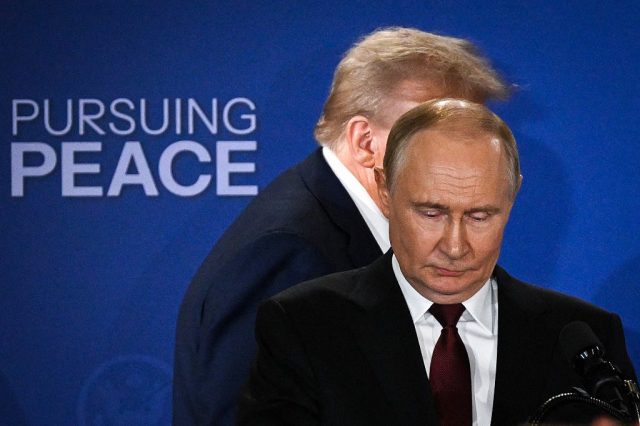
‘Can a transition to a genuine multipolar order occur without catastrophic confrontation?’ (Drew Angerer/AFP/Getty)





Yesterday, Russia, Ukraine and the US met for yet another round of peace talks in Geneva. At around the same time, scores of missiles and hundreds of drones pummelled Ukrainian infrastructure, causing chaos across eight regions and injuring dozens of people. And, in a sense, both these events are connected: as the war in Eastern Europe enters its fifth year, a peaceful resolution seems no closer than it did a year ago, when Trump began his second term promising a swift end to the conflict. If anything, in fact, peace seems to be receding ever further from reach.
On the surface, the explanation appears straightforward: Russia and Ukraine remain deadlocked over territory. Moscow insists on full control of the eastern Donbas region — of which it holds only a portion — as well as of the Zaporizhzhia nuclear power plant. On both counts, Zelensky has refused to budge, despite Russia’s relentless attacks on Ukraine’s dwindling power grid.
But framing the impasse as a territorial dispute between Ukraine and Russia obscures a deeper reality: this has always been, at its core, a proxy war between Russia and the United States — one which can only be resolved through an agreement between the two powers. The Ukrainian military, after all, is effectively kept on life support by Washington, particularly through the satellite intelligence that has become indispensable to modern drone warfare. Both Moscow and Washington are aware of this, which is why over the past year they have repeatedly privileged bilateral talks from which Ukraine and Nato allies were excluded.
Last August’s summit between Putin and Trump in Anchorage marked the high point of the new US-Russia détente. It was the first face-to-face meeting between the US and Russian presidents since the outbreak of the war in Ukraine, and the first such encounter on American soil in nearly two decades. The substance of the talks was never officially disclosed, but the symbolism was unmistakable. From the red-carpet welcome, to Trump calling Putin warmly by his first name, everything was choreographed to signal a turning point in relations, which, since 2022, had sunk to levels of hostility not seen since the Cold War.
Since then, Russian officials have frequently invoked the “spirit of Anchorage” to describe the framework of understanding purportedly reached between the two leaders. In practice, we can surmise that this sought to reconcile Trump’s transactional instincts, in the form of economic arrangements beneficial to US companies and Trump’s own prestige, with Putin’s insistence on the need to address the “primary roots of the conflict”: namely the need for a new security arrangement in Europe. This agreement, however, always rested on very shaky grounds, precisely because the two parties invested Anchorage with two very different meanings. From Moscow’s standpoint, what is at stake is nothing less than a fundamental renegotiation of the rules underpinning European and global security; Washington, by contrast, sees the matter in narrower terms: a specific conflict to be managed and contained, without disturbing the broader structure of international power that suits Washington just fine.
Russia has sought to manage this tension through what might be called a double-track approach. On the one hand, it has tasked Kirill Dmitriev — the Harvard-educated financier who heads Russia’s sovereign wealth fund — with negotiating a large-scale economic deal with the US. Meanwhile, senior diplomats, above all the veteran foreign minister Sergey Lavrov, have worked in parallel on the broader geopolitical settlement. This approach has so far failed to yield concrete results, prompting the diplomatic track to ratchet up its rhetorical pressure on Washington. The clearest sign of this came in a recent interview in which Lavrov spoke of the Trump administration in unprecedentedly harsh terms.
Lavrov openly challenged the idea that the US is working towards the cooperative framework meant to emerge from the Anchorage talks. He claimed that Russia had accepted Washington’s proposals on resolving the war in Ukraine, only to find the US backing away from them in practice. “They made an offer, we agreed — the problem should have been resolved. Having accepted their proposals, we believed we had fulfilled the task of resolving the Ukrainian issue and could move on to full-scale, broad, mutually beneficial cooperation. But in practice everything looks the opposite”.
Lavrov accused the US of not only failing to take concrete steps to rein in Kyiv — most likely an implicit reference to Ukraine’s continued drone strikes on Russian territory, which could not be carried out without US intelligence and satellite support — but, more fundamentally, of actively intensifying its economic war on Moscow. He cited new sanctions, Washington’s campaign against Russian tankers in international waters, and efforts to pressure India and other partners into abandoning Russian oil. “This is pure ‘Bidenism’”, Lavrov remarked, offering it as proof that the US’s true objective remains that of “achieving economic domination”.
At the same time, Lavrov framed all this as part of a broader “neo-imperial” strategy on Washington’s part that extends well beyond Russia. “The West,” he said, “is reluctant to relinquish its formerly dominant positions… With the arrival of the Trump administration, this struggle to constrain competitors has become particularly obvious and explicit” — a reference to the White House’s hyper-bellicose posture over recent months, including the capture of Nicolás Maduro, the escalation of US pressure on Cuba, and the growing threats against Iran.
It remains unclear whether Lavrov’s remarks signal a genuine rift — within the Kremlin’s corridors of power and more broadly between Moscow and Washington — or whether they are simply a manifestation of the double-track approach: pairing backroom diplomacy with calculated public pressure. What is clear, though, is that the current deadlock is emboldening the more hawkish elements within the Russian security establishment.
In a recent article, Sergey Karaganov, who heads the influential Council for Foreign and Defence Policy think tank, openly criticised the Kremlin’s “muffled responses to open aggression” by the West: especially the Europeans. Karaganov argues that Russia’s excessive restraint to date — its refusal to retaliate against Nato for Western-backed attacks on Russian territory, or to launch decapitation strikes against Kyiv’s political and military command centres — has in fact increased the risk of all-out war between Russia and Nato, by emboldening the West to keep escalating, in both practical and rhetorical terms.
Karaganov’s prescription is stark. Europe, he argues, is preparing for a future confrontation with Russia, and will likely deploy the reconstituted remnants of the Ukrainian army to prosecute it. The only way to stop this, in his view, is for Russia to demonstrate a genuine willingness to strike the command centres, infrastructure and military bases of those European countries most actively involved in operations against Russia. Should conventional strikes prove insufficient, he argues, Russia must be prepared to escalate to strategic nuclear weapons. His conclusion pulls no punches: “At present, [the Europeans] only give the appearance of fearing us, so as to build up their military strength. But they should actually fear us. They should be in terror of us. They should understand that escalating or even continuing the conflict risks their immediate physical destruction, and that a military buildup is pointless, as it will entail an obliterating nuclear response”.
One might dismiss this as mere sabre-rattling — and it is quite possible that such options would never be seriously entertained by the Kremlin — but the mere fact that these scenarios are being openly debated in Russia ought to send a shiver down the spine of every European. Whatever the rights and wrongs of the Ukraine war, fringe ideas have a way of becoming mainstream when conflicts drag on and frustration mounts; the longer this one continues without end, the louder and more influential radical voices are likely to become.
There is, moreover, a deeper danger that operates independently of any deliberate choice Russia might make. By allowing tensions with Moscow to keep rising, we are constructing a situation whereby a single miscalculation — an errant strike, a misread signal, an escalatory move that spirals beyond anyone’s intentions — could set off a chain of events that no single actor would be able to arrest. How long, for instance, before the Russian Navy starts providing armed escorts to its oil fleets, and treating any seizure of its tankers as an act of war? Or taking similar action against Western tankers? The gravest wars in history have not always begun with conscious decisions; they have begun with incidents that spun out of control. That possibility grows more real with every week the conflict remains unresolved.
Yet if that’s partly true of Russia itself — what with the hawkish language of its outriders, and its continued assaults on Ukrainian soil — European leaders appear reckless themselves. At the recent Munich Security Conference, the assembled Brussels elites and their attendant apparatchiks took turns stoking the drumbeat of war, ramping up their own hawkish rhetoric while offering little in the way of serious strategic reflection. Politico captured the prevailing mood with uncomfortable precision. “Western countries see World War III coming”, it said, a headline that glossed over the inconvenient fact that many of those sounding the alarm are themselves among the most vigorous advocates for continued escalation. As Nato’s Secretary General Mark Rutte recently put it, Europeans “must be prepared for the scale of war our grandparents and great-grandparents endured”. There is something deeply troubling about a European political class that cultivates war hysteria while remaining seemingly indifferent to where that hysteria might lead.
The situation is particularly disconcerting when set against the backdrop of Europe’s ongoing industrial decline. One might expect a weakening continent to seek accommodation and de-escalation; instead, European leaders continue to think in rigidly unipolar terms, dismissing Russia’s security concerns as illegitimate while remaining blind to the material reality of a world that is rapidly becoming multipolar — a shift that is already translating into Europe’s own economic and geopolitical marginalisation. In this, however, they are simply mirroring Washington’s broader posture.
As the Indian strategist C. Raja Mohan recently argued in Foreign Affairs, we are living through a hybrid and deeply unstable geopolitical moment: one marked by growing multipolarity in economic terms, yet remaining largely unipolar in military terms, with the United States still uniquely capable of projecting force across the globe with impunity. The consequences of this asymmetry, Mohan suggests, have been paradoxical. Rather than ushering in a more balanced international order, the rise of economic multipolarity has, if anything, emboldened Washington to shed the constraints that once tempered its behaviour and to project its power ever more aggressively — a dynamic that the Trump administration has made more explicit than ever.
This raises difficult questions. Can a world in which the US remains free to engage in repeated acts of military and economic aggression — unchecked by other powers — truly be called multipolar in any meaningful sense? And can a transition to a genuine multipolar order, one in which unrestrained US military primacy gives way to a world based on sovereign equality for all, occur without the world first passing through a period of acute and potentially catastrophic confrontation? These are not abstract theoretical puzzles. Given the trajectory of events in Ukraine and beyond, they are among the most urgent questions of our time.
Thomas Fazi is an UnHerd columnist and translator. His latest book is The Covid Consensus, co-authored with Toby Green.
 battleforeurope