




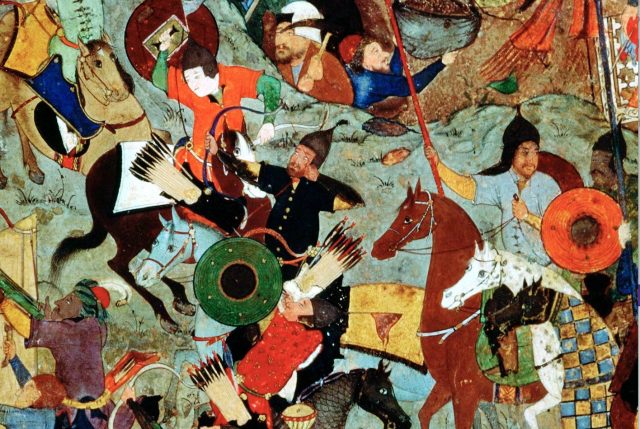
Mongol emperor Timur attacking the Knights of St. John at Smyrna, 1402. Credit: Getty





This Martin Luther King Day comes at a grim moment for racial and cultural harmony not just in the United States, but across much of the West. In America, mass immigration and Left-wing racial politics have have stoked an ugly and vicious backlash on the Right, parts of which now openly speaks in terms of white racial identity and solidarity. From Portland to New York, immigration, integration, and belonging form fraught political fault lines. Similar problems dominate politics across the Atlantic, with no easy or obvious solution in sight.
This shift is the result of deep, and perhaps inexorable, changes that contemporary Western leaders celebrated in the name of “diversity”. Western societies have indeed become more diverse, but the process hasn’t been the product purely of Western openness, but also of structural forces. To wit, modern communications and mass immigration have shrunken distances, making Western countries less like their past as exclusionary metropolises of racially based sea empires, and more like the multiethnic Eurasian land empires like Rome, Russia, Iran, and China.
Thus, the history of those empires has important lessons — and warnings — for us. Above all, the Eurasian empires were civilisational states, dependent for their success upon the strength of their inherited civilisations, and on respect for these civilisations by their multiethnic populations. By these standards, Western countries today are in increasingly poor shape.
Civilisational decline is not so dangerous in ethnically homogenous societies. Like many formerly great peoples before them, the ethnic English of the future could squat contentedly on the steps of the half-ruined monuments of their ancestors, scratching for fleas while telling themselves stories of their great past victories, great past works of literature that they no longer read, and great buildings that they no longer have the craftsmanship to build. This is, however, unlikely to impress new residents of their island.
In a world in which new residents are a given, the historical distinction between oceanic empires and land empires becomes crucial. Western-European colonists traveled thousands of miles across the sea and encountered completely different cultures with whom they had had no previous contact, and which were generally at a markedly lower level of technological development. In the Americas, on top of this came the immense new commercial opportunities of plantation crops and industrialised slavery based on race. The result was institutionalised racist systems for social management. There were of course beliefs in imperial missions civilisatrices, but accompanied by an implicit or explicit assumption that the process of civilising the natives would take a very long time and probably always remain incomplete.
The great land empires — Roman, Chinese, Muslim, and Russian, among others — couldn’t be like this. They had lived next to the peoples they conquered for hundreds or thousands of years. They had similar levels of technological development. Sometimes, the subjects were tacitly recognised by the conquerors to have in certain respects a higher level of “civilisation” than themselves: Greeks over Romans, Iranians over Arabs, Baltic Germans over Russians. For long periods, moreover, the subject peoples had been the former rulers: several of the great Chinese dynasties were from “barbarian” peoples; several of the great Iranian dynasties were Turkic; the Russian principalities lived for almost 300 years under the “Tatar yoke”.
In these circumstances, hierarchies based on racial origin and proportion were hard to sustain — certainly if the empires wished to expand and survive. Dynastic intermarriage was a regular thing. To secure imperial rule over conquered territories required the successful co-opting of large parts of their elites. These elites then merged into the existing imperial elites. Hence the Tatar surnames of some of the greatest Russian noble families, like the Sheremetievs and Kochubeys.
The test was not race, but readiness to adopt the civilisation, language, and, in the case of the Muslim and Russian empires, religion of the empire. The originally “alien” ethnic origins of writers like Ivan Turgenev (with his Tatar roots) in Russia have never affected their status as great national cultural icons. Given time — and the Iranians and Chinese had millennia — whole populations could merge into the imperial people. Thus a large majority of “Han Chinese” south of the Yangtse River are, in fact, of non-Chinese “tribal” origin.
Or as a Russian friend exclaimed when I first explained America’s racial “one-drop” rule to her, “That’s ridiculous! By that standard, every Russian is actually a Mongolian!” Indeed, the quasi-racist charge that Russians are racially and culturally mixed with Asiatics and therefore “not really European” has always helped to fuel Western prejudice against Russia. British visitors to Russian-ruled Central Asia in the later 19th century were appalled by the levels of corruption — and also by the ease of intercourse between Russians and “natives”.
What are the lessons — positive and negative — of these imperial traditions for our increasingly multiracial societies today? The first is that equality of racial origin in the elites has never said anything at all about the social and economic position of the mass of the population, whatever their race or ethnicity. The second is that social stability depends upon the integration of new populations by providing them with tolerable lives and equal rights before the law; and this process depends, in turn, on there being rights and a rule of law to start with.
Caracalla, who reigned AD 211-217, was one of the nastier Roman emperors. Even so, he was responsible for extending Roman citizenship to all free-born men in the empire. A great sign of progress in a brief moment of liberalism? Not exactly. His chief motive, according to the historical consensus, was to increase the tax base. It may have been the right direction, but it did nothing to slow growing tax evasion by the elites, and the intensifying slide of the mass of the empire’s population into immiseration and exploitation.
By the fifth century, this had reached a point at which many preferred to be ruled by the “barbarians”. Equally importantly, the “Antonine Constitution” granting universal citizenship was part of the process whereby the last vestiges of the Roman republican tradition and its legal rights were extinguished and replaced by the absolutist, quasi-sacred monarchy of the later empire: “equality in misery” as the old Russian saying has it. A multiracial elite is very nice, but it is even nicer when it is not ruling over a population of impoverished multiracial serfs.
Above all, the history of the great Eurasian land empires raises the question of whether our societies can maintain the combination of material success, elite ethics, and civilisational attraction that made the “barbarians” respect the empires and enabled those empires to assimilate not only their subjects, but even in some cases their conquerors. This is in large part a question of maintaining — or rather, restoring — widely spread economic opportunities and prosperity for citizens of all races; but it is much more than that besides.
The success of ancient Rome also depended upon the ethics and values known as Romanita, emphasising such virtues as loyalty, discipline and fortitude. Chinese states repeatedly failed and were repeatedly put back together by ruling elites united and strengthened by the values imparted by the different strands of Chinese cultural tradition. Core to both was a deep sense of loyalty to the inherited idea of the state, leading to duty to the actually existing state. When contemporary critics say — rightly — that present Western cultures think too much about rights at the expense of duties, they should remember what happened to ancient Rome when the elites lost their sense of duty. How can immigrants develop a sense of loyalty to Britain or America, if those countries’ elites themselves have lost it?
When it comes to assimilating immigrants, Western civilisation is being undermined from several directions at once. Capitalist demand for wage arbitrage and a “reserve army of labour”, legitimised politically by a fanatically utopian and historically illiterate Left, is producing a nativist reaction in much of the older ethnic population. Some of President Trump’s restrictions on immigration are thus a necessary corrective.
But by abandoning the universalist values of American “credal nationalism” in favour of a chauvinist version of US identity, Trump threatens to wreck America’s version of Romanita, and destroy the cultural and ideological elements that made the successful assimilation of immigrants possible. In Europe, the populist Right’s growing insistence on the Christian basis of national identity worked well for the great universalist religious empires of the past but is unlikely to do so in an irreligious contemporary Europe, where the strongest religious allegiances are found among Muslim immigrant communities.
Finally, and perhaps most fundamentally, there is the need for a “great tradition”, a cultural core capable of assimilating other cultures. It has been said that “a language is a dialect with an army”, but it would be more accurate to say that a language is a dialect with a literature. Languages with a strong literary core have played a key role in preserving national identities and the idea of the state, for centuries or even millennia during which the state itself has vanished. This role has been most powerful when the literature is integral to a codified religion, as in the Jewish diaspora, or bound up with philosophies of state, as in China.
In the Middle Ages, the legends of King Arthur and his knights were called “The Matter of Britain”, as the legends of Charlemagne were called “The Matter of France”. In Persian-speaking lands, the Shah-Nameh (and the miniature art it generated) helped to preserve an idea of Iranian identity during long periods in which Iran was fragmented. The same was true of the “Knight in the Panther’s Skin” in the Georgian lands.
The frantic attempts of late 19th-century nationalist writers to “rediscover” and write down “national” myths — like Lacplesis in Latvia, transformed from a mythical half-bear into a “historical” national hero fighting the German medieval crusaders — has attracted a good deal of justified mockery. But these revisionists were onto something: national pride can bring us together.
These are, however, specifically national and ethnic (or pseudo-ethnic) myths, rather than a literary corpus that can attract other peoples. Modern Russia has possessed, rather than one national myth, the corpus of great 19th-century Russian novelists and poets, whose work has been central to Russian civilisational identity. Being secular in form (if religiously-influenced), this core body of work has attracted many people of non-Russian ethnic origin to the Russian tradition.
Britain and France — and the United States, in a more complex and diffuse way — also possess such immensely prestigious inherited modern literatures, that exercised a powerful effect on colonial subjects who were educated in English and French.
For Britain and France to maintain the influence of their literary traditions within their domestic societies, however, requires a sufficiently large literate class interested in preserving them and reworking them for present and future generations. Quite apart from the apparent desire of much of Western academia to destroy this tradition, can such classes survive the era of AI and an atomised mass media? And when they do try to rework the classics, can institutions like the Royal Shakespeare Company in its present debased form carry a great tradition forward? All too often, the RSC’s “adaptation” looks more like woke Procrustean torture, and by the time they have finished stretching Shakespeare and cutting bits off there is not enough left to see him at all, let alone sense his part in a great tradition. Or can the Smithsonian in America, with its present insistence on curatorial self-flagellation over the misdeeds of the past, now transmit an American tradition?
I hope that the picture I have drawn is too gloomy, and that our sea-faring societies will find the cultural and political strength to adjust successfully to new populations in the way that the Eurasian land empires did. Should we fail, we can derive some thin comfort from the fact that all states come to an end, and that in the end, perhaps the best they can hope for is to leave a good-looking cultural corpse to help fertilise the civilisations of the future.
Anatol Lieven is a former war correspondent and Director of the Eurasia Program at the Quincy Institute for Responsible Statecraft in Washington DC.
 lieven_anatol