




I stepped out of my apartment and saw that my car was encased in ice. (Credit: Jodi Hilton / Getty Images)





One of the first things I saw after moving to Austin two decades ago was a sign near the airport alerting drivers to the risk of ice on bridges. It seemed a rather unlikely message for a state famous for its punishing heat, but I was assured that it referred to a real phenomenon: sometimes in Texas the temperature did drop suddenly, instantly transforming rain to ice, and the bridges would then be very slippery indeed.
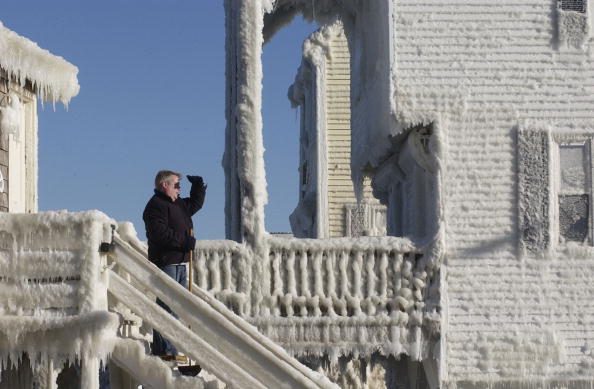
It was a year before I saw the results of one of these “ice storms”. After some brief rainfall, I stepped out of my apartment and saw that my car was encased in ice. Even stranger, each blade of grass had its own miniature ice jacket, as if moulded to fit. Although I had lived in Russia, I had never seen this manifestation of cold before. That said, it didn’t strike me as being particularly extreme: within about 15 minutes the ice had melted. The main risk with these sudden freezes was that your pipes might burst, but so long as you left your taps dripping you would probably be fine.
That was true for a long time. But as this weekend’s “life-threatening Arctic blast” marches south across the country toward Texas, accompanied by apocalyptic headlines such as “frostbite in five minutes” and stories about exploding trees, I find I am no longer quite so sanguine. After all, the last time I saw a winter storm on this scale was the genuinely catastrophic Great Texas Freeze.
That was in 2021. The extreme weather warning went out on Valentine’s Day, for all 254 counties in the state, which had never happened before: “Winter Storm Uri” was coming. But I found it difficult to take seriously a meteorological event that shared a name with a man who bent spoons for a living. Besides, in all the time I’d lived in Texas, I’d never seen much more than a light dusting of snow that was quickly gone.
I was very surprised therefore when I woke up the next day to find the world knee-deep in snow. Excited, I dug out my sheepskin coat from the back of the wardrobe and took my kids outside to see the real deal. They had great fun trudging about, making snowmen and throwing snowballs. But there was also something eerie about it. There were no cars; nobody else was out on the street. It was as if they were all hiding from something.
Friends started texting me, asking if I still had power. My house did; theirs did not. They were hunkered down indoors, wrapped up in blankets and heavy coats, waiting for the power to come back on. My in-laws called to ask if we still had water. We did; they did not. Worse, we couldn’t help them because the roads were buried in snow.
The reason for our good fortune was that we lived close to a hospital and so were on a protected part of the grid. But many had a much harder time. More than two out of three Texans lost power over the course of six days, for an average of 42 hours; nearly half went without running water for an average of 52 hours. Some people trekked to stay with friends or family who did have power, while others stayed warm by running their car engines or cooked using camping stoves. But this in turn led to an epidemic of carbon monoxide poisoning, with over 1,400 seeking treatment in emergency rooms and 19 people dying. Ultimately, the Texas Department of State Health Services attributed the deaths of 246 people to Winter Storm Uri. Along the Texas coast, nearly four million fish died.
The scale of the catastrophe, and the state’s failure to protect its inhabitants or maintain basic services, was unprecedented. And yet, compared to the cold extremes that you might experience for months at a time in Russia, Minnesota or Canada, Winter Storm Uri was not that severe. By 20 February it was over. The problem was that the state’s lack of preparedness had left it exposed to disaster. Recriminations started flying immediately. The Democrats blamed Governor Greg Abbott for ignoring warnings that the grid would fail in extreme cold, Abbott blamed renewable energy sources, although the ultimate fall guy was ERCOT, the independent organisation that ran the grid. There was also a theological element as environmentalists interpreted the Great Texas Freeze as punishment from the heavens for Texans’ love of huge trucks and hydrocarbons.
As for me, I didn’t know who to blame. The event was such a black swan that I wasn’t convinced any leader of any political party would have bothered investing in preparations. One of my neighbours, who had lived in the area his entire life, told me that he hadn’t seen anything like it since the Fifties, when he was a child. I didn’t mind those odds. If big freezes continued on that schedule, I’d be under the ground by the time the next one came round.
What actually happened, however, was that the Great Texas Freeze began to feel like it was but one of a series of biblical plagues that had begun with Covid, the year earlier. Two years later, I awoke from a dream that snow was falling off my roof, only to discover that it wasn’t snow but tree branches, snapping off and crashing to the ground. A sudden freeze had encased them in thick ice, making them too heavy to support themselves. One tree had fallen over and landed on a neighbour’s garage; another had crushed a truck. But that was nothing compared to the freak hailstorm that followed nine months later. Baseball-sized hailstones hurtled from the sky for 10 minutes, pummelling our roof, smashing our windows and destroying our cars. A disaster recovery firm boarded up my windows, but I was informed that there was a shortage of glass and it would be months before replacements were available. My house looked like a particularly insalubrious crack den and stayed that way for half a year.
There was something disturbing about all of this on an existential level. One freak weather event is bad enough, two seem extremely unlucky, but by the third you’re starting to suspect that the universe has it in for you. Indeed, I think these experiences gave me an insight into how ancient peoples felt when confronted by disasters, and their feelings of awestruck powerlessness before the whims of fickle gods. All you can do is hunker down, wait for it to be over, and hope that you make it through to the other end.
Sometimes, disasters are just going to happen. And as this latest storm approaches, I find myself waiting. If I were to run, where would I run to? The cold is everywhere, all the way up to New York City. Hopefully the state learned its lesson last time and has reinforced the grid. Or maybe it won’t be that bad, and just like in Werner Herzog’s film, La Soufrière, where the volcano does not erupt, so this week’s media weather porn will turn out to have been sheer scaremongering. We’ll find out soon.
Daniel Kalder is an author based in Texas. Previously, he spent ten years living in the former Soviet bloc. His latest book, Dictator Literature, is published by Oneworld. He also writes on Substack: Thus Spake Daniel Kalder.
 DanielKalder