




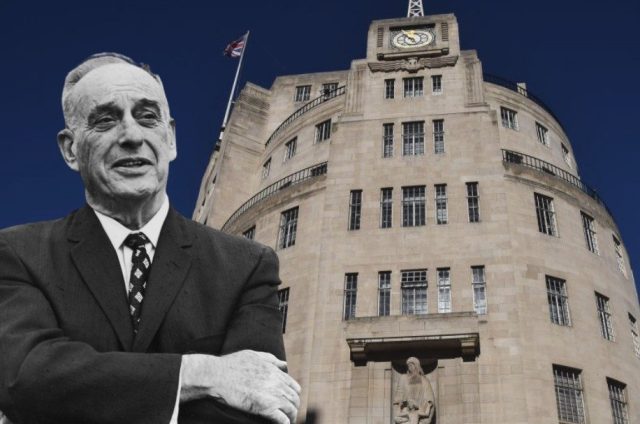
Moses, pictured, might have seen something of his own projects in the BBC: ‘A carved-out part of the British state, but with independent income.’ Photo: Getty





When Paul Screvane failed to win the Democratic nomination for New York Mayor in 1965, he was offered a choice of three lucrative jobs: two in engineering companies, one as the chairman of a public authority. The man doing the offering was Robert Moses, boss of the sprawling Triborough Bridge and Tunnel Authority and much else besides.
“Bob always took care of people who cooperated with him,” Screvane told Moses’s legendary biographer, Robert A. Caro. But only the people who cooperated, as Caro notes in his biography of Moses. “If you didn’t there would be no consulting jobs, no authority make-work, and you would find your pension was less than you had believed you were entitled to.”
Not long ago, Caro turned 90. In a short recent book on his writing career, he reflected how he came to write his biography of Moses after realising what he was doing as a journalist was “bullshit”. In contrast, people like Moses wielded powers of patronage that startled politicians like Screvane who stood to benefit from them. Caro recalled: “Here was a man, Robert Moses, who had never been elected to anything, and he had enough power to turn around a whole state government in one day. And he’s had this power for more than forty years, and you, Bob Caro, who are supposed to be writing about political power and explaining it, you have no idea where he got this power.”
The book that he eventually completed, The Power Broker, has passed into legend along with its author, becoming widely recognised as one of the greatest biographies ever written. It offers many lessons, from how a new road or housing development can generate blight in a neighbourhood to how the Tammany Hall system of political corruption worked in New York. However, its main subject matter is how Moses effectively deployed a new, technocratic, form of corruption.
Most importantly for us perhaps, The Power Broker sheds light on how democracies are fragile and open to erosion and exploitation, casually handing away their crown jewels without realising it — and with hardly anyone noticing. For the Britain of 2026, it helps clarify how a trusted and even loved institution like the BBC has lost its way, getting carried away on its own hubris and — crucially — remaining detached from public accountability thanks to the license fee.
Moses’s hubris arose not just from natural arrogance but a deep well of achievement. He studied at Yale, Oxford and Columbia, where he wrote an admiring PhD on the British Civil Service, before he sought to apply his learnings to the state government of New York. His goal in this work, he explained in a later report, was “[to] press for progress toward responsive, responsible, efficient and democratic government in the state.”
But he got to advance in his career only by accepting the compromises and accommodations of politics. As assistant to New York State Democratic governor Al Smith, Moses became an expert in drafting bills to conceal their real content. He got himself appointed to various independent Commissions and built parks, playgrounds, parkways (i.e. roads) and even beaches for families to flee to in the hot summer months. He built up a reputation as someone who Got Things Done — things which helped people.
As Caro writes, the prevailing image of Moses in the pre-Second World War years “was of the totally unselfish and altruistic public servant who wanted nothing for himself but the chance to serve… The image was of the fearless independent above politics. The public believed authorities — entities outside the normal government setup, entities whose members were unsalaried and appointed to terms long enough in theory to ensure their independence from politicians — to be ‘nonpolitical.’”
This image helped Moses to get away with his greatest power grab. This was to turn the Triborough Bridge Authority, which built what is now the Robert F. Kennedy Bridge linking the boroughs of Manhattan, Queens and the Bronx, from an instrument of the city into an independent, permanent entity insulated from interference by city and state officials.
Using the drafting prowess he had obtained while working for Al Smith, Moses had concealed the power-grab in the financing documents of the bill that established the Authority. Once the bridge itself was complete (1936) and had paid off its bonds, its toll revenue flowed into the Authority’s coffers, rather than going to the city that had commissioned it.
With the end of the Second World War, the volume of car traffic soared. The Triborough Bridge went from carrying 11 million vehicles in 1941 to 23 million in 1949 and 46 million in 1960. Meanwhile, the Authority’s income from this and other infrastructure swelled from $8 million in 1941 to $26 million in 1951, $37million in 1960 and $75 million in 1967. The money allowed Moses to attract extra financing through bond issues, giving him an extra $750 million to spend on public works in New York City in the 15 years after the Second World War. All this money also allowed him to grease the wheels of New York politics whenever resistance arose to his projects from citizens and their representatives.
The Triborough Bridge Authority acquired some of the powers of a sovereign state, including the power of eminent domain, permitting the seizure of private property. The bill Moses drafted gave it power not just over bridges and their approaches but roads, streets, and parkways connecting with those approaches. And so Moses started hacking through highly populated areas of the city to build expressways to connect to his bridges. One of the most stunning chapters in The Power Broker, “One Mile”, details the consequences of this in a one-mile stretch of the Bronx where a community was torn apart and destroyed.
Altogether, around half a million city residents were forced to leave their homes to make way for Moses’s projects. He built 627 miles of major road infrastructure and much more besides. The justification he used for his road-building was that it would reduce traffic congestion on existing thoroughfares. But his projects only ended up creating more traffic. Within a few years of them being built, the new roads were as congested as those they were meant to relieve. Meanwhile, the New York City Subway’s infrastructure was decaying. Moses successfully blocked any new track being laid.
“In road-building in and around New York, he had a dictator’s powers,” Caro writes. “And he used them. He enjoyed using them — for using them gave him what was his greatest pleasure: the imposition of his will on other people.” But all along, Moses maintained that he was not political, that he was the antithesis of the politician and never let political considerations influence his projects. Compromise was what politicians did, he said. He saw himself as above politics: concerned with right and wrong, where he was right and anyone who objected was wrong.
Of course, these ideas of “independence”, of “independent expertise” and being “above politics” retain a powerful currency today. Francesca Albanese, UN Special Rapporteur on the Palestine Territories, describes herself as a “UN Independent Expert”, despite her evident sympathy towards Palestine. In Britain, whole swathes of government functions are farmed out to supposedly independent bodies. One of the most high-profile is The Office for Budget Responsibility (OBR), which provides authoritative and easily-available predictions which, in practice, work to heap pressure on the government of the day. Never mind that those predictions have proved consistently wrong.
But perhaps the most egregious examples appear in the non-economic sphere; see the Independent Office for Police Conduct (IOPC), which sometimes appears vulnerable to activist exploitation. There is a distinct tendency for “quangos” to start acting like mini, alternative governments. This tendency is exacerbated when the quango is expected to have an impact, not just in its own particular areas of concern but on society as a whole. Arts Council England (ACE), for example, has broadened its remit from funding artistic work to supporting “creative practitioners” which it describes as “an umbrella term for all those who work to create new, or reshape existing, cultural content.” This has pulled in all sorts of groups and people who would not previously benefit from arts funding, including a BAME-only organisation called Rising Arts Agency, which plastered the billboards of Bristol in 2020 with messaging including “The blood is on your hands” repeated three times accompanied with the message: “So, Mr White Man… What are your plans?” As the ACE chief executive Darren Henley has said, “Together, let’s create better lives.”
However, perhaps the best match to Moses in Britain, in terms of scope, style and impact, is the BBC. It is a carved-out part of the British state, but with independent income. In this respect, the licence fee mirrors the tolls Moses collected from users of his bridges and tunnels — tolls that were almost compulsory for those living in the suburbs. Like Moses, with his manic road- and bridge-building, the BBC has magnified itself over time, intruding into ever more areas of life with a proliferation of channels, platforms and activities, while giving us news high on interpretation and promotion — from Israel-Gaza to Trump, the latest celebrity clickbait and puff pieces on drag queens. Moreover, the corporation’s ability to do this without advertising or charging extra has deterred any competitors, similar to how Moses deterred competition from railroad and subway.
Like Moses, the BBC has exploited its previous reputation as a trustworthy, broadly impartial and high-quality broadcaster to push in the opposite direction. Its commitment to “due impartiality” has become heavy on what it has thought is “due” and lighter on “impartiality”. If Donald Trump is a bad man, so the logic runs, then it is appropriate to emphasise that rather than report accurately on his ongoing activities. The approach could cost the BBC dearly, with a vengeful Trump suing it for $10 billion in a Florida court over Panorama doctoring his January 6 speech — a case that has already led to the resignations of both the Director-General and Head of News.
In truth, the very idea of being independent of politics, or “anti-” or “above” politics, is another kind of politics. The activists who heap pressure institutions like the Beeb, from inside and outside, have a point. All are sites of power; and the BBC is no exception. Politicians from Ed Davey to Harriet Harman want the BBC to be a bulwark against right-wing populism, but in doing so they point to how this idea goes wrong. They treat the BBC as an arbiter, promoting what is right — basically liberal-left progressivism — rather than serving in a more modest fashion as a reporter, mediator and facilitator for discussion. Theirs is the logic of the dictatorship rather than democracy, of Pravda against the old BBC. If a national broadcaster becomes a voice for some, in opposition to others, it does not deserve to survive while taking the money of both groups.
William Exton, a reformer and critic of Moses’ West Side Improvement project, told Caro: “His only reply to everything we had proposed was an ad hominem attack on us, and it was all a lie, a goddamed lie.” Cut to the reactions of BBC supporters to its present crisis and you hear talk of “right-wing” conspiracies and even “coups”, of nefarious “political” forces that are trying to destroy the noble Corporation. These could come straight out of a Moses playbook; except that Moses used accusations of Communism.
Moses ultimately fell victim to a ruse of the kind that got him his power in the first place. He was eased out of Triborough by Governor of New York State, Nelson A. Rockefeller while he wasn’t paying attention. It may be that this sort of ruse, of an intensely political kind, is the only way the BBC can be reformed and restored to anything like the entity that built its reputation. Maybe the insiders and outriders are right. Maybe the leaking of the Prescott memo was a political act. And maybe it will prove to be the beginning of the end of an activist BBC, provoking a return to the rigour, trustworthiness and restraint that made the BBC worth exploiting in the first place.
But, like the formidable Robert Moses, the Corporation shows few signs of turning and few signs of regret.
This article was amended to change John D. Rockefeller to Nelson A. Rockefeller, who ousted Moses when Governor of New York State.
Ben Cobley is the author of The Tribe: the Liberal-Left and the System of Diversity and, most recently, The Progress Trap: The Modern Left and the False Authority of History.
 bencobley