




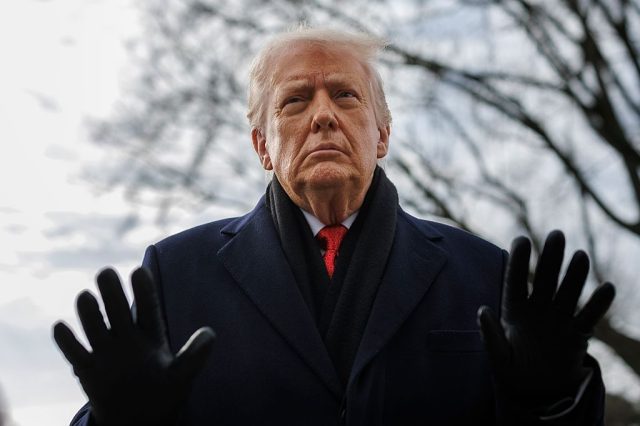
Photo by Tom Brenner/Getty Images





It’s tempting to wonder, at this juncture, whether all those progressives who insisted “America was built on stolen land” might come to regret their part in propagating this meme. On liberal lips, it was grounds for sorrow and contrition; in the eyes of the Trump coalition, though, it seems to have become an exhortation to steal some more.
Denmark, Trump said derisively, has no claim to Greenland except that “a boat landed there 300 years ago”. To mounting horror from America’s erstwhile Nato allies, and many among America’s own elected representatives, the US President has declared his intention to “take” this Arctic island, long considered a Danish territory, citing “national security” concerns.
After the October 7 Hamas attacks on Israel, the Teen Vogue writer Najma Sharif wrote: “What did y’all think decolonization meant? vibes? papers? essays? losers.” The post caused uproar for its callous response to shocking violence. But “vibes, papers, essays” has since become a meme: it captures a reality that, in parts of the world still clinging to the comparatively peaceful and affluent End-of-History order, remains under-appreciated. Namely: that seismic change happens in the real, material world, not the world of debates and ideas. And when change occurs, there is sometimes no solution that doesn’t involve force of some kind, and accordingly also winners and losers.
This is the context in which we might look at the Greenland crisis, and ask ourselves: what did we think multipolarity meant? Vibes, papers, essays? The clock has been ticking, for some time now, on the “rules-based international order”. But for all that a transition from this order to some form of “multipolarity” has been much discussed, this has tended to assume tensions between “the West” — understood as a single bloc stretching from Eastern Europe to California, plus some outposts — on one hand, and Russia and/or China on the other. A few fringe theorists on the European Right have long regarded America as an enemy; but in general, the transatlantic alliance has never been in doubt. Until now. And this development poses an especially acute challenge for Europe’s populist Right, where Trump has long been viewed as an ally, inspiration, and example of where (some hope) European politics might one day be induced to go.
This view was reinforced by JD Vance’s Munich dressing-down of European leaders last year, for censorship and mass migration, and repeated in the State Department’s Substack call for “civilisational allies in Europe”. The sentiment was further bolstered by lines in the State Department’s recent National Security Strategy (NSS), on “preserving the freedom and security of Europe, while restoring Europe’s civilizational (sic) self-confidence and Western identity”. Not least, this document noted the American optimism inspired by “patriotic parties” within Europe — which, the NSS asserted, should be encouraged as a means of “cultivating resistance to Europe’s current trajectory within European nations”.
But far from cultivating such resistance, Trump has instead turned on Denmark, whose soldiers were fighting and dying alongside Americans in Afghanistan just a few years ago. He’s threatened punitive tariffs, at an escalating rate, against Nato members, including the UK, until Europe accedes to his demand for a “deal” on Denmark.
Previous conflicts between the Trump administration and the EU, for example on jurisdiction of social media, could be spun as being in the interests of the European Right. Not this time. This is old-fashioned imperial business: a demand for control of territory America perceives as in its sphere of influence. The postwar convention of national borders as fixed and sacrosanct is officially dead.
What, indeed, did any of us think multipolarity meant? Vibes, papers, essays? Trump’s actions have united Europeans in anger, perhaps permanently shattered what was left of trust in the Nato alliance, and tipped an ice-cold bucket of realpolitik over the head of the European political elite. And, far from lending support to “patriotic parties” orthogonal to the current EU regime, he has royally screwed the European Right.
However paradoxical the notion of a nationalist Internationale, many had pinned their political hopes on Trump fostering just such a coalition — a hope fanned by the NSS. Instead, Trump has tainted by association every European populist group that has ever given his regime so much as the time of day.
The fractiousness and inertia of the existing EU panjandrums can never be overstated, so even as great a provocation as Greenland may still prompt no serious repercussions. But to the extent the crisis galvanises European resolve to consolidate as a geopolitical bloc, Trump’s actions have sharply increased the likelihood that this will not happen under some hypothetical rising populist coalition, but under the existing technocratic one, complete with the climate, censorship and mass-immigration shibboleths Trump’s own NSS so decries.
This coalition will now assert, with some justice, that no European in their right mind should trust any political body aligned with Trump, and by extension America, when this body’s interests are so plainly not those of Europe. You might as well appoint Putinists to run your country. We have already seen a worked example of this kind of political backswing in Canada, where Trump’s threats of annexation prompted so fierce a retaliatory groundswell of anti-American fury that an election previously polling strongly for the Right-wing change candidate went instead to the technocratic anti-Trump continuity guy, Mark Carney. Will we see the same dynamic in Europe? Farage, Le Pen, and the AfD would all be in for a dose of blowback, and the outraged responses from RN’s Jordan Bardella and AfD’s Alice Weidel are perhaps calculated to head the worst of this off.
Carney has since, somewhat pointedly, deepened Canada’s ties with China — perhaps prudent, from a balancing perspective, but surely less than desirable from a US one — and, indeed, from the vantage-point of the nationalist Internationale. In this chaotic context, progressive Europe is already calling loudly for “sovereignty”, even if this has to date comprised more vibes, papers, and essays than concrete material action. What about the European Right, though: will it, too, turn more explicitly and decisively against America?
This tendency has long lurked on Europe’s Right-wing fringes. Most obviously, it’s a theme among Russia-aligned “Eurasian” thinkers such as Alexander Dugin, for whom the America-led “West” is every bit as much the bogeyman as it is for Third Worldist supporters of “decolonisation” such as Najma Sharif. But even beyond Putin’s immediate ambit, French anti-migration theorists such as Guillaume Faye and, notably, the controversial polemicist Renaud Camus also view America not as Europe’s prospective saviour but, respectively, either irrelevant or even, in Camus’ case, as a principal source of European woes. For Camus, America represents both an ideological wellspring and principal actor in the spread of “davocracy”: a homogenising, post-national global order he views as virulently destructive of distinctive peoples and cultures worldwide, including in Europe.
To my knowledge, Camus has not indicated whether he welcomes the end of that stabilising and neutralising power, nor whether he would celebrate the decoupling of Europe from America. But it’s plausible that a growing proportion of European Right-wingers may move in that direction — not least because American promises of “civilisational” assistance evidently take second place behind more old-fashioned realist ones, consistent with the post-liberal, multipolar new order.
Was it ever possible to imagine an America-led “civilisational” influence that was not, in practice, “davocracy”? We are in the process of finding out: the venerable globalist shindig is running at the moment, and Trump is attending, reportedly to “punch allies in the head”. The Danes are staying away. What comes next is anybody’s guess. But contra those dreaming of a based transatlantic “civilisational” coalition, however well intentioned and sincere, what Greenland has brought ferociously home is the primacy over such ideals of two hoary realist preoccupations: geography and hard power. Geography makes Greenland of strategic interest to America. Multipolarity sharpens the perceived exigency. Hard power guarantees that no one and nothing can prevent an America that seems to have discarded its erstwhile “internationalist” scruples from rolling up and taking it.
Short of severe and perhaps self-destructive escalatory measures such as evicting US military bases, dumping Treasury bonds, or imposing self-harming retaliatory tariffs on the USA, it’s hard to see what the EU can do about it. States that have relied on the US security umbrella for decades have, as a result, comparatively little hard power of their own, and certainly nothing that could stand up against the USA — even if Europe cared enough about Greenland to try. Thus, as Thucydides famously put it, in his History of the Peloponnesian War: “the strong do what they can, and the weak suffer what they must.”
But power-plays of this kind have second-order effects. And I wonder if the longer-term ripple effects of an American transition from the soft de facto imperialism of the “rules-based international order” to a harder, more coercive sort really will, as some in the online peanut gallery seem to imagine, actually Make America Great Again.
Let us say, for example, that the cost of acquiring Greenland by force turns out to be the entire accumulated stock of faith that there exists something called “the West”. Under these circumstances, there will be little future appetite for any kind of “coalition of the willing” led by America — or, perhaps, for its cultural output or even moral blandishments.
Perhaps it will be Trump’s harsh treatment of America’s European satrapies, long stupefied by peace and comfort, that finally shatters what remains of a desire among Europe’s elites to cling to the postwar American imperium of rules. If so, it may ironically be the man who sought to Make America Great Again that ends up handing Third Worldists such as Najma Sharif their long-sought prize, namely the end of the America-led cultural and political order we generally call “the West”.
Should that happen, America will have definitively shrunk from monopole to one of several bloc leaders, from arbiter of global norms to playing realist games of geography and hard power. If so, we can expect those factions within the European Right who flew too close to the Trump to retire, badly singed, perhaps for some time. And yet a Europe obliged to embrace realism abroad would surely, eventually, be obliged to abandon its dreams of progressive internationalism. After that, who knows? For better or worse, perhaps those Right-wing “Eurasians” would get their prize as well: the “decolonisation” of Europe.
