




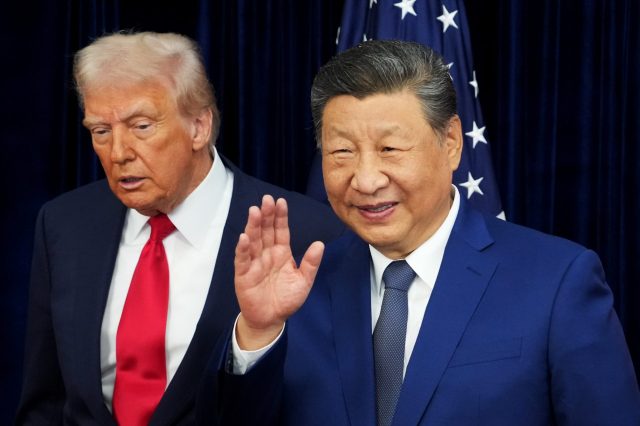
Credit: Andrew Harnik / Getty Images





There weren’t supposed to be any more communists — not since the free trade of goods, services, and people transformed the Chinese into true liberal democrats. Or at least that’s what good liberals thought, back in those heady days when history was meant to have ended and democracy would sweep the globe.
But now, how distant that era seems: the US and China are locked in an apparently existential race for technological supremacy, and instead of becoming liberals, the Communist Party has become even stronger under President Xi. Yet ironically, that may be what it needs to engineer a capitalist transformation to rival the West.
A recondite Marxist debate makes today’s events make curiously relevant. In The Communist Manifesto, Marx argued that the state, in a capitalist society, was merely the executive committee of the bourgeoisie. Many years later, in the Seventies, Left-wing intellectuals argued over whether capitalist states amounted to government by or for the capitalist class. On one side were the instrumentalists, among whom the most famous was Ralph Miliband (father of the Labour politicians David and Ed). On the other were the structuralists. The instrumentalists said that the capitalist state was controlled by a business elite who used it to advance their interests, whereas the structuralists said that if the state was to manage the capitalist economy, it needed “relative autonomy” from the owning class to discipline it and manage its evolution.
Today, you could hardly ask for a better representation of the instrumental state than the second Trump presidency: run by a real estate magnate, surrounded by oligarchs, staffed by businesspeople — a banker as Treasury Secretary, a fund manager as commerce secretary, an oilman as energy secretary. This has given rise to a curious type of state interventionism. If industrial policy is about picking winners, then the leitmotif of the second Trump administration is that a cabinet of proven winners meddles directly to reward those they see as best placed to win the future.
Yet the paradox of capitalists is that they don’t necessarily like capitalism. Rather than a free market, what is resulting is a form of oligarchic capitalism in which wealth is becoming highly concentrated. America’s richest and most powerful players are able to use the penetrability of the democratic state to capture and shape power, using it to limit competition and secure their position. So, while the US has many more AI startups than China, capital is flowing heavily towards a handful of tech titans.
In contrast to this strategy of maximisation, in which the ultimate goal is to secure an uncontested position at the vanguard of a new technology, China seems to prefer an optimisation strategy. In its approach, the government first nurtures the development of a large set of players, something facilitated by the structure of the Chinese state. Using open-source technology, China’s provincial governments, competing with each other to meet national growth targets, steer resources to local firms. Then they are cut loose on a fiercely competitive playing field, in which a Darwinian struggle is allowed to rip.
This relentless competition drives a breakneck speed of development. So, for instance, while the US auto industry is dominated by the “three big” firms, along with a number of national champions operating US branches like Toyota and Hyundai, China’s auto sector has over 100 auto firms struggling against one another. It is this fierce competition to survive that has driven the industry’s development to the point that China is now the world’s largest carmaker.
But while the winners of these competitions become national champions of sorts, there is little patience for them trying to manipulate state power to their advantage. On the contrary, whenever oligarchs show signs of becoming too powerful, the Communist regime doesn’t hesitate to cut them down to size. In effect, China enjoys the relative autonomy needed to discipline the market and keep it competitive. China’s ruling class can’t be called capitalist, but it may just be doing a better job than America’s in creating an environment in which competitive capitalism can thrive.
China’s aim is not primarily the creation of a tech titan at the very frontier of technology, but rather to move quickly to embody existing technology in products and services, achieving a sort of fungibility. Put differently, China is developing AI with an eye to producing usable products at a reasonable cost, dispersing them widely throughout the economy. In contrast, the US is placing a huge bet that it will develop a radical technology that will so transform the economy that the country will own the future.
But how is that future shaping up? If we consider the release of ChatGPT three years ago as the launch of the AI era in America, that revolution seems a little underwhelming. While there are signs that AI has marginally raised productivity in sectors that have adopted it, the increase has so far been well short of the dramatic rise the tech firms say would justify the massive increase in investment going into their companies. Meanwhile, AI is sucking all the oxygen out of the market. While the headlines speak of trillion-dollar investment plans in this emergent industry, in the rest of the economy, capital expenditure remains flat as other sectors are comparatively starved of capital. After peaking early this year, capital expenditure in the US has fallen in the course of 2025, which means that in non-tech sectors, things are going backwards.
Compounding this is the Trump administration’s energy policy which appears to be building a wall beyond which it will be difficult for AI to continue scaling at its current rate. Reflecting both Trump’s biases and the role of oligarchs in shaping policy in the US, the administration is blocking the rise of renewable energy to strengthen the powerful oil and gas industry, going all-in on a strategy of “energy dominance” based on fossil fuels. But one effect of this has been to slow the installation of new electrical capacity to a rate much lower than China’s. Thus, as demand to power energy-hungry data centres surges, electricity prices are rising — up 40% in the past five years and nearly 7% since just the start of this year. Good for the bottom lines of energy companies, perhaps, but not for the economy.
Nor, apparently, for society. One of the impacts of the AI boom in America is that it is stirring a groundswell of opposition, not only because it is helping drive up prices, but also because its benefits seem to flow into the hands of oligarchs alone. In previous technological revolutions, new technology not only seemed to confer broad-based benefits but also lifted wages. Amid the dot-com bubble of the late Nineties, American incomes rose strongly for a few years and everyone was able to do exciting new things on the internet. In contrast, tech oligarchs keep on insisting that AI will destroy millions of jobs — how else to justify the sky-high valuations of their companies’ shares except with a pledge to save loads of money in labour costs? The public is turning against the technology, with very large margins of both Republicans and Democrats more anxious than excited about AI.
China seems like it will avoid this fate, in part because its system enables the government to produce joined-up policy. For instance, the country’s education ministry is encouraging AI use in universities so as to create a ready market for AI products whilst encouraging their more effective use. Moreover, ordinary Chinese people already see the applications of AI in their everyday lives in ways that make things simpler, like biometric turnstiles at train stations, creating a more receptive environment for the technology.
America’s AI revolution may now be running out of time. Investors are growing antsy: they note that the much-promised breakthrough that will turbocharge productivity still remains notional, and there are signs that they are running out of cash. (This shortfall of cash explains why the big tech companies are starting to issue a lot of debt to fund their further expansions). Meanwhile, the public is warming to populist politicians who will campaign against the tech oligarchs. 2026 is likely to deliver a Congress more willing to question Trump’s economic strategy.
If the result is that the AI bubble gets punctured in the US, that wouldn’t be all bad. All the startups doing inventive things by optimising existing AI innovations, rather like what the Chinese are doing, would have more space to thrive. Nevertheless, a market crash could tip the US economy into recession, just as China’s economy is slowing as it reorients away from investment to consumption.
In short, the euphoria of 2025 may well give way to a global slowdown in 2026. China may emerge in a comparatively favourable position, but any “victory” may prove Pyrrhic. Meanwhile, the rest of us will feel the fallout.
John Rapley is an author and academic who divides his time between London, Johannesburg and Ottawa. His books include Why Empires Fall: Rome, America and the Future of the West (with Peter Heather, Penguin, 2023) and Twilight of the Money Gods: Economics as a Religion (Simon & Schuster, 2017).
 jarapley