




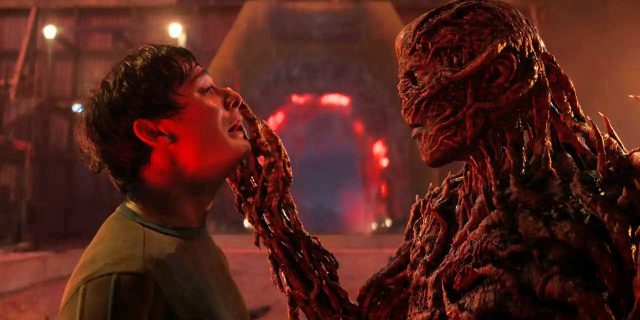
Vecna is equal parts fussy and vengeful, and also, sometimes, a buff demon made of veins and vines. (Netflix)





A good place to start in tracing the descent of Stranger Things from beauty and brilliance into numbing badness is also an obvious place: the first few scenes of the first episode of the show’s first bad season, Season Three. When you rewatch these scenes, each one feels bloated with bad omens. The closeup shot of Mike (Finn Wolfhard) and Eleven (Millie Bobby Brown) sitting on a bed and slurping at each other’s faces tells you the charming romantic confusion and deferral of the earlier seasons will now be overtly resolved into the tedious ways of the teenage relationship — this inexpert kissing, yes, but also the endless and charmless talking and arguing, the predictable cycles of breaking up and reconciling, and, in general, the too-great familiarity with things best kept private, not because they’re salacious but because they’re irksome and boring.
The closeup shot of Hopper (David Harbour) scowling in the next room carries at least two omens even darker than those conveyed by the noisy mouthplay of Mike and Eleven. As an image, Hopper’s scowl tells you that he’s angry. As an omen, it tells you that this anger will define him for an entire season, eight episodes of Hopper yelling when he really needs to be feeling his feelings. But Hopper’s angry figure is also cartoonish in its details — his eyes nearly crossed, his passive grip on a bag of Tostitos implying the timeless impotence of sitcom fathers — which tells you that the show’s creators are hatching a change in its genre. Stranger Things will now be, not exclusively but substantially, a comedy. And, like the sitcom figure of Hopper in a chair eating Tostitos and fuming to himself, this Stranger Things comedy will not be funny.
But maybe the darkest and deepest omens come in the very first scene of that episode, the one before the opening credits in which Soviet scientists train a massive laser on a cave wall, in what appears to be an effort to access the parallel dimension known from the earlier seasons as “the Upside Down”. The laser machine fires impressively, but the interdimensional barrier holds and the machine explodes, after which a cyborgish enforcer from the Soviet Communist Party lifts the chief scientist by the jaw, with a single hand, and fixes an iron cyborg grip on the soft scientist throat, and the scientist’s face goes realistically purple as he slowly dies. The Soviets, apparently, brooked no failure when it came to breaching interdimensional barriers.
For parents who watched Seasons One and Two with their tween and early-teen children, this strangulation was a bad omen indeed. Seasons One and Two had their violent and disturbing moments, which we parents put up with because it was Covid and the whole family loved this show, but the violence generally had a comic-book quality, and much of it was outright animated. Given the show’s status as beloved (if parentally guilty) family viewing, the slow, up-close, medically accurate strangling that opens Season Three was a shock and a betrayal. As an omen, it foretold the grosser betrayal of Season Four, when the show lurches into full-on “body horror”, with teenagers suspended midair by an unseen force that then snaps their limbs like pretzel sticks accompanied by medically accurate cracking sounds and totally believable screams of the teenagers being so carefully tortured and murdered. So much for family viewing.
But the most deeply ominous thing about these Soviets was that they were shown at all. Through the first two seasons, the Cold War had functioned, beautifully, as a sort of atmosphere. It murmured in the background, on the TV news, and it explained the perverse research and paranoid ferocity of those sci-fi bureaucrats bothering little Hawkins, Indiana, as well as the dull Eighties patriotism of Mike and Nancy’s dopey dad. But now the Cold War is present as a force of Soviet soldiers and scientists, grim with purpose but haunted by an air of slapstick incompetence. This is the omen that tells us everything merely latent or tacit from seasons One and Two, everything elegantly unstated and merely evoked, will be activated and made explicit. Nothing will be left to linger as atmosphere. Everything will be reference, and much of this will be self-reference. This self-reference will be comic in tone and aspiration, but, again, it will not be funny.
Others may have their own ways of describing what went wrong with Stranger Things, but few would reject my premise. Stranger Things has been really bad for three seasons. It just has. But if that’s the case, why does anyone still care about it? Why are so many people writing about it? Why am I writing about it? We complainers have actually watched those three bad seasons, which means watching over 30 hours of television that keeps merely re-delivering in greater intensities the experience of the first of those 30 hours: aesthetic revulsion. The analogy that comes to mind is wading into a bitter rain for several miles to pick up a pizza with all your least-favourite toppings on it.
The most powerful answer to those questions is that the first two seasons of the show were just refreshingly great, so refreshing and so great that the elevator-drop into badness after Season Two induced a sort of disbelief in the audience, a disbelief so total that it amounted to a form of hope: surely this was temporary? It had to be some unintended glitch. So instead of being repelled and turning away, people seem to have hung on expecting that the glitch would resolve itself, any time now, one of these episodes, one of these seasons, and we’d return to the rich and innocent thrills of the first two.
That this show originally had magic in it was signalled in the first episode of Season One, with an instantly beguiling pair of scenes. The first happens inside an apparently remote rural facility called “Hawkins National Laboratory”, whose lights are acting strangely and where some murderous beast or monster — we only hear it at first — seems to have got loose. So, a government research programme gone awry, presumably. The next scene is four boys — Mike, Lucas (Caleb McLaughlin), Dustin (Gaten Matarazzo), and little, big-eyed Will (Noah Schnapp) — sitting in the basement of a two-storey house, at the climax of a dramatic 10-hour “campaign” of Dungeons and Dragons, which then goes haywire as Mike slaps the mega-monster, the “Demogorgon”, onto the board. But family dinner at Mike’s house ends the campaign at this dire moment and the boys disperse, after which we learn that Hawkins National Laboratory is in their town, Hawkins, Indiana, and we see little Will being chased through the woods by something with a scary silhouette, after which his family can’t find him.
Will’s disappearance places the remaining three boys in an emergency, which quickly becomes both an adventure and a cosmic mystery that somehow parallel their campaign. Using Dungeons and Dragons to frame this mystery and imbue it with mythic meaning and vocabulary for these nerdy boys — the monsters from Hawkins Lab, for example, become “Demogorgons” — is ingenious and enormously charming. The boys sitting around that gaming board as the first season begins are cute like children, but the unruly adolescence beginning to spark inside them makes them more interesting than children. They have forbidden things to learn, a real thirst to learn them, and, finally, the innocent audacity and the bicycles (and the pre-Nineties childhood freedom) they need to chase this forbidden knowledge.
From the boys’ perspective the mystery itself is fairly straightforward: what happened to Will? Or, more essentially, where did he go? Season One, then, is driven by the human emergency that little Will Byers appears to be lost in some alternative dimension, and, for the other characters, by the incredible head-trip that this dimension exists in the first place. When a would-be superhero appears, a short-haired girl with telekinetic powers who calls herself “Eleven”, her story takes on a similar structure. Who is Eleven? Where did she come from? What are her powers? Where did they come from? What does she know about Will?
Season Two adds various new elements, some that work beautifully and a few that seem to foretell the badness that would descend upon the show so suddenly a season hence. Dustin’s adoption of a mini-Demogorgon as a pet is implausible and irritating, and Eleven’s bizarre dalliance with punk-rock revolutionaries in Chicago seems to happen entirely for fashion reasons, as if the Duffer Brothers, the creators, grew suddenly alarmed that their show about the Eighties had no long coats or mohawks in it. The introduction of Murray the investigator works well enough in the season but it’s historically odd, in that a countercultural paranoid like him would have been paranoid about the Reagan Administration, not the Commies. His antic presence and the buggy closeups on his bearded face also foretell the grim wackiness that would soon take over the show.
But the boys’ world holds together. Their advance from board games to video games, for example, is historically accurate and narratively fruitful. And, crucially, the second season effectively redramatises the excellent mystery of the first simply by introducing a new character into the friend-group — Max — and then having her innocence and scepticism sit volatilely alongside the incredible knowledge those nerdy boys carry with them. In Season One we followed along with the credulous boys as they learned about the Upside Down. In Season Two we follow along with wised-up Max as the boys’ knowledge about the Upside Down works its way through the layers of her disdain and disbelief. This is an underappreciated but powerful sci-fi story archetype — the drama of communication, in which characters occupy different sides of an epistemic chasm and must overcome doubt or distance or some other interference to understand each other.
The convincing-Max storyline defines what’s good about Season Two, to me, but the most powerful example of the drama of communication actually occurs in Season One, with Will sending signals from the Upside Down to his desperate mother Joyce (Winona Ryder) through their telephone, blazing lightbulbs, a boom box, and the Christmas lights she’s insanely hung around her living room, and Joyce decoding these signals in states of agony and hope and purpose. Winona Ryder makes these scenes deeply moving (perhaps especially for the parent-viewer, for whom she is almost too good as an emotional proxy), and, together with communicative trials of Max and Lucas in Season Two, they illustrate the fertile constraints of the two-world structure the Duffer Brothers imposed upon themselves in those first two seasons. As in the first Matrix movie, Seasons One and Two of Stranger Things posit the exhilarating idea that an alternative world exists alongside our everyday reality. But a movie or show built on such a two-worlds scheme is wise to observe a sort of reticence or parsimony, to allow the alternative reality to linger vaguely in its details, as abstract counterpoint more than fully-fleshed-out alternative world, and to let the weird world and the familiar world interact with each other only sparingly. When you let the two worlds tangle with each other too much, plots can get pretty arbitrary, pretty fast. The embarrassing Matrix sequels showed this notoriously.
The Duffer Brothers observed these strictures for two seasons. However, the end of Season Two carried some hints that this arrangement was breaking down, and that things would get pretty ragged if Netflix agreed to a Season Three. The climactic scene of Demogorgons swarming Hawkins Lab and munching the faces of people trapped inside it was well wrought, but this wanton spilling of the contents of the Upside Down into the regular world pretty much undid the two-worlds tension that gave the show its metaphysical kick. And this would be the last time the audience could ignore the visual ridiculousness of Eleven fixing the big problem by dropping her chin and lifting her gaze and extending her hand to channel her supernatural girl-power at the evil force until it retreats. Deployed a second time, it becomes a built-in spoiler for every future season. Whatever climactic troubles descend upon our young heroes, we can just assume that Eleven will fix them in the final episode by doing that faith-healer thing with her hand, while screaming and having a nosebleed.
In other words, when Eleven descends to the nether regions of Hawkins Lab and uses her telekinetic hand to close the molten vagina from which the Demogorgon horde is being birthed into the human world, that should have been it. The Duffer Brothers should have taken their own hint and closed up the whole Stranger Things enterprise.
Persisting after this point, when the two-worlds edifice had collapsed, meant abandoning the imaginative rules of the show, indeed all storytelling discipline and logic, after which every plotline became laughable and arbitrary. In Season Three, for instance, the Soviets are crafty enough to have built an underground laser facility below a small city in the American Midwest — but not crafty enough to keep the teenage staff of an ice-cream parlour from infiltrating it. In Season Four, Hopper finds himself in a Siberian Gulag, where he earns his noble right to be called “Crazy American” several times by admiring Russians. In this Gulag, he fights a gladiatorial cage match against a Soviet-captured Demogorgon, and wins (because he’s Crazy American). While this is happening, Joyce and Murray are flying a small plane from Alaska into the Soviet Union to spring Hopper from his Gulag captivity, all of which can happen because, like manic Murray, the incompetent Soviets are wacky visitors from the land of comedy.
In other words, the genre-lurch from supernatural adventure to geopolitical sitcom is supposed to underwrite or excuse all this absurdity, but since the comedy isn’t funny nothing is actually underwritten or excused. It all just lingers before us as hyperactive and nonsensical, episode after episode. No audience in the history of television has been forced into so much baffled shrugging as those of us who stayed with Stranger Things after Season Two.
And it’s not just storytelling logic. Once the two-worlds edifice collapses, the show’s style and sensibility also deteriorate. This is clearest with the Upside Down itself. Through the first two seasons it was suffused with some dimensional force that was thrilling in its vagueness. Those broken, photo-negative shards of wholesome Hawkins, Indiana, in Season One, suggested the rule of an elusive nothingness more than some coherent evil. But through Seasons Three, Four, and Five this force resolves into a standard Eighties horror-movie villain: which is to say that the haunted atmosphere from the evocative alternative dimension in Season One is slowly revealed to be, well, a guy: Vecna. This guy, played by Jamie Campbell Bower, is equal parts fussy and vengeful, and also, sometimes, a buff demon made of veins and vines.
Season Five gives us another random turn of genre dial. Like the original Matrix trilogy, Stranger Things concludes as something like a war movie, with US Army outposts both above-ground in Hawkins and down below in the Upside Down, to fight both Eleven and the Demogorgons, and to enforce martial law on the little town. In a way, this eases the burden on the show to meet the standards it set for itself in Seasons One and Two: that is, to be moving and fitfully beautiful, and to make a reasonable amount of sense. The audience can now be distracted by large-scale battles and escapes and chases, whatever narrative or physical sense they make.
But even here, with scores of soldiers being torn apart and run through by those athletic monsters whose faces are just flower-petal mouths, the war story makes way for a spectacular failure of taste that arrives from an entirely different direction. It’s not gratuitous violence but extreme and finally comic sentimentality. That Will Byers is gay has been made pretty clear through the first four seasons, and so a buried subplot through these seasons has been, basically, his coming-out story. In Season Five, he is prepped and coached for this coming-out by Robin (Maya Hawke), the fast-talking lesbian member of the friend-group, who gives him a final pep-talk in an underground tunnel, a mawkish, bizarrely prolix speech that finishes with this grimly inevitable lesson: be yourself.
A few scenes later, we see Will recalling this Churchillian speech as he rises from paralysing pain to realise he can kill Demogorgons with telekinesis like Elevan. Thanks to the operatic staging of this moment, and to its psychological content as Will Byers finally being himself and admitting he’s gay, and also learning he’s a superhero, it registers indelibly as camp. As Will finally stops questioning himself and starts breaking Demogorgon bodies, the scene oscillates with two declarations, distinct in their words but seeming to mean the same thing: “I’m gay! I’m a superhero! I’m gay! I’m a superhero!”
The unintentional humour of this revelatory moment does give some consolation as we approach the release of the three Christmas episodes and the New Years finale. For one thing, it offers a scheme for making the last half-season tolerable, perhaps even enjoyable. After all, the final episode is said to be several hundred minutes long. And we’ve got the Christmas day triptych to get through first. No doubt it will be an extravaganza of random causality, the Duffer Brothers’ final assertion of their prerogative to just make things up as they go along. It will almost certainly feature Eleven and Will directing their spread fingers at a final phalanx of Demogorgons, screaming in unison as these monsters break and die. Something will conveniently explain how they now have the power to kill Vecna himself, and Vecna will die a villain’s predictable death, that is, after having said a bunch of evil stuff. Who knows what tactical busywork Joyce and Murray and chatty Robin and the other mortals will be asked to perform, but we do know it will be silly. The show’s final genre-turn into a classic form of camp will make it, if not worthwhile, at least diverting. Stranger Things will not have answered our stubborn hope and returned to its original excellence, but, after all its futile straining after comedy, it will have finally got funny.