




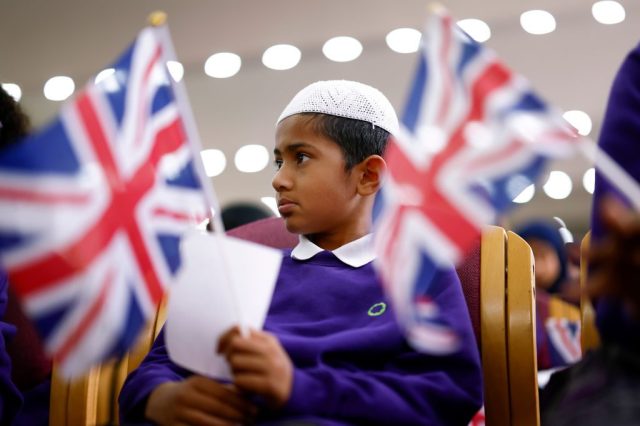
Younger Muslims are more likely to identify with their faith. Jeff J Mitchell via Getty.





The first: a devout Muslim who dedicated his 2024 election victory to Gaza. The second: a red-cheeked former banker who habitually calls for remigration. Yet for a brief moment this week, Adnan Hussain and Rupert Lowe were in the same political foxhole, eager to deport a pair of Afghan rapists back to their homeland. “They are owed nothing,” is how the bearded MP for Blackburn put it on X, adding that exile is exactly the punishment Islam demands for such convicts.
This robust approach to criminal justice was duly backed by Lowe: “Now you’re talking”. In truth, though, the broader political currents Hussain represents are likely less pleasing to his fellow backbencher. For in his enthusiastic declaration of Islamic values, especially as a balm for the nation’s woes, he is the avatar for an increasingly prominent kind of British Muslim: educated, self-confident, political. Echoed across the country’s cultural life, and indeed in its birthrates, men like Hussain could soon shape life far beyond the internet, with vast consequences for Muslims and non-Muslims alike.
Perhaps the best place to understand the rising power of Britain’s Muslims is not Westminster, or even Hussain’s Blackburn — but my hometown of Luton. It’s safe to say the place that hosted the Islamist “Butchers of Basra” demonstrations, and is the birthplace of the EDL, does not have the finest reputation. Over recent years, in fact, it’s become a kind of negative poster boy for the terminally online Right, what with its Islamic schools, halal butchers and peri-peri chicken joints. Its once-thriving pubs, meanwhile, are becoming a thing of the past, and though there’s a Christian revival of sorts, it’s mostly immigrant-inspired.
That’s hardly the best news for people like Rupert Lowe, anxious over ethnic and racial change. Yet the fact is that where Luton leads, the country is heading. According to the most recent census, after all, 3.8 million Muslims now live in England: a sharp rise from 2.7 million in 2011. From 2001 to 2021, England’s Muslims have risen by nearly 150% in terms of number of people, and grown by 116% as a proportion of the national population. A sharp decline in Christian identification has only hastened these trends, as have Muslim birthrates. Think, again, of Luton. It’s now a majority-nonwhite town where one in three residents are Muslim. More than that, it’s the baby capital of England, with Slough, Oldham and much of East London following closely behind. Judging by the recent data, the demographic trajectory of England will be increasingly shaped by Islamic social conservatism.
Behind the headline growth, however, or the vivid streetscapes of towns like Luton, Britain’s Muslim population remains strangely complex. Studies suggest that the country’s Muslims believe in the richness of Britain’s opportunities — yet aren’t particularly impressed with the society they live in. Once again, the numbers here are telling. Though over 85% think this is a good place to live, over three in five feel that most Britons put themselves over their families or communities. Strikingly, this number rises even higher among British Muslim millennials.
That last figure strikes at the heart of the so-called “integration paradox”: the idea that as ethnic and religious minorities become more integrated into the economic and social mainstream over the generations, they will do away with their ancestral and faith-based identities. This optimistic theory has been blown to smithereens by the British Muslim experience. Just like Adnan Hussain, a former solicitor born in Burnley, younger Muslims are not only more likely to be born in the UK, educated at British universities, and work as white-collar professionals than their elders — they are also more inclined to identify with their faith.
Compared to their elders, younger conservative Muslims are generally more aware of the excesses of social liberalism in mainstream Britain, even as they fail to share their cultural connections with ancestral homelands. It’s in Islam, not Kashmir or Sylhet, that they find a true sense of belonging, a trend that will only continue as Muslims from different ethnic communities intermarry. All the while, younger Muslims tend to have greater expectations and demands of the nation’s politics, certainly compared to foreign-born elders who were often just grateful to escape conflict or corruption.
That shift, in turn, makes younger British Muslims more prone to disappointment with the nation’s institutions, especially over issues with an implicitly religious character, notably Palestine. There is also the ironic possibility that by being more integrated — economically, educationally — younger socially conservative Muslims are more exposed to secular trends not to their liking. Young Muslim YouTubers shaming the social mainstream over perceived forms of moral degeneracy are hardly in short supply, even as figures like Hussain are tougher on deportations than many white liberals.
All this works to reinforce the religious identity of British Muslims. And if that encourages many to “selectively” integrate — being decent neighbours and working hard without fully immersing themselves in the country’s culture — that still leaves a stark divide with the non-Muslim majority, especially around women’s rights and mixed-sex interaction. Consider the case of Maheen Kamran. An aspiring medical student who won the seat of Burnley Central East in last year’s local elections, she ran on a platform which not only called for an improvement in school standards and public cleanliness — but also encouraged public spaces to prevent “free mixing” between Muslim men and women. More recently, the East London Mosque organised a fun run which barred female participation.
The mosque’s decision caused predictable outrage from liberal politicians. But that still leaves the question of how eager British Muslims are to take advice from the mainstream on matters of gender equality, especially given its struggles over even defining what a woman actually is. That’s broadly been Hussain’s own line. More than that, British Muslim traditionalists, whether in Luton, Blackburn or elsewhere, may well argue that Western-style empowerment has contributed to the breakdown of the traditional nuclear family unit, and has fed the fertility crisis which means Britain now faces an economic timebomb. And all this in a country where a fifth of people routinely report that they have an unfavourable view of Muslims as a group.
These tensions may even get worse, as upwardly mobile British Muslims begin to hold more positions of influence in business, the public sector, and larger civic associations. Indeed, there are growing signs of religious co-ordination across sectors, with the new Muslim Impact Forum (MIF) having a central mission of “uniting Muslim leaders and institutions across politics, charity, and business to move ideas into collective action”. This hints at a broader point. While the ever-growing British Muslim population has been caricatured by some as an undereducated and welfare-dependent monolith, one which has colonised Britain’s social housing stock, the reality is somewhat different.
In truth, it’s a relatively youthful population, one defined by its upward social mobility — and which is increasingly assertive across national life. Young British Muslim sportspeople, notably England’s Pakistani-heritage cricketers Shoaib Bashir and Rehan Ahmed, have not shied away from expressing the centrality of their Islamic faith. Something similar can be said of Tottenham Hotspur’s Djed Spence, who in September became the first recognised Muslim to play international men’s football for England during their 5-0 win in Serbia.
Hussain aside, the most obvious recent example in politics is Shabana Mahmood’s appointment as home secretary. Her arrival in Marsham Street was met with disquiet by some on the Right due to her religious background, and the fact that she was allegedly the first Muslim to take up the post. Not quite: Sajid Javid, who was the first home secretary of Pakistani Muslim origin, appears to have been memory-holed — which tells us much about changing attitudes. It almost feels as if, as a “hyper-integrated” Muslim, one with a white British wife and who once said that Christianity was the only faith practiced in his home, Javid didn’t count as a real Muslim. Yet if Javid was the kind of “sanitised” Muslim more acceptable to the political mainstream, he is far from the norm. Echoing Hussain and other Muslim MPs, Mahmood has told The Times that Islam is the “centrepoint” of her life.
Faith aside, Mahmood has plenty on her plate. Consider the small-boats crisis, a thoroughgoing national emergency, and one largely down to the unchecked importation of younger males from Muslim-majority countries: exactly the kind of person Hussain and Lowe would like to send back home. At the same time, Labour recently announced a national statutory inquiry into the grooming gangs scandal, with Mahmood finally announcing Baroness Anne Longfield as the chair. That’s a start, but as a minister of Pakistani-Muslim heritage herself, Mahmood will be under pressure to make sure the inquiry thoroughly investigates the cultural and societal drivers behind the abuse, especially when men of her own ethno-religious background are disproportionately involved. Then there’s the looming threat of Islamism, with antisemitism partly promoted by Britain’s segregated Muslim communities.
Whether fair or not, anyway, Mahmood will be under extra pressure to deliver as home secretary because of her ethnic identity and religious affiliation — which exposes the growing tendency to hold British Muslims “collectively responsible” for problems surrounding security and integration. Mahmood, like many of her peers, has another major headache too: the rise of religio-political mobilisation within traditionally Labour-voting British Muslim communities. In her seat of Birmingham Ladywood, she was run close in the last general election by pro-Gaza independent candidate Akhmed Yakoob, who also performed well in the last West Midlands mayoral election. British Muslim voters have deserted Labour in droves under Starmer’s leadership; before being elected as an independent, Adnan Hussain was a Labour activist.
Here’s yet another irony: British Muslims have become so socially integrated, and politically disillusioned, that they’re now mobilising along religious lines, electoral shifts which be devastating for Labour in Muslim-dominant parts of the country. That’s especially if Your Party, the Greens, and George Galloway’s Workers Party for Britain, as well as the wider pro-Palestine independent movement, are all able to organise coordinated electoral pacts. All this varied activity could transform British politics, particularly if backed by traditional ethnic-minority habits that pool resources for community projects.
It’s clear, then, that the country is entering uncharted territory, with several of England’s provincial towns effectively becoming political battlegrounds between traditional British nationalists and Islamic social conservatives, with the only thing they share being a hatred of the so-called “legacy parties”. Some of the results from the local elections earlier this year provide a flavour of what is to come. Despite Reform UK taking control of Lancashire council, its candidates were beaten by independent Muslim candidates across Burnley and Preston. Whatever way you look at it, Britain is changing — and not necessarily in a direction Rupert Lowe will welcome.
