




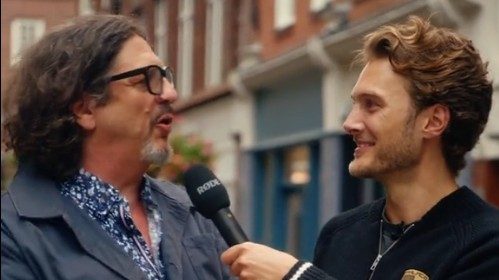
‘The grandees of print must now appear as guests on influencer feeds, reducing their art to a five-second take.’ @topjaw via Instagram.





If you like food and own a phone, you won’t be scrolling long before they appear: two slick boys in Chelsea boots loitering in a Soho doorway, one with a mic, the other with a camera, rehearsing their double act. “Yeh maaate, best place in Landan,” says the first, his vowels wobbling like jelly, a parody of Cockney welded onto the lacquered polish of a boarding-school quad. The other obliges with an artificial cackle. It’s all part of the ritual: the banter, the blow-dried hair, the chumminess of a pair of estate agents pretending to be your mates.
This is the routine they’ve flogged to millions of views. One asks a stranger (or, increasingly, a celebrity) their favourite places to eat in London; the other edits the “Nooo way, mate!” responses into a neat, reel-able montage. They don’t discover restaurants; they collect them, like Pokémon cards, to be traded, ranked, and bragged about. Their videos are interchangeable, the restaurants interchangeable, the answers indistinguishable from the ones given yesterday or the day before. London is a chorus of cloned soundbites: best pizza, best Guinness, best hidden gem, best, best, best.
Welcome to the grease-flecked world of Topjaw, with host Jesse Burgess and cameraman Will Warr enjoying clicks galore and endless hangouts with everyone from Jamie Oliver to the guy who runs The Devonshire. Alongside other perennially online influencers — from the faux-gasmic gurner “Eating With Tod” to the patronising seriousness of James Dimitri — there’s no doubt that they’re revolutionising London’s restaurant scene. Yet whether that’s a good thing is a very different question, and one with vast implications for how the capital thinks about food.
Not so long ago, restaurant criticism was serious business. Fay Maschler could sink an opening with a single disdainful sentence. AA Gill, for his part, famously turned reviews into prose-poems of bile and beauty. In one, he dismissed a Mayfair dining room as “so beige it felt like eating inside a wet wipe” — before segueing into a meditation on civility, cities and the theatre of hospitality. Marina O’Loughlin, Jay Rayner, Giles Coren; each wielded less a fork than a rapier, writing pieces that were as much about politics and morality as they were about food.
Then came the cuts. Newsrooms downsized, supplements shrank, critics’ expense accounts disappeared. The long lunches and slow deadlines that had once produced operatic write-ups were strangled by spreadsheets. Twenty years ago, every major paper had a roster of critics; now there are only seven national restaurant critics left in Britain. The wider picture is no healthier either: investment in frontline editorial staff fell by around 15% through the 2010s. None of this is really that surprising. Why send a writer out to eat five courses when you could commission an intern to bash out “Five Rooftop Bars for Summer” in half an hour, then watch it gather 10 times the clicks?
Social media had an impact here too, as Instagram filled the vacuum with a carnival of lurid food porn. The examples here are depressingly varied, from rainbow bagels and milkshakes topped with doughnuts to burgers bisected in high-def close-up. These are less meals than pageantry, edible pantomime staged under ring lights. Food has increasingly ceased to be about sustenance, or even pleasure; it’s mere theatre for the camera, an endless striptease of yolks and cheese-pulls, consumed not by mouths but by eyes.
This didn’t happen by accident. Instagram, after all, rewards spectacle: the more unhinged the dish, the more it’s shared, liked and reposted. Viral reach means money — queues, brand deals, investment — so restaurants engineer dishes for shock value alone.
Then there’s the broader cultural context. The fact is that Britain has fewer entrenched culinary traditions than its peers. For if Paris and Rome have storied dining cultures, and New York has institutions that outlive trends, London’s food scene is young, status-driven, brittle. It grew up fast in the 2000s and 2010s, powered less by heritage than by waves of migration, fashion and finance. Restaurants here are ventures more than inheritances, built on concepts that can quickly get old.
In other words, then, the algorithm’s appetite for novelty has slotted neatly into London’s frantic zeitgeist. And with the repeatability of social media came real power. A single Topjaw reel could now transform a business overnight. When they filmed at The Devonshire a few years back, the clip rocketed past a million views in days; queues snaked down the street, reservations vanished for months, and the pub tipped into outright mania. Diageo, I can only imagine, licked its lips at Guinness’s sudden trendiness.
Yet where an old-school critic might savage you, an influencer would only ever promote. They want to be seen as a soft touch, someone who, for a free meal — or, later as they became more powerful, a figure with tens of thousands of fans — would give you a 30-second reel of glowing, excitable praise. It isn’t hard to see why. A traditional critic arrives as a stranger, armed with anonymity and the freedom to be unimpressed; their job is to tell the truth, not make friends. Influencers, by contrast, build their entire brand on access, from the kitchen tour to the matey chat on camera. Yet once you’ve been welcomed into the back office and patted on the shoulder, it becomes almost impossible to be honest; criticism feels like betrayal, not reportage.
Of course, London is far from unique here, with social media fandom now dominating the culinary discourse across many major cities. In Berlin, for instance, the online food scene skews anarchic and niche: thinking grainy videos of Turkish grill masters in Neukölln and vegan doughnuts in Friedrichshain. But London is particularly susceptible to the glibbest praise — and not merely because of its history. This, after all, is a city in economic churn. Rents are crippling and margins thinner than filo pastry. Restaurants age in dog years: if they’re not packed from day one, they die. Nine in ten fail in their first year. In this climate, a viral TikTok is oxygen. Ignore it and you might just suffocate.
Add to that society’s peculiar obsession with status. In a city where housing, clothes and cars are out of reach for most, restaurants become the accessible status marker. It’s cheaper to book the hot new pasta spot than buy a flat in Hackney. Food, then, has become a way of performing success. As so often, social media turbocharges these trends: even if you don’t eat there, reposting a reel lets you take part in the performance of taste.
It would be unfair, here, to sneer too heavily. The Topjaw lads seem nice enough, enthusiastic, polished. They haven’t committed a crime; they’ve merely given us what we want. And while the old guard of critics turned reviews into theatre and polemic, they were writing for readers who had the time to sit with 1,000 words. TikTok is the opposite: food for the impatient, calories for the thumb. And it works: #LondonFood racks up literally billions of views, and even the old guard gets dragged in too.
The grandees of print — Coren, Rayner, the rest, all of whom, I should say, still write with flourish and flair — must now appear as guests on influencer feeds, mugging for the camera, trading their authority for likes, reducing their art to a five-second take. They laugh, fist-bump, faux-disapprove. Their presence flatters the influencer more than it enlightens the viewer. And you sense, watching them, a certain ambivalence. They know the format cheapens what they do, yet old-media prestige doesn’t insulate you from the gravitational pull of the algorithm. The audiences barely overlap — Times readers aren’t the ones queueing outside the latest Topjaw spot — but perhaps that’s the point: it’s the press trying to look “current,” a flicker of insecurity in an industry that has dwindled in influence.
Either way, the cumulative effect is to turn London into a spreadsheet of “must-tries”. And it’s a profound shift, when you think about it: for most of the last century, eating out in London was defined by the food itself — whether the grand hotels of the interwar years, the postwar Formica caffs, or the explosion of immigrant cooking from the Sixties on. Restaurants were places of sustenance, community, escape; even when the food was bad, the point was the meal. The idea that dining might be primarily about experience would have baffled almost every previous generation. Only in the 21st century, as hospitality fused with lifestyle branding and then with social media, did the centre of gravity tilt. Today, the food almost feels incidental: what matters is the image, the queue, the vibe, the verification. In historical terms, it’s a radical inversion: the meal as souvenir rather than the meal as memory.
The consequences are vast. Curiosity is the first thing to vanish: the chance of stumbling into somewhere you’ve never heard of, the joy of a dish that photographs badly but tastes sublime. The possibility of disappointment should always be inseparable from the possibility of delight. TikTok erases all that in advance; you have pre-lived the meal before you’ve even sat down.
This often leaves the oddballs — the places that give a city texture — struggling to survive. A bowl of stew can’t go viral. A restaurant full of silence and warmth has nothing to show the algorithm. And so, especially with those rent rises, many are squeezed out. The few who do catch the influencers’ eye face the opposite fate: institutions that survived for decades suddenly find themselves mobbed by TikTok pilgrims, their regulars elbowed aside by ring lights and selfie sticks. Take E. Pellicci’s on Bethnal Green Road. It’s a casual place I grew up going with my dad. Now, it’s overrun by fry-up fetishists.
No wonder, then, that we are starting to tire of it. As Hunger magazine wrote last year: “Once you’ve seen one Topjaw video, you’ve pretty much seen all of them.” The formula is polished to the point of parody, and by their own admission, they have no intention of deviating from it. They, along with all other successful influencers, feed the algorithm with the same set-ups, the same cackles, the same “best in London” superlatives, because that is what works.
Perhaps, even for Topjaw, fatigue will set in. Perhaps people, bored of the infinite loop, will seek out the weird, the old, the unfilmable. Or perhaps we might start eating in silence. Don’t tell anyone. Go somewhere unfashionable. Refuse the compulsion to share. Because food is not just hedonism; it’s the scrape of cutlery, the sag of conversation, the lull when nothing happens. It is accidents, mistakes, the unexpected. And these are things that cannot be edited into a reel. So next time you pass the lads outside The Devonshire, ignore them, and let them ask their questions to the void.