


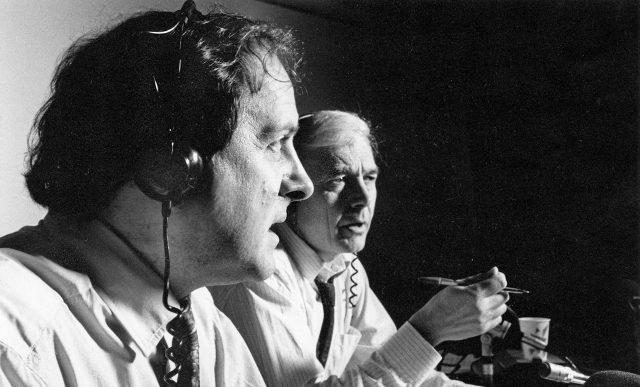
Series Oxbridge is killing journalism Group-thinking graduates are part of the establishment BY Justin Webb . The greats, James Naughtie and John Humphrys, didn't need an elite education. Credit: Bill Robinson/Radio Times/Getty Images Series What’s the point of university? Our contributors reflect on the years that didn't make them Other articles in this series > Justin Webb presents Radio 4's Today programme and was previously the BBC's North America Editor June 2, 2021 JustinOnWeb June 2, 2021 Filed under: BBCEducationHigher educationJournalismUniversityUniversity years Share: Fresh out of the London School of Economics, my head full of theories about taming inflation, I was sent to cover a coup in the Maldives. At an airfield outside Delhi, I was shepherded onto a Russian Antonov troop carrier with a few other journalists. It had no seats. The journey took hours and at one point a pilot appeared and started walking down the row of reporters, asking each person something. It was very loud so there was no way of hearing his question until he got to me. “Do you have a guidebook for the Maldives? We don’t know which Island the airport is on.” I did. The pilot beamed. He returned to the cockpit, and the plane changed direction, doubling back on itself. I’d spent long hours in the library with Hayek and Schumpeter, but in the end I was saved by Berlitz. We landed safely in the Maldives — only to find the coup had fizzled out. The pirates who had cackhandedly attempted to overthrow the government set sail and never came back. This was the beginning of my career. Since then, it has included wars, revolutions, errors of judgement, stomach-turning fear, blood-spattered sights, narrow scrapes, changes of heart and mind. And that’s just inside Broadcasting House. Could all of this — should all of this — have been achieved without an education provided at the taxpayers’ expense in the years 1980 to 1983 at the London School of Economics? Almost certainly. My father Peter Woods had no degree when he threw himself out of an aircraft for his first and last parachute jump in order to report on the Suez crisis for the Daily Mirror. Martha Gellhorn had no degree when she became the world’s most celebrated and intrepid reporter and author. Nor did another force of nature, the great John Humphrys, whose alma mater is The Penarth Times. But John’s hopped it to Classic FM and we are left, on the Today Programme, in a fusty senior common room impervious to cheeky lads and lasses from South Wales — unless they’ve spent years looking at books. The current presenters’ roster boasts two Oxford graduates, two from Cambridge, and me. It is unlikely that another non-graduate like John will present it any time soon and we are reduced as a result. Our perspectives are less diverse. The BBC, to its credit, is upping the number of recruits from non-degree backgrounds, suggesting that it understands that three years punting on the Cam is not the only pathway to success. More from this seriesWhat Oxford taught me about posh peopleBy James Rebanks Perhaps that’s because the Corporation sees the wider picture. Death by professionalisation. It’s not elite over-production that worries me so much as the quality of the elite that is being over-produced. University these days encourages a way of thinking about the world that is homogenous. Those who go — even those who have seen hardship and adversity — are smoothed around the edges. They don’t question the establishment because they (alright, we) are the establishment. At its worst, all this leads to a deadening. A weeding out of the kind of prickly cussed characters who bring vivacity to any line of work — and have made British journalism what it is. Take the late great Brian Barron, a former BBC war correspondent. He came across an ITN crew broken down in the desert in the first Gulf war he gave them water and passed on their co-ordinates to the military so that they could be rescued, but he refused to take their tape back to base to be broadcast. Brian was once described by Jon Snow (who competed with him in Africa for ITN) as, “the most tenacious, even ruthless, correspondent I have ever worked against — the ultimate, objective professional.” That word, “professional,” is used here — was once always used — to describe ability rather than status. Because Brian did not go to university. I seriously believe if he had he would have taken the tape for the stranded crew. He would have been professional in our modern sense — polished and polite — but unprofessional in Snow’s terms. Snow, though he went, never graduated, and has also been professional without being, well, a professional. In their pomp these people found things out, asked simple direct questions, never let anyone get away with waffle. Their minds were uncluttered. They respected themselves and their craft. They thought they knew the difference between up and down, right and wrong, good and bad, male and female. They were not befuddled by questions asked for the sake of asking. Thoughts had for the sake of thinking. More from this authorBoarding school put me in my placeBy Justin Webb And yet even as I write this, I know my heart is not in it. I learned nothing of much use to me at the LSE and yet, in truth, I learned everything. Crucially, I learned that I didn’t matter as much as I assumed I did. On a Saturday afternoon, sitting in the hugeness of the light-filled library and realising, courtesy of Eileen Barker’s moral philosophy course, that humans might not have free will. Rushing in on the tube for an early class with George Jones, doyen of politics professors, who hated what select committees were doing to the House of Commons. Bill Letwin (father of Oliver) who seemed to me to be impossibly Right-wing because he thought governments needed to be wary of involving themselves in economic life. David Starkey on how every other historian of his period was an idiot and a charlatan. Here is the first lesson they all taught: they don’t care about you. For the first time in my life I was on my own. Of course, there are schoolteachers who don’t care about you either, but they had to pretend. At university in the 80s, they didn’t pretend. David Starkey was a good example, on the up in those days and with bigger fish to fry. And because of that: an electrifying teacher. I loved the idea that this was an opportunity I could feast on or pass up: the choice, for the first time ever, was mine. So while I am sympathetic to the “too much education” school, I can’t in all honesty join it. University, done right, sorts your mind out. Confronts you with your own insignificance. Suggested readingWho gains from the great university scam?By Mary Harrington Of course, the education has to be real. Meaning lecturers must lecture and students must listen. Although the LSE in the 80s had its share of protesters and no-platformers and shouters about this and that, most of us understood that the trick was to listen. Humility is not much in fashion in the age of Twitter but it’s a good thing to have at university. Perhaps that’s an argument for paying for the whole thing from general taxation again: we never thought we had ‘rights’ because we were not consumers. We were privileged — all of us at university in the pre-fees and pre-mass attendance age — and we knew it. This may have allowed those who taught us more space to be better at what they did, which was thinking more than teaching. Nobody had to worry about being cancelled because they’d committed a micro-aggression. And this in turn encouraged eccentricity, intellectual heterodoxy, adventure. Most of the academics and most of the students actually believed in freedom. One of my lecturers was a supporter of the Cambodian mass murderer Pol Pot. Another (the wonderful Kurt Klappholz) had been in a Nazi Concentration camp. Neither of them prepared me to cover a coup, but they taught me to look twice. No punting of course in Aldwych, no misty memories of dawn after the May Ball. But halcyon days. I wouldn’t have missed it for the world. Even if it’d made me a better journalist. Join the discussion Since we’re all discussing our university experiences, I’ll add mine. I found Oxford (mathematics and computation) difficult after a high-achieving independent school. I simply didn’t know how to operate in a totally different environment, where you’re having to work out how to wash your clothes and feed yourself as well as get to the lectures and do work for tutorials. A year or two ago, I heard a speaker saying that university lectures aren’t like school lessons – it’s normal for students not to understand, but they’re expected to use it as a prompt to study independently until they can make sense of it. I’d have found it useful if someone told me that at the time, because I just assumed that there was something wrong with me in not being able to understand. I did get some very good things out of it though. I learned a lot about rigorous thinking, and the facilities were excellent for learning things which were nothing to do with the curriculum but which I found fascinating and ended up being very useful in my software development career. One of the problems I had at the time was being ashamed and/or worried to ask about things I didn’t know, because I assumed I was supposed to and didn’t know what the consequences would be of admitting I didn’t. Now I have no problem admitting my ignorance. Apart from being a good way to learn myself, it can also help to reveal when other people don’t know what they’re talking about. I’ve seen lots of examples of that in economics, which I’ve been studying independently for the last 13 years. Great article So many posters here who went to great universities, and did well, seem to not understand how huge effect it inevitably had on you. That time where thinking is the thing, and with other people who are thinking, and that group dynamic – it is the most amazing thing that us who did not get it miss most. I did some college, and one term at a university, but always as an outsider just passing through – but I would see the kids living and breathing it for consecutive years, I saw it as an outsider rather as an insider, and so I believe got a better picture. In my life instead I had no community, mostly mixed with the fringe and rough kinds where thinking and reading and being educated were the rare exception. We talked of lifes hardness and events, and got stoned and drunk – but not thoughtful talk, not intellectual, not smart talk. Years passed without getting that intellectual basis – I read immensely, as I always had, and that filled in, but to have spent years with bright minds and the reason you are there is to gain ideas and how to think about them – Amazing! What a great fourtune you all had. You all just do not realize how formative that must have been – to have learned so much information, and to think and understand it wile in the company of a vast variety of others doing the same, but for different topics – amazing. The school of hard knocks is pretty effective at teaching survival, but rarely at teaching intellectual thinking – and that is the higher value. (that and you likely make a lot of money) I only learned four useful new things really. One was, as you’ve said, “being buried in a mound of information and sort[ing] it out”. Before university your school did all this for you. Another, ancillary to that, was developing the habit of classifying tasks into Important, Urgent, and Overdue, and managing them accordingly. The third was that, as you were more or less left to your own devices, you had to work out what the scope of work was – this week, this term, this year – and organise your time to deliver it; nobody did this for you because your version of the course was your own. The fourth lesson was that this university minted 3,000 graduates a year substantially like me, and I had better have more than just my degree to talk about, if I wanted a job at the end of it; the degree was the bare minimum expectation. So I got busy with the extra-curricular stuff that marks you out as different. I’ve used all those throughout my working life. I’ve never needed the actual subject matter. Hear Hear, couldn’t agree more. In my 10+ years of university (mostly biochemistry/toxicology/physiology), I then “tried” one semester in the “humanities” and was completely appalled at the lack of literacy and critical thinking I saw there, and that was in 1986! I followed up with three semesters in business, which was all partying and self-congratulatory/aggrandising, then I left uni. Went back a few years later, but by then the even the sciences had been dulled by graduate profs prostituting themselves to find money to run their labs. The golden-age of university is well behind us. Yes, for me the working smarter bit came after I graduated – the apprenticeship in Life. There is also learning things to be civilized and learning useful things. Later in life I ended up studying a pair of postgrad STEM degrees in computer science and artificial intelligence (useful, and challenging, I rue my younger self for not applying myself in the beautiful mysteries of mathematics). Also a history degree – useless, but back in 2005 there were still a few old school professors hanging on who ensured it made you just a little more civilised, especially as I took to studying Old English and Latin as part of it, and medieval palaeography that requires a level of intellectual discipline and respectful dedication to the past. I also studied a social “science” at the time as “joint honours” which was neither useful nor civilising and was a complete waste of time, not least as they fraudulently used the scienrific method and statistics in crude semi-numeric ways to proffer not very much of anything. Those sort of subjects shouldn’t exist. Peter Hitchens: you should be writing articles for Unherd, not just contributing to the comments! Justin Webb , the BBC yes yes man trying to diversify as retirement draws near. What next an article by Jon Sopel on how Trump was not all bad? I had a different reaction to not doing well – I was already a keen bean, but I worked harder. And harder. And harder. And was upset when no results came. I was basically like a Land Rover, stuck in sand with the wheels spinning. What I needed to do was work smarter…that lesson took a long time to learn and I think I missed out on a lot of fun at university because I was too busy getting my knickers in a twist. To view all comments and stay up to date, become a registered user. It's simple, quick and free. Sign me up

Since we’re all discussing our university experiences, I’ll add mine. I found Oxford (mathematics and computation) difficult after a high-achieving independent school. I simply didn’t know how to operate in a totally different environment, where you’re having to work out how to wash your clothes and feed yourself as well as get to the lectures and do work for tutorials. A year or two ago, I heard a speaker saying that university lectures aren’t like school lessons – it’s normal for students not to understand, but they’re expected to use it as a prompt to study independently until they can make sense of it. I’d have found it useful if someone told me that at the time, because I just assumed that there was something wrong with me in not being able to understand. I did get some very good things out of it though. I learned a lot about rigorous thinking, and the facilities were excellent for learning things which were nothing to do with the curriculum but which I found fascinating and ended up being very useful in my software development career. One of the problems I had at the time was being ashamed and/or worried to ask about things I didn’t know, because I assumed I was supposed to and didn’t know what the consequences would be of admitting I didn’t. Now I have no problem admitting my ignorance. Apart from being a good way to learn myself, it can also help to reveal when other people don’t know what they’re talking about. I’ve seen lots of examples of that in economics, which I’ve been studying independently for the last 13 years.
So many posters here who went to great universities, and did well, seem to not understand how huge effect it inevitably had on you. That time where thinking is the thing, and with other people who are thinking, and that group dynamic – it is the most amazing thing that us who did not get it miss most. I did some college, and one term at a university, but always as an outsider just passing through – but I would see the kids living and breathing it for consecutive years, I saw it as an outsider rather as an insider, and so I believe got a better picture. In my life instead I had no community, mostly mixed with the fringe and rough kinds where thinking and reading and being educated were the rare exception. We talked of lifes hardness and events, and got stoned and drunk – but not thoughtful talk, not intellectual, not smart talk. Years passed without getting that intellectual basis – I read immensely, as I always had, and that filled in, but to have spent years with bright minds and the reason you are there is to gain ideas and how to think about them – Amazing! What a great fourtune you all had. You all just do not realize how formative that must have been – to have learned so much information, and to think and understand it wile in the company of a vast variety of others doing the same, but for different topics – amazing. The school of hard knocks is pretty effective at teaching survival, but rarely at teaching intellectual thinking – and that is the higher value. (that and you likely make a lot of money)
I only learned four useful new things really. One was, as you’ve said, “being buried in a mound of information and sort[ing] it out”. Before university your school did all this for you. Another, ancillary to that, was developing the habit of classifying tasks into Important, Urgent, and Overdue, and managing them accordingly. The third was that, as you were more or less left to your own devices, you had to work out what the scope of work was – this week, this term, this year – and organise your time to deliver it; nobody did this for you because your version of the course was your own. The fourth lesson was that this university minted 3,000 graduates a year substantially like me, and I had better have more than just my degree to talk about, if I wanted a job at the end of it; the degree was the bare minimum expectation. So I got busy with the extra-curricular stuff that marks you out as different. I’ve used all those throughout my working life. I’ve never needed the actual subject matter.
Hear Hear, couldn’t agree more. In my 10+ years of university (mostly biochemistry/toxicology/physiology), I then “tried” one semester in the “humanities” and was completely appalled at the lack of literacy and critical thinking I saw there, and that was in 1986! I followed up with three semesters in business, which was all partying and self-congratulatory/aggrandising, then I left uni. Went back a few years later, but by then the even the sciences had been dulled by graduate profs prostituting themselves to find money to run their labs. The golden-age of university is well behind us.
There is also learning things to be civilized and learning useful things. Later in life I ended up studying a pair of postgrad STEM degrees in computer science and artificial intelligence (useful, and challenging, I rue my younger self for not applying myself in the beautiful mysteries of mathematics). Also a history degree – useless, but back in 2005 there were still a few old school professors hanging on who ensured it made you just a little more civilised, especially as I took to studying Old English and Latin as part of it, and medieval palaeography that requires a level of intellectual discipline and respectful dedication to the past. I also studied a social “science” at the time as “joint honours” which was neither useful nor civilising and was a complete waste of time, not least as they fraudulently used the scienrific method and statistics in crude semi-numeric ways to proffer not very much of anything. Those sort of subjects shouldn’t exist.
Justin Webb , the BBC yes yes man trying to diversify as retirement draws near. What next an article by Jon Sopel on how Trump was not all bad?
I had a different reaction to not doing well – I was already a keen bean, but I worked harder. And harder. And harder. And was upset when no results came. I was basically like a Land Rover, stuck in sand with the wheels spinning. What I needed to do was work smarter…that lesson took a long time to learn and I think I missed out on a lot of fun at university because I was too busy getting my knickers in a twist.



