




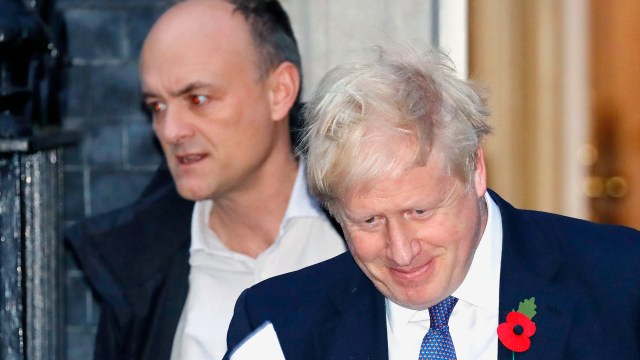
Does the Red Wall care about Boris’s pandemic? Credit: TOLGA AKMEN/AFP via Getty





When we go to sleep our brains go through a cycle of different stages; first the dreamless, NREM (non-rapid eye movement) stage, during which our minds digest the events of the day; and then the REM, when it interprets them with dreams.
It’s the same with historical events, which are digested and then usually followed about five to ten years later by serious works of fiction and history offering an interpretation of what happened. The more traumatic events might take longer, and those “dreams” may change the collective view of what happened; the popular interpretation of the First World War was only really established in 1929 with three different plays damning the conflict, quite different from how it was viewed at the time. The Holocaust took even longer, and it was only from the late Seventies that it became a subject replayed over again in our minds.
We have yet to collectively dream about the awful events of 2020. The history of how Boris Johnson handled Covid is still to be written, and today’s opinion polls tell us little. For that reason, I’d be wary of dismissing too quickly the impact of Dominic Cummings’s testimony yesterday.
The Cummings narrative, of grotesque incompetence and a shambolic, lazy hack of a Prime Minister, will almost certainly have no impact on the Government’s commanding lead in the polls, and Boris Johnson will continue his satanic lucky streak.
Most people don’t seem to mind that the Prime Minister is lazy and dishonest, and none of yesterday’s revelations will “cut through” to ordinary voters, at least immediately. When it comes to Johnson’s performance the people have spoken. The people think he did a good job. And yet maybe the people are wrong. Maybe we ought to care more about what the elite think.
Five years ago we started hearing a lot more about “the people”; on one side some talked of the referendum being “the will of the people”, while others demanded a “people’s vote”, as if the first referendum had been decided by geese or ducks.
It’s not encouraging. Pretty much everything in history with “the people” in it has tended to be either murderous, stupid, disingenuous or just incompetent, from the People’s Crusade (an orgy of religiously-fuelled mob murder of Jews followed by humiliating defeat by Muslims) to the various terrible regimes that have “people” in the name. (Or “the people’s vaccine”, for which read: no vaccine.)
Yet here were Tory politicians invoking “the people”, something far closer to populism than conservatism.
Conservatism is built around institutions, the framework of social organisation — monarchy, church, family, social organisations, legal and government bodies, even sports clubs. Robert Peel said in a famous 1838 speech: “By Conservative principles, I mean … the maintenance, defence and continuance of those laws, those institutions, that society, and those habits and manners, which have contributed to and mould and form the character of Englishmen.”
Populism, in contrast, is built around the sovereignty of “the people”. Populists tend to disregard institutions because they feel little connection with them, partly because they have become dominated by their political opponents and international elites. There is a particular danger with conservatives becoming disenchanted with shared institutions, because they are psychologically best suited to maintain them, being overall more conscientious and sticklers for rules.
In a world where shared institutions are crumbling, conservatism will morph into populism, which doesn’t base political legitimacy on such civic bodies but on “the people”. If Boris Johnson has the support of the people, if none of Cummings’s revelations makes any difference in the polls, then it doesn’t matter — the libs are owned.
The Johnson Government is not populist, it is what someone described as a Whig oligarchy with a populist vibe. Johnson is a right-wing liberal but he has the personal charisma usually associated with populists, as well as the dreadful record of consistently lying.
The voters don’t mind, because there is also a vague feeling that he supports “people like me” against remote elites, yet it is not spelled out. On another characteristic populist trait — the belittling of expert authority — Johnson’s government is hardly Trumpian, either. While political leaders in France and Germany have behaved appallingly with regards to vaccines, the British Government has always followed expert advice throughout the epidemic — it’s just a shame the experts got a lot of things wrong.
And yet, the Johnson Government’s raison d’etre seems to be that, so long as it has the support of the people, aka the median voter or Red Wall, that’s enough. Which is not the way we end up with good government.
Even if Cummings’s revelations don’t matter to the Red Wall voters, it’s still disastrous that the Government completely failed to respond to Covid. It’s still disastrous if, as Cummings alleges, the Prime Minister was distracted by a book he has to write to pay for a divorce caused by his philandering. It’s still disastrous that the Cabinet Office is “terrifyingly shit”.
Most voters have a view regarding how competently the country is run, but they don’t consider it their role to be the watchdog of political morals; that used to be the job of that dreaded word no one will admit to being part of — the elite. John Profumo spent four decades living a life of shame-induced public service not because it “cut through” with voters but because he’d disgraced himself in the eyes of his peers.
The norms of British public life stated that you didn’t lie and cheat, but once that norm was broken, it was impossible to put back together. Norms are far easier to destroy than to build.
Most people are not that interested in politics and are mostly apolitical, which in effect means small-c conservative. They don’t tend to notice the everyday rigmarole of Westminster, and what does “cut through” isn’t necessarily important. For example, Cummings driving to County Durham so that his family might care for his son if both he and his wife became ill did cut through with non-political voters; the fact that the Government incompetently shunted Covid patients into care homes and in doing so killed thousands of people hardly made an impact.
Does that mean that Conservatives are supposed to view the former as more important? Sometimes “the people” are wrong, sometimes we shouldn’t care so much whether an issue cuts through with the public because it is actually important in itself, to the country’s elites who are supposed to ensure good government. Conservatives have forgotten how to even articulate this point because, since June 2016 at least, their core self-justification is that the people is sovereign.
The politically apathetic or semi-interested often have sounder political instincts than the university-educated because they suffer less from biases and groupthink. The more people learn about a political subject, and become more vested in it, the more extreme they tend to become and the more tribal. It is the job of conservatives to protect the country from such people.
But the politically apathetic also don’t write the narrative, and while they might not be aware of the day-to-day political rigmarole, they are still subject to the same historical memory. Yesterday’s revelations might not affect the polls now or even next year, but if the Cummings narrative — of incompetence, laziness and callousness at the hands of a dishonest and disorganised prime minister — builds as a historical memory, then it will start to break through, not just into opinion polls but into the history books.
Even if yesterday’s revelations make no impact on the polls, it may well affect the longer cultural memory, the REM of British life. John Major’s government had given us 16 consecutive quarters of economic growth by the time of the 1997 election, but at that point, the memory of Black Wednesday had seared itself into the collective memory. The same might happen with Covid.
Few blame the Government right now for how they dealt with Covid, just as few in 1919 doubted the wisdom of fighting Germany. But history hasn’t been written yet, and when it is, historians won’t be as forgiving to Boris Johnson as “the people”.
