









July 5 2026 - 12:00pm
The firewall erected by Germany’s establishment parties against the AfD has come up against a tricky potential scenario: what happens when the populist Right unites with the populist Left?
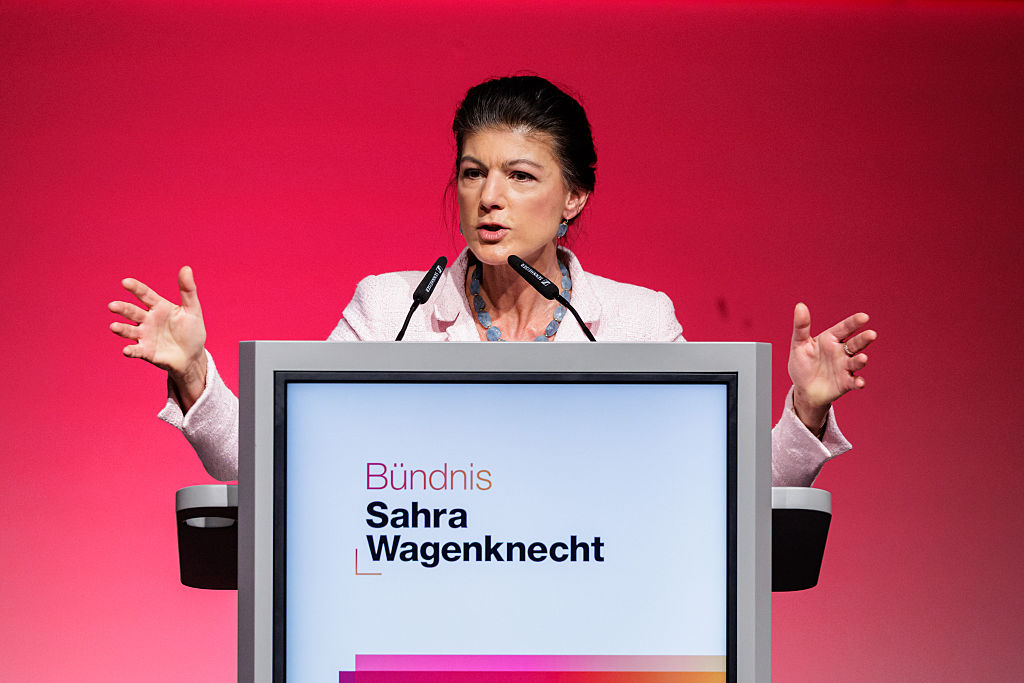
Sahra Wagenknecht, who founded the Bündnis Sahra Wagenknecht (BSW) in 2024, is reportedly pushing for an alliance with the AfD ahead of state elections in September. Though she stepped down as party leader last year, she maintains influence on the German Left. Now her successors at the top of BSW have sent a letter to AfD leaders Alice Weidel and Tino Chrupalla criticizing attempts to exclude the Right-wing party from the parliamentary process.
Ahead of the elections in the fall, popular anger is firmly directed against Chancellor Friedrich Merz and his grand coalition with the Social Democrats. His encouraging comments for the German national soccer team following its ignominious exit from this summer’s World Cup only served to show how out of touch he is with the wider public mood, while a general fatigue has set in over the Ukraine war, which can only benefit the AfD and BSW. Is this the end of the firewall as we know it? The CDU has a strict one against the AfD and the Left-wing Die Linke, but what if the AfD no longer needs the Christian Democrats to govern? And how far could Wagenknecht’s support benefit the Right-wing party?
The AfD is already leading the polls with 42% in Saxony-Anhalt and around 35% in Mecklenburg-Western Pomerania, the two states that will hold state legislative elections in September. In western Germany, the numbers are lower, but with 20%, the party still comes third in Lower Saxony, where regional elections will also take place.
What are the coalition options? In Saxony-Anhalt, there is no alliance between centrist parties that could stop the AfD, even if one were to add the CDU, SPD, the FDP and the Greens together. The BSW is thus not critical there. Wagenknecht’s party offers more in Mecklenburg-Western Pomerania, where it could bolster the AfD to get 41% or more and thus challenge the centrist options of either a coalition between the CDU, SPD and Greens or the current coalition of SPD and Die Linke. According to Insa polls, the three-party coalition could get 42% and the incumbent one 39%.
The AfD remains cautious about teaming up with Wagenknecht, signaling that it is open to dialog but publicly rejecting any formal alliance or joint campaigning. The Left-wing party has far more to gain than its counterpart on the Right, but Wagenknecht’s conservative cultural views are in line with the AfD’s ideology. What’s more, a combined opposition to the political establishment may prove potent, just as the German public loses patience with the status quo.
This is an edited version of an article which originally appeared in the Eurointelligence newsletter.