









January 30 2026 - 8:00pm
Earlier this month, a healthcare nurse in Richmond, Virginia posted a “resistance tip” on TikTok about how to undermine ICE agents who round up immigrants for deportation. She recommended injecting the agents with muscle relaxants, spiking their drinks with laxatives, and spraying their faces with water steeped in poison oak.
On Tuesday, the nurse was fired by her employer, Virginia Commonwealth University, after her posts went viral online. VCU Health issued a statement saying that “the content of the videos is highly inappropriate.”
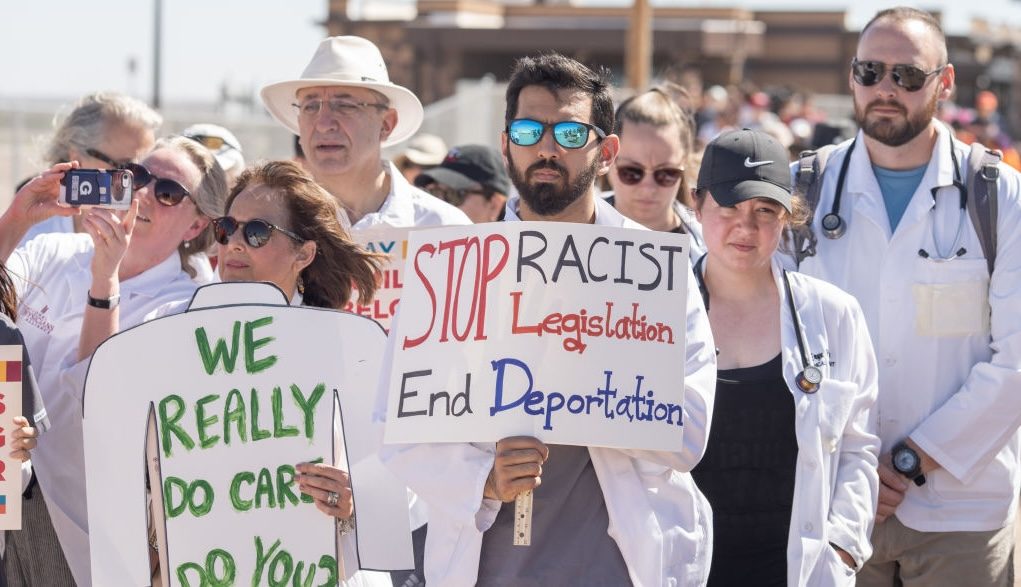
It’s tempting to dismiss this nurse as a rogue actor, but her attitude is at least partially a result of America’s radicalized medical culture. Over the past decade, as DEI swept through elite institutions, the healthcare profession — from medical schools and journals to state boards and professional associations — emerged as one of its most zealous adopters. Yet the profession has still not reckoned with the consequences of saturating healthcare workers with the claim that white supremacy is not merely a social pathology but a foundational feature of the system in which they operate.
The concept of deploying medicine to promote social justice is accepted as conventional wisdom by many in the profession. But some cross the line and encourage the use of medicine to cause harm to racists and others they deem immoral. In recent days, a Florida nurse on TikTok wished serious injuries on White House Press Secretary Karoline Leavitt. Another Florida nurse posted on Facebook that his ethical oath allows him not to administer anesthesia “for any surgeries or procedures for MAGA”.
As strange as that may sound, the medical profession has long been debating the ethics of withholding medical care and refusing to treat “racist” patients. Some medical ethicists contend that racial discrimination laws protect doctors and nurses from belligerent patients who espouse racial hostility, as long as there are alternative means for providing medical care. It’s just one of many controversial ideas floated as a means to repair an unjust society.
During Covid, more than 1,200 public health officials signed a letter endorsing protests against racism, even though public congregation was otherwise prohibited at the height of the pandemic. The letter helped legitimize a broader shift within medicine, galvanizing efforts in medical schools to argue that systemic racism within the profession is the primary driver of racial health disparities — and that it must be countered through explicitly antiracist education.
In practice, this logic informed proposals to prioritize African Americans for Covid vaccinations, a policy ultimately rejected when it became clear it would increase overall mortality. Elsewhere, it has taken firmer institutional form. At Boston’s Brigham and Women’s Hospital, clinicians once prioritized oppressed racial minorities for cardiac care, explicitly applying Critical Race Theory as a diagnostic framework. In psychiatry, the same moral imperative has extended even further, translating into efforts to recruit patients to vote — a controversial practice many regard as abusive and unprofessional.
Taken together, these episodes point to a profession that has blurred the line between moral advocacy and clinical duty. When medicine frames itself not as a neutral practice oriented toward care but as an instrument for redressing political wrongs, it risks licensing exactly the sort of extremism now being waved away as aberrant. The danger is not merely reputational. A healthcare system that teaches its practitioners to sort patients and adversaries into moral categories will inevitably produce clinicians who feel justified in using their skills to punish as well as to heal. The consequences will extend far beyond a handful of viral TikToks.