








10 February 2026 - 7:00pm
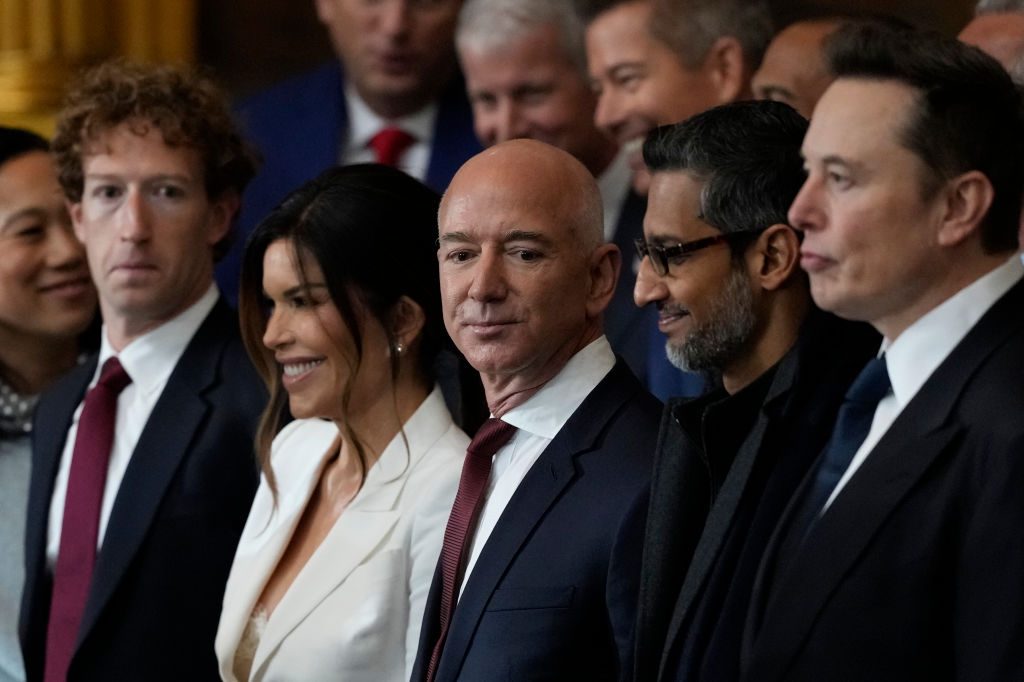
As the dominant economic and social force of our time, a handful of Silicon Valley-based companies shape our politics more than we’d like to admit. These tech oligarchs are not ideological, but instead are motivated by what Lord Palmerston referred to as “permanent interests”. Controlling state power, or constraining it from undesirable intrusions, often requires flexible politics.
After all, today’s tech billionaires lead what are effectively global nation-states. Last summer, Nvidia became the world’s first $4 trillion company, making it more valuable than 97% of the world’s economies and all of the world’s military spending. By September last year, the combined profits of the 10 most profitable tech companies were so vast that, if treated as a country, they would rank as the world’s third-largest economy, ahead of Japan.
So where are these titans positioning themselves now? There has been another turn of the wheel — this time back towards the political centre. Tech firms have long bristled at MAGA’s protectionism: tariffs disrupt their offshore operating models, while restrictions on H-1B visas threaten the steady inflow of foreign labour on which the sector depends.
While the tech billionaires still outwardly placate Trump, there are signs of growing unease. There was vocal outrage from many in the industry following the two shootings by ICE agents in Minneapolis last month. Anthropic CEO Dario Amodei warned about “the horror we are seeing in Minnesota”, while OpenAI’s Sam Altman told the company’s staff that ICE is “going too far”. “There is a big difference between deporting violent criminals and what’s happening now, and we need to distinguish them correctly,” he added. Yann LeCun, one of the godfathers of AI, posted a single word: “murderers”. An employee petition at ICEout.tech has gathered over 800 signatures demanding CEOs cancel ICE contracts and speak out.
Like those who lead nations, these oligarchs shift their political desires with changing conditions. In the Eighties, when they were a shadow of their current size, they embraced Reaganism. But as political reality shifted, they tilted to endorse the neoliberalism of former California governor Jerry Brown. In 2016, Silicon Valley donated 60 times more to Hilary Clinton than it did to Donald Trump. Then, in 2024, much of the industry — disgusted by the economic illiteracy of the Biden years — shifted to Trump, led by “tech bros” Elon Musk and Peter Thiel. Zuckerberg and Jeff Bezos followed: unsurprisingly, they were looking to consolidate their chances of winning lucrative government contracts in space and defence. Both Musk and Thiel have certainly achieved that so far. Even so, it’s worth pointing out that not all of Silicon Valley shifted Right in 2024. Plenty of major donors remained Democrat, such as Facebook co-founder Dustin Moskovitz and Reid Hoffman.
In deep blue cities and states, where the oligarchs are facing campaigns to impose a massive “billionaires tax” and regulation of AI, they cannot look to their libertarian friends in the Republican Party. Less than a fifth of all elected officials in the Valley are Republican, while Democrats have over 70%. There is not one Republican from the Valley in Congress.
The alliance with moderate Democrats may be the best way for Silicon Valley chiefs to hold onto their profits. They fear the return of progressives such as Lina Khan, former commissioner of the Federal Trade Commission, who threatened to break up the big tech firms. More recently, she served as co-chair of New York Mayor Zohran Mamdani’s transition team.
It is becoming clear that the politics epitomised by Mamdani and the increasingly powerful DSA on the West Coast represent a clear threat to the very future of the tech oligarchy. Rising inequality and general fear of downward mobility have increased support for expanded government, with the majority of voters under 40 strongly in favour of socialism. As of September last year, a majority of young Americans also supported limiting incomes. In response, Silicon Valley is now splintering, but it is increasingly aware of threats from both the MAGA Right and the socialist Left. Tech, once widely admired, is increasingly feared by the majority while the oligarchs scramble to protect themselves.
Joel Kotkin is a Presidential Fellow in Urban Futures at Chapman University and a Senior Research Fellow at the Civitas Institute, the University of Texas at Austin.
 joelkotkin
Join the discussion
Join like minded readers that support our journalism by becoming a paid subscriber
To join the discussion in the comments, become a paid subscriber.
Join like minded readers that support our journalism, read unlimited articles and enjoy other subscriber-only benefits.
Subscribe