








14 February 2026 - 1:00pm
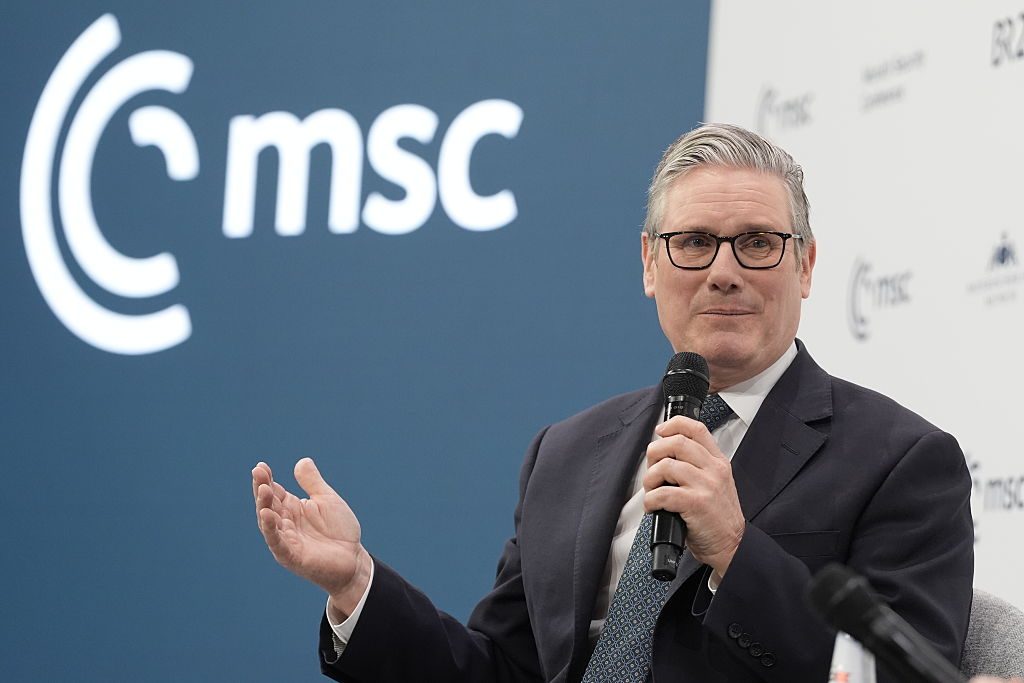
At the Munich Security Conference this morning, Keir Starmer proposed a shift in foreign policy. Calling for “deeper links” with the European Union, the British Prime Minister warned that “leaders have looked the other way, only rearming when disaster is upon them”. He added: “This time must be different.”
According to the Financial Times, Starmer will use meetings with other leaders this weekend to propose a “multinational defence initiative that could oversee joint weapons procurement and drive down the costs of rearmament”. That appears to make sense. Given the threat from Russia and China, coupled with the volatility of US foreign policy, it’s clear that the rest of the West needs to increase its security spending. So it’s only right to maximise the value we get from that investment.
Nevertheless, there are reasons to question Starmer’s motives. Especially suspicious is the fact that his initiative coincides with his renewed interest in getting Britain involved with Security Action for Europe (SAFE). This is an EU scheme in which member states jointly borrow money to fund defence initiatives.
SAFE’s financial mechanism is remarkably similar to that of the EU’s Covid recovery fund, which was also propped up by loans raised on the global money markets by the European Commission — but underwritten by national governments. Its true purpose was to bail out the single currency, because without a fiscal union to buttress a monetary union, the eurozone is vulnerable to external shocks like the pandemic. Of course, it was sold to the European public as a one-off emergency measure and not the start of a fiscal union by stealth. And yet here we are again with another “exceptional and temporary response” — only this time it’s Vladimir Putin and Donald Trump supplying the external shock, not Covid.
Fortunately for Britain, Brexit meant that the country didn’t have to participate in the Covid recovery fund. Brexit also means that we don’t have to participate in SAFE. And yet there’s a danger that as part of his ambition for closer UK-EU alignment, Starmer will use British taxpayers’ money to buy our way in. As the Chagos Islands deal has shown, he’s all too ready to hand over tens of billions of pounds in return for dubious security benefits.
It’s not just the expense that’s the problem, but the fact that SAFE entrusts international defence cooperation to the European Union, which is thoroughly unsuited to the task. For a start, not all EU member states can be relied upon: some, such as the Irish and Austrians, are officially neutral, while others, like the Hungarian and Slovakian governments, are far too close to Russia. And even if all 27 national governments were on the same side, the EU’s cumbersome decision-making processes are no way to run a military alliance.
To cap it all off, the EU’s inevitably insular focus excludes the wider defence interests of the free world, including Japan, Canada, Australia and New Zealand. In other words, we need a “Nato-plus” to defend democracy, not the EU (which is Nato-minus).
One might also ask how all this plays into the hands of Emmanuel Macron. The French President is currently pushing his idea for eurobonds — i.e. joint EU debt — to finance a massive ongoing increase in public investment. This would take the old EU game of getting other countries to pay for your stuff to a whole new level. Before Brexit, it was a game Britain lost badly, and the country must resist any attempt to get drawn back in again. If the nations of Europe are to have one another’s backs, they must get their hands out of one another’s pockets.
Peter Franklin is Associate Editor of UnHerd. He was previously a policy advisor and speechwriter on environmental and social issues.
 peterfranklin_
Join the discussion
Join like minded readers that support our journalism by becoming a paid subscriber
To join the discussion in the comments, become a paid subscriber.
Join like minded readers that support our journalism, read unlimited articles and enjoy other subscriber-only benefits.
Subscribe