








18 February 2026 - 5:30pm
As American military assets pile into the Gulf and rumours swirl about an imminent US–Israeli strike on Iran, the Islamic Republic took a dramatic step on Tuesday: it moved to close the Strait of Hormuz. The decision marks a significant escalation at a moment of mounting regional tension.
Some 17 billion barrels of oil pass through the Strait of Hormuz every day, amounting to 90% of the oil from the Persian Gulf and about one-quarter of global supply. Closing the waterway would cause an immediate spike in world energy prices, impacting essentially every human on earth, with unpredictable economic and political consequences. Tehran justified the move as a set of “security precautions” during an Islamic Revolutionary Guards Corps naval drill. The disruption was, for now, partial and temporary, lasting only a few hours. But the Islamic Republic’s record offers little reason for reassurance.
The regime cheats incrementally to avoid providing a blatant casus belli. It tests boundaries, retreating when it meets force and consolidating gains when it does not. By that logic, the White House’s silence over yesterday’s closure is hardly reassuring.
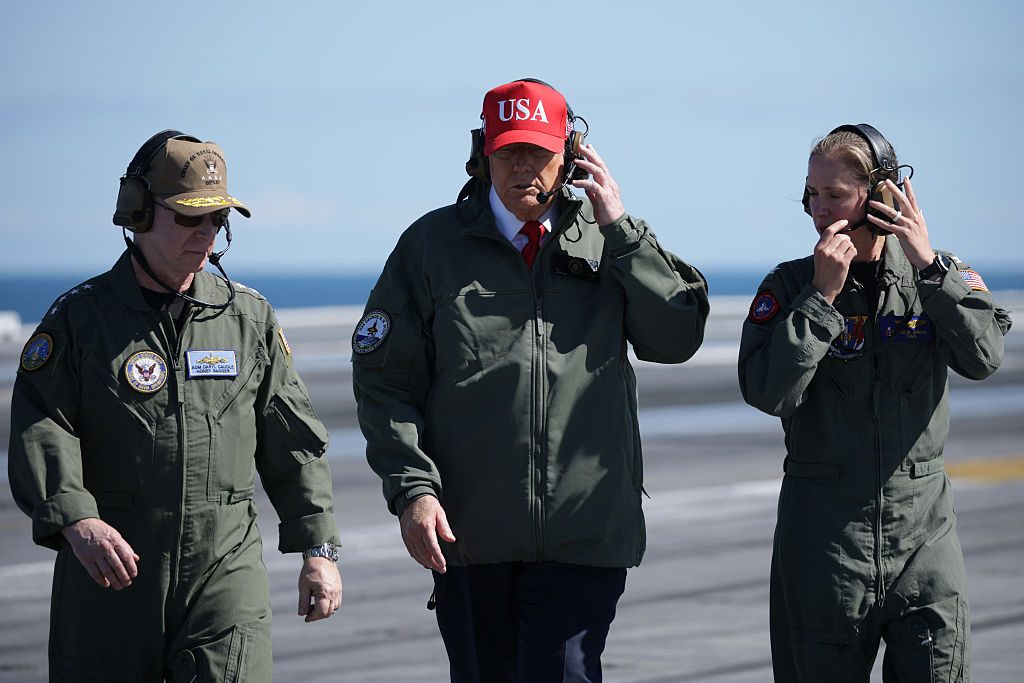
It may be that Trump thinks the “beautiful armada” he has gathered around Iran speaks for itself. One nuclear-powered US aircraft carrier recently arrived in the Arabian Sea and another is on its way. There are a dozen other American ships in the region, carrying 5,000-plus troops and long-range missiles, and more fighter jets have been sent to the US base in Jordan. The problem is that Trump is sending mixed signals about his willingness to use this hardware and has a record of hesitancy with Iran, despite the bellicose rhetoric and dazzling one-off strikes in 2020 and 2025.
In the late Eighties, an Iranian attempt to close the Strait of Hormuz ended with the swift destruction of the IRGC Navy, and there is no reason that could not be repeated. It is true that President Trump launched America’s first direct military action inside Iran, breaking a taboo that has restrained American policy towards the country for nearly half a century. However, even there, Trump called off the campaign before Israel had hit all its targets.
His first term followed a similar line. In 2019, Trump suddenly abandoned a military response to Iran’s attack on crucial oil facilities in Saudi Arabia. This was a shocking departure from decades of policy that caused the Saudis to lose faith in America’s security guarantees and reorient to a non-confrontational policy with Iran. This time around, Trump encouraged Iranians to escalate their uprising, promising “help is on its way”, only to then stand down and accept a regime offer of negotiations on the nuclear weapons programme. The Islamic Republic used the time bought to carry out the largest massacre of Iranians in centuries and slaughter thousands of prisoners, many after unspeakable torture.
Trump officials are currently leaking that a “more existential” US military campaign will occur in Iran if the nuclear negotiations fail. But the President let the moment when the protest movement seemed to threaten the Islamic Republic pass. He has also been silent on this latest closing of Hormuz. Escalation, therefore, rings hollow.
If it is a negotiating tactic, it will not work to pressure Iran into meaningful concessions. Trump’s choice is to follow Barack Obama in being so desperate for a deal that he signs an accord on Iran’s terms, or to follow his rhetoric and pull the trigger. If he chooses the latter, and the Iranians react by closing the Strait, Trump’s decision at that point will define his presidency whichever way it goes.
Join the discussion
Join like minded readers that support our journalism by becoming a paid subscriber
To join the discussion in the comments, become a paid subscriber.
Join like minded readers that support our journalism, read unlimited articles and enjoy other subscriber-only benefits.
Subscribe