




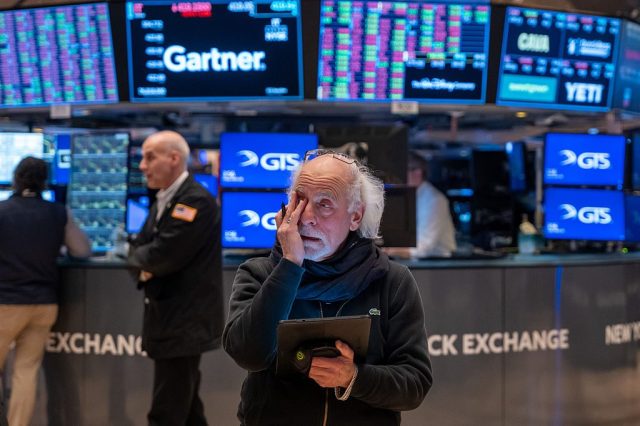
'Beyond the regulatory reach of democratic and undemocratic states.' (Spencer Platt/Getty Images)





In what must be one of the highest-stakes gambles of all time, tech billionaires are betting trillions of dollars on a technology that they believe could usher in an age of abundance, cure all diseases and ultimately save the planet. So far, speculators big and small have bet $5 trillion on Nvidia, the AI industry’s chipmaker — and with it the success of Artificial General Intelligence (AGI).
It’s the kind of bet that Nathan Detroit might call “very big potatoes”. But for the tech barons, it’s nowhere near big enough. Meta, Alphabet and Amazon announced earlier this month that they needed to raise more than $600 billion this year to fund spending on AI data centers. And although Elon Musk’s xAI raised $20 billion in December, he’ll need far more if he wants to remain competitive. Hence his proposed IPO this summer, when he’ll invite millions of ordinary people to finance the “Muskverse”.
Much of this money is being spent on building vast, energy-guzzling data centers to power the smarter-than-human machines. Such infrastructure will be vital for any tech oligarchs hoping to win the war for AI dominance. “We have decided,” said OpenAI boss Sam Altman in October, “that it is time to go make a very aggressive infrastructure bet … But to make the bet at this scale, we kind of need the whole industry, or a big chunk of the industry, to support it.”
Now that tech giants are raising and spending other people’s money, how confident can investors be of getting repaid? The truth is companies such as OpenAI are likely to run out of cash before their tantalizing new technology produces profits. That is why, having used up their own voluminous supplies of cash, AI companies are now being forced to borrow, or go public — with no certainty that the billions of dollars invested will generate revenues sufficient to compensate millions of small-time investors. Last November, Big Tech stocks sold off sharply as shareholders balked at what the Financial Times called “the gargantuan capex plans” of Silicon Valley tech bros, and worried that their investments were unlikely to generate a return.
Big tech gamblers have deceived us before. After all, it was not long ago that we, the trusting public, were offered an equally enticing product: the internet. The original internet wasn’t just a network. It was meant to be a nervous system for humanity. A decentralized oracle. A library of Alexandria that no empire could burn. “Information wants to be free,” we were told. “No one owns the net — it belongs to us all,” we believed.
Their promises turned out to be false. Instead, the internet has become utterly enshittified. There are few platforms or devices whose user experience has not degraded.
Nor was it long ago that Mark Zuckerberg made a bet of more than $100 billion on the “metaverse” — a virtual-reality world to which he was so committed he changed Facebook’s branding to Meta. Yet now it seems that bet is off. As financial journalist Robin Wigglesworth noted: “The whole metaverse thing now seems to be completely memory-holed by everyone — including Zuckerberg himself.” As of the end of 2024, the cumulative losses suffered by Meta’s Reality Labs division stood at $68.9 billion. Big potatoes indeed.
It seems that AI, too, is on the path to enshittification. Last October, Altman announced that, as part of OpenAI’s “treat adult users like adults” principle, the company would be allowing erotica on the platform. Now, he’s gone further. Because AI is expensive to run, OpenAI has started testing advertising on ChatGPT. Zoë Hitzig, a former researcher at the company, resigned over the issue last week. In a New York Times article, she warned that: “For several years, ChatGPT users have generated an archive of human candor that has no precedent, in part because people believed they were talking to something that had no ulterior agenda … People tell chatbots about their medical fears, their relationship problems and their beliefs about God and the afterlife. Advertising built on that archive creates a potential for manipulating users in ways we don’t have the tools to understand, let alone prevent.”
The extraterritorial, largely unregulated space in which tech billionaires wheel, deal and speculate is defined by economists as the “international financial and monetary system”. I, however, in the spirit of J.M. Keynes, would call it the “Global Casino”. Tech titans are joined in this space by big corporate and individual speculators in the Casino’s markets for money, food, energy and pensions, and by an unregulated shadow banking system that spews out easy, if shady, money.
Though the Casino operates in an unregulated sphere, it remains tethered to the real bailout economy that the rest of us — the “little people” — live and work in. If the Casino goes down, central banks will have to bail it out. The gamblers know, as we do, that they are too big to fail, and too big to jail.
Of course, capitalism has always produced daring, creative risk-takers — those who dreamed of, invested in and built the railways, computers and the internet. What’s different today is that unlike railways, computers and the internet, AGI doesn’t exist. The AGI bubble may just be a vast techno-dystopian power play designed to put Silicon Valley bosses in political and financial control over a weakened global labor force. This is class war at its most brutal.
The Casino’s activities have already had a damaging impact on the real economy, and ignited a global political backlash. To my mind, it is the volatility, instability and imbalances of the Global Casino, rather than wages or the pandemic or even Big Tech, that is largely to blame for the ongoing cost-of-living crisis endured by most of the world’s economies since 2020. It is the Casino’s speculative global markets for agricultural goods and energy that have led to volatility in the prices of key commodities, and that in turn has driven up the cost of living. That has led to a worldwide clamor for protection from markets that deny consumers affordable food and energy, and in some countries affordable housing, health and education. Voters are increasingly turning to authoritarian leaders who promise to protect the public from the out-of-control Global Casino and the system’s attacks on living standards.
To restore stability to the global economy, and protect consumers from Big Tech, we must bring the Casino back down to earth and comprehensively transform the international financial architecture. This may be a grand ambition, but in the event of another global financial crisis, or even a catastrophic world war, it will be a necessary one.
In the meantime, we must address the problem of speculation. It’s hardly a new phenomenon. For centuries people have gambled on future outcomes. For much of that time, the most honorable purpose of speculation was “hedging” — a form of insurance to deal with the uncertainty of the future. Judges, courts and the law have long recognized that there is a difference between hedging that serves a social purpose and hedging that is mere speculation. Speculation increases risk, leading to price bubbles, volatility, manipulation schemes and inflation — all characteristics of the AI bubble. In its worst form, it must be understood as rent-seeking: the attempt to acquire wealth not by creating it but by effortlessly extracting wealth from another.
Harvard Professor Lynn Stout suggests that we return to an older system. “The old common law rule against difference contracts was a simple, elegant legal sieve that separated useful hedging contracts from purely speculative wagers,” she argues. Under this system, the law would no longer be used to enforce the terms of a speculative contract if it were broken.
This reform would bring speculators — and tech billionaires — back to reality and force them to think carefully before making bets at scale by inflating bubbles and encouraging speculation that cannot be honored by reference to real-world conditions and law.
Ann Pettifor is a British economist. Her latest book is The Global Casino: How Wall Street Gambles with People and the Planet (2026) is published by Verso. Her Substack is System Change.
 AnnPettifor